

Cak Imin Encourages Pesantren-Based Vocational Schools to Elevate Standards to International Levels
-
News
-
4 hours ago
This article was translated by AI. Read the original article on Kompas.com. See Original
Higher interest rates also impact stock markets and other risk assets.
When government bond yields rise, investors have more attractive fixed income alternatives, which can reduce equity appeal.
Moreover, rising borrowing costs increase expenses for companies seeking loans or new financing.
This pressure does not affect all stock market sectors equally.
Sonders noted that rate hikes have already influenced more cyclical market sectors.
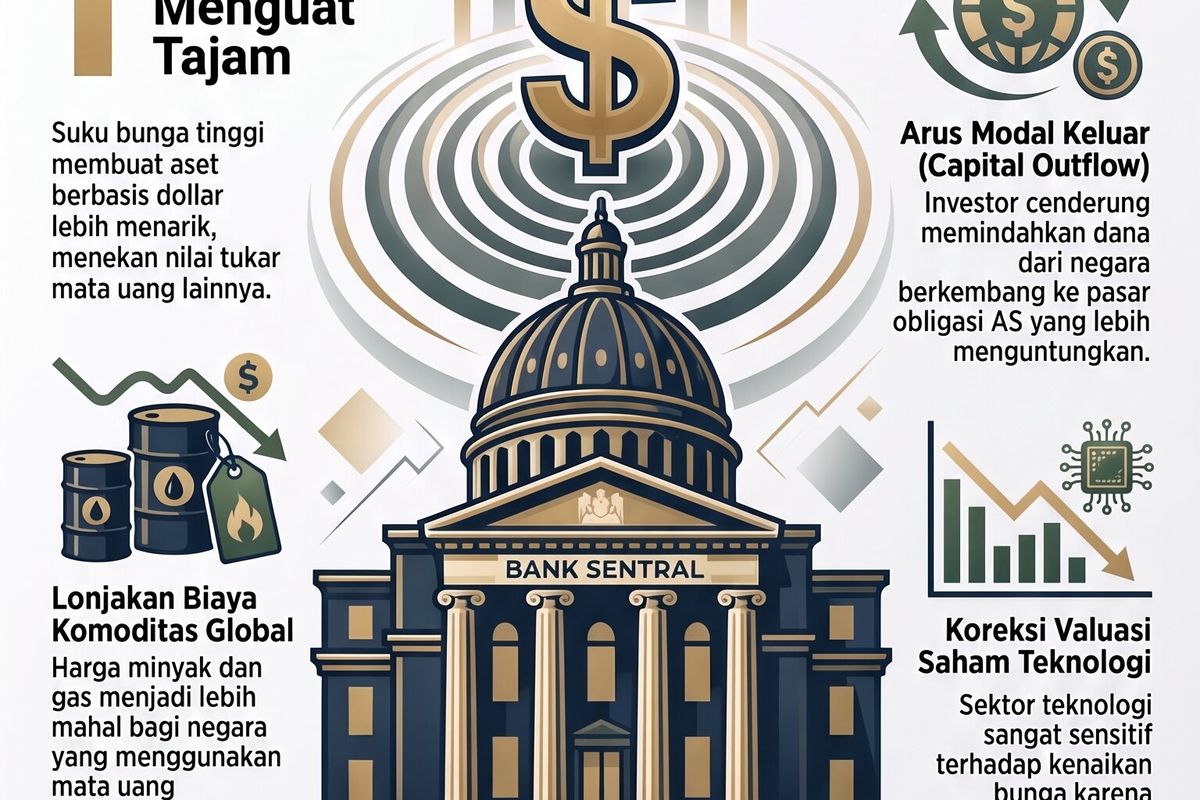
The Fed’s interest rate hike impacts not only the U.S. economy but also has the potential to influence currency exchange rates, bond markets, central bank policies, and stock valuations worldwide.
Cyclical sectors are those whose performance closely correlates with economic activity changes.
Strong corporate earnings growth can also affect inflation prospects.
Robust profits can support employment growth, which in turn may affect inflationary pressures.
J.P. Morgan Asset Management highlights that investors may need to reassess stock valuations if the Fed maintains its hawkish stance into 2027.
Hui specifically emphasized technology stocks, which are relatively sensitive to interest rate changes.
"Investors may need to reassess valuations if the Fed remains hawkish through 2027, especially for tech stocks which are more sensitive to rates," Hui said.
This valuation change relates to how investors discount future corporate earnings.
Higher interest rates mean a higher discount rate applied to anticipated profits.
Despite the Fed’s rate hikes pressuring global markets, the impact stems from factors beyond monetary policy alone.
The strength of the U.S. economy remains crucial in determining how this policy affects other countries.
Strong U.S. growth provides The Fed with space to raise rates.
At the same time, it supports demand for goods and services from other countries.
BlackRock’s Saigal said that strong U.S. economic growth is expected to continue driving global activity, trade flows, and corporate fundamentals throughout Asia despite short-term pressures from higher rates.
"Robust U.S. economic growth is expected to sustain global activity, trade, and corporate fundamentals in Asia even as higher rates impose short-term pressures," Saigal said.
Thus, the Fed’s rate increase has two channels of influence on the global economy.
On one hand, higher rates can increase pressure on currencies, bond markets, and stock valuations.
On the other hand, strong U.S. growth can boost trade activity and corporate performance in other countries.
Meanwhile, differences in inflation and domestic economic conditions mean central banks worldwide maintain their own policy considerations.