

Cak Imin Encourages Pesantren-Based Vocational Schools to Elevate Standards to International Levels
-
News
-
4 hours ago
This article was translated by AI. Read the original article on Kompas.com. See Original

JAKARTA, KOMPAS.com - The United States central bank, the Federal Reserve (The Fed), has raised its benchmark interest rate for the first time since July 2023.
This policy move is part of the Fed's efforts to rein in rising inflation, driven in part by surging oil prices.
The Fed's rate hike impacts not only the U.S. economy but also has the potential to influence currency exchange rates, bond markets, central bank policies, and stock valuations across multiple countries.
 Illustration representing interest rates, benchmark interest rate.
CNBC reports, citing economists and investment managers on Saturday (19/9/2026), that the renewed cycle of U.S. monetary tightening could strengthen the U.S. dollar, weigh on other currencies, and limit other central banks' ability to ease their monetary policies.
Against the backdrop of rising oil prices caused by conflicts in the Middle East, several countries are facing pressures such as higher energy costs, currency depreciation, and persistently high interest rates.
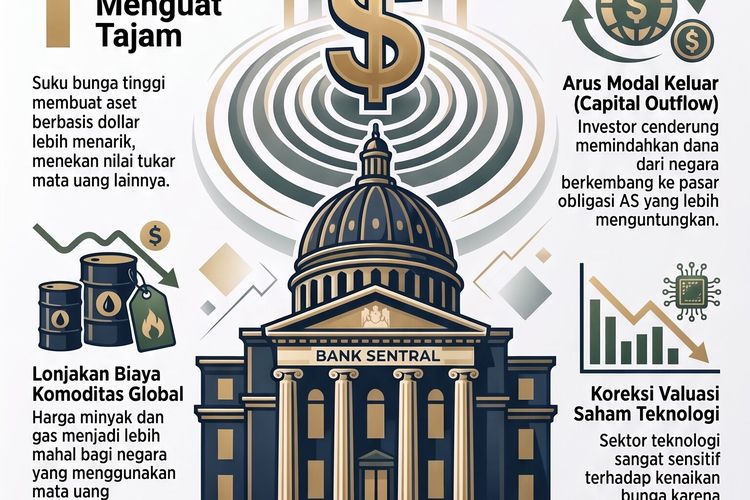
One of the fastest channels through which the Fed’s monetary policy affects the global economy is the U.S. dollar exchange rate.
Higher U.S. interest rates make dollar-denominated financial assets more attractive to investors.
This dynamic often supports a stronger U.S. dollar while putting pressure on other countries' currencies.
Mark Zandi, chief economist at Moody’s Analytics, stated that the Fed’s rate hike, along with signals of further increases, exerts upward pressure on the dollar and downward pressure on other currencies.
"The Fed’s rate increase and signals of further tightening are causing upward pressure on the dollar and downward pressure on other currencies," Zandi told CNBC.
The dollar’s strength is especially notable since many key global commodities—such as oil, natural gas, and agricultural products—are priced in dollars.
This means that as the dollar strengthens, countries using other currencies face higher costs to purchase these dollar-denominated commodities in their local currency.
Zandi explained this dynamic creates economic pressure worldwide, particularly in countries whose currency or monetary policy is closely linked to U.S. interest rates.
"That indeed creates global pressure," Zandi said.
Such pressure is even more pronounced amid rising global oil prices driven by the Middle Eastern conflict.
Increasing energy costs add to import expenses, while domestic currency depreciation makes acquiring dollar-priced commodities more expensive.
The Fed’s policy is also grabbing the attention of Asian financial markets.
Navin Saigal, head of global fixed income for Asia Pacific at BlackRock, said that the markets’ generally hawkish interpretation of the Fed meeting could exert short-term pressure on Asian currencies and bond markets.
"The market's hawkish take on the Fed meeting may put near-term pressure on Asian currencies and bond markets," Saigal explained.
The Fed’s interest rate hike impacts not only the U.S. economy but also has the potential to influence currency exchange rates, bond markets, central bank policies, and stock valuations worldwide.
The term hawkish refers to a monetary stance prioritizing inflation control, often through higher interest rates.
For foreign exchange markets, U.S. rate hikes increase the attractiveness of the U.S. dollar.
For bond markets, rising yields on U.S. government debt may influence investors’ capital allocation decisions globally.
Higher U.S. bond yields also raise the likelihood of capital outflows from other countries toward the U.S.
This situation can increase pressure on other central banks to respond to Fed policy changes; however, each central bank’s response may differ due to varied domestic economic situations.
The Fed’s rate hike occurred while several advanced economies’ central banks are also tightening their monetary policies.
The European Central Bank raised rates by 25 basis points the previous week.
Meanwhile, J.P. Morgan Asset Management forecasts that the Bank of Japan will also hike rates by 25 basis points this week.
Tai Hui, head of Asia Pacific market strategy at J.P. Morgan Asset Management, said that central banks in advanced economies are moving in tandem to tighten policies amid inflation concerns.
"Central banks in advanced economies are aligned in tightening monetary policy to address inflation worries," Hui said.
However, the Fed’s rate increase doesn’t necessarily mean all central banks worldwide will follow suit.
Inflation levels across Asia vary significantly. China and Thailand still face deflationary pressures.
In contrast, inflation in Australia and Japan remains above each central bank’s target.
Meanwhile, India’s inflation hovers around the midpoint of the Reserve Bank of India’s target range, according to BlackRock.
These differing conditions mean domestic monetary policies remain key considerations for each central bank.
Therefore, while a stronger U.S. dollar may limit room for monetary easing, it doesn't automatically dictate interest rate directions in every country.
Zandi cited Japan as an example, where yen depreciation adds justification for the Bank of Japan to continue raising rates.
"This indeed puts pressure on Japan to take similar steps and raise rates," Zandi explained.
Another impact of the Fed’s rate hike appears in the U.S. Treasury market.
Higher U.S. interest rates often push up Treasury yields. For global investors, these changes are an important factor in portfolio allocation.
Higher government bond yields make fixed income assets more competitive against equities.
Concurrently, rising rates increase corporate financing costs.
This dynamic also affects how investors value a company’s future earnings.
When interest rates rise, the present value of expected future profits tends to decrease.
Liz Ann Sonders, chief investment strategist at Charles Schwab, pointed out that what matters is not just the absolute yield level but also the speed and regularity of increases.
According to Sonders, 10-year U.S. Treasury yields reaching broadly 5 percent are justifiable given inflation levels, Fed policy expectations, and strong nominal economic growth.
"I believe if yields start moving out of control, the stock market will face greater adjustment challenges. However, I think the economy and markets can handle it to some extent as long as movements stay orderly," Sonders told CNBC.
Higher interest rates also impact stock markets and other risk assets.
When government bond yields rise, investors have more attractive fixed income alternatives, which can reduce equity appeal.
Moreover, rising borrowing costs increase expenses for companies seeking loans or new financing.
This pressure does not affect all stock market sectors equally.
Sonders noted that rate hikes have already influenced more cyclical market sectors.
The Fed’s interest rate hike impacts not only the U.S. economy but also has the potential to influence currency exchange rates, bond markets, central bank policies, and stock valuations worldwide.
Cyclical sectors are those whose performance closely correlates with economic activity changes.
Strong corporate earnings growth can also affect inflation prospects.
Robust profits can support employment growth, which in turn may affect inflationary pressures.
J.P. Morgan Asset Management highlights that investors may need to reassess stock valuations if the Fed maintains its hawkish stance into 2027.
Hui specifically emphasized technology stocks, which are relatively sensitive to interest rate changes.
"Investors may need to reassess valuations if the Fed remains hawkish through 2027, especially for tech stocks which are more sensitive to rates," Hui said.
This valuation change relates to how investors discount future corporate earnings.
Higher interest rates mean a higher discount rate applied to anticipated profits.
Despite the Fed’s rate hikes pressuring global markets, the impact stems from factors beyond monetary policy alone.
The strength of the U.S. economy remains crucial in determining how this policy affects other countries.
Strong U.S. growth provides The Fed with space to raise rates.
At the same time, it supports demand for goods and services from other countries.
BlackRock’s Saigal said that strong U.S. economic growth is expected to continue driving global activity, trade flows, and corporate fundamentals throughout Asia despite short-term pressures from higher rates.
"Robust U.S. economic growth is expected to sustain global activity, trade, and corporate fundamentals in Asia even as higher rates impose short-term pressures," Saigal said.
Thus, the Fed’s rate increase has two channels of influence on the global economy.
On one hand, higher rates can increase pressure on currencies, bond markets, and stock valuations.
On the other hand, strong U.S. growth can boost trade activity and corporate performance in other countries.
Meanwhile, differences in inflation and domestic economic conditions mean central banks worldwide maintain their own policy considerations.