
Choosing a New Vice President: Voting or Deliberation?
-
News
-
4 minutes ago
This article was translated by AI. Read the original article on Kompas.com. See Original
The last phrase is a clear measure: the prosperity of the people, not just the prosperity of investors.
Bung Hatta, who articulated the spirit of this article, viewed cooperatives as the pillar of enterprises suiting the character of a maritime nation.
Article 18B (2) recognizes and respects the unity of customary legal communities along with their traditional rights.
Article 28I (3) respects cultural identity and the rights of traditional communities in line with the development of the times.
Article 32 places national culture as something that must be advanced amid global civilization, with the state respecting and preserving regional languages as cultural riches.
The Constitutional Court has also taken significant steps in this regard. In Decision No. 35/PUU-X/2012, the court emphasized that customary forests no longer belong to the state’s forests.
This ruling restored the position of customary forests to their rightful holders. Unfortunately, the journey from ruling to on-the-ground reality is not straightforward: the recognition of customary territories is still slow, procedures are convoluted, and a bill regulating the protection of indigenous peoples has long stalled in the legislative process. There is a wide gap between law on paper and the living law.
This notion of layered sovereignty resonates with Bung Karno’s concept of Trisakti—sovereign in politics, self-reliant in the economy, and possessing identity in culture. All three are inseparable.
Political sovereignty without economic independence will create dependency. Economic independence without cultural identity will lead to a directionless society.
Spirituality and Culture as Moral Sources
The constitution indeed provides a legal framework. But law without soul is easily distorted.
Thus, the Third Republic requires a deeper moral source, and this is where the spirituality and culture of the archipelago play a role.
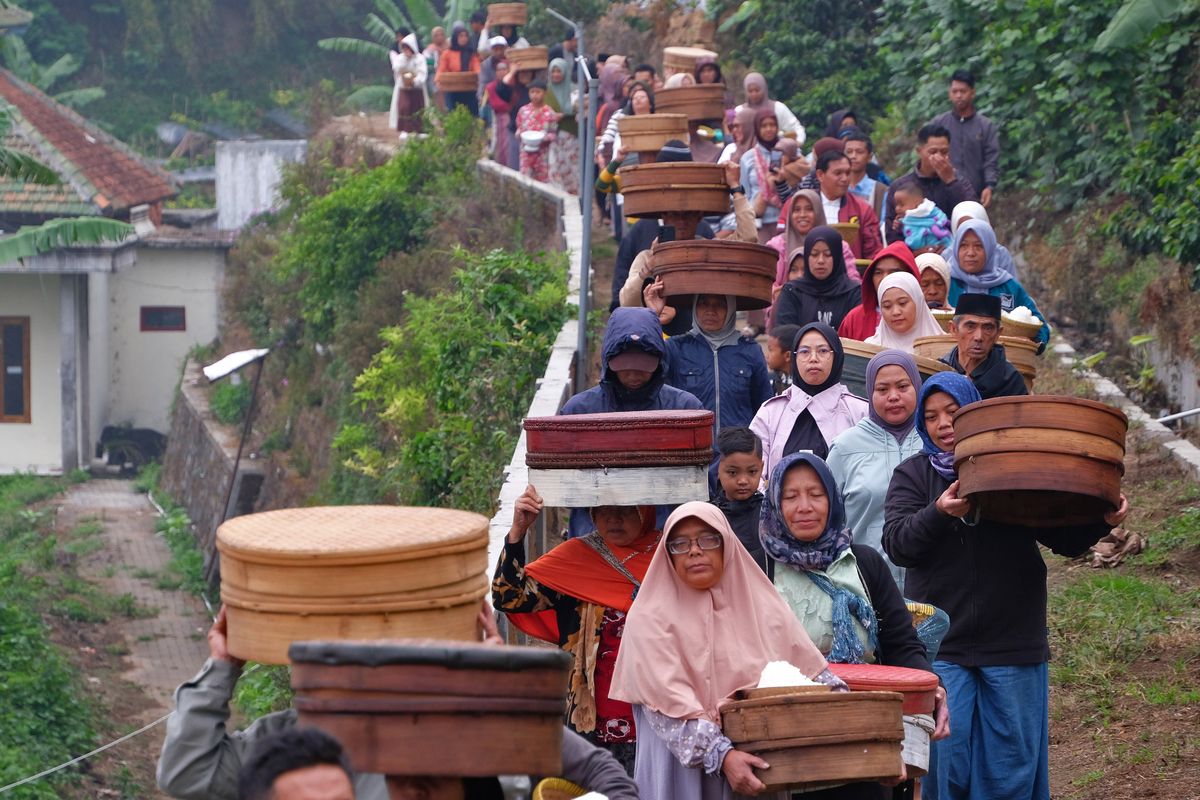
Consider how various traditions across these islands treat nature. In Bali, the subak system manages the distribution of irrigation water based on community agreements, rooted in the philosophy of tri hita karana (three sources of happiness): harmony with God, harmony with fellow humans, and harmony with nature.
In Maluku, sasi is a customary prohibition against harvesting natural resources for a certain period to allow resources to recover.
In Kanekes, an ancestral message states, “Mountains cannot be demolished, valleys cannot be destroyed; the long cannot be cut, the short cannot be joined.”
In Kajang, South Sulawesi, forests are kept as sacred spaces. In many Papuan communities, land is understood as a mother, not a commodity.
In Minangkabau, community deliberation and the principle of adat based on syarak (religious law), and syarak based on kitabullah (the Quran), provide an ethical framework for the management of their customary lands.
This diversity does not form a singular teaching, but there is a clear common thread: humans are not the absolute owners of the earth, but rather guardians of God’s endowment. This idea finds a corresponding expression in many religions practiced by our people.
In Islam, there is the concept of amanah and khalifah, meaning human beings as bearers of responsibility on earth, as well as mizan, the balance that must not be violated. In Christianity, there is an understanding of humans as stewards of creation.
In Hinduism, there is tri hita karana, in Buddhism there is compassion towards all beings, and in ancestral beliefs, there is respect for ancestors and spirits.
Why is this important for politics? Because procedural democracy, which merely counts votes, cannot answer questions of limits.
How much can be taken from the earth? Who has the right to speak on behalf of generations yet unborn? What must not be sold?
These questions are not technical. They are moral questions, and answers can only come from the culture and deepest beliefs of a nation.
Some may argue that injecting spirituality into politics is dangerous. This objection is reasonable if the spirituality in question refers to one religious interpretation imposed on everyone. What is proposed here is quite the opposite.
Spirituality in the Third Republic is pluralistic, not monopolized by one religion or group, functioning as a source of shared values accessible across beliefs. The principle of the right to life for all groups serves as a fence. No interpretation should oppress another group in the name of sanctity.
The next question is, is such communal management realistic in a modernized society? The answer is there is strong evidence that it is realistic, and even superior in certain conditions.
Nobel Prize-winning economist Elinor Ostrom researched hundreds of cases of communal resource management worldwide, from grazing lands in Switzerland to irrigation systems in the Philippines and Spain.
Her findings debunk the notion that communal ownership inevitably leads to failure, often referred to as the “tragedy of the commons.”
Communities with clear boundaries, collectively made rules, oversight mechanisms, and graduated sanctions have been able to sustain resources for centuries. Our subak and sasi are examples of this shared tradition.
The study on Poso in Central Sulawesi cited earlier also shows how communities, especially women in rural areas, challenge elite-driven political and economic structures through collective decision-making.
In other words, local deliberation practices are not museum relics. They continue to work and, in some cases, even outperform formal procedures that are distant from citizens.
Based on all this reasoning, we can formulate three interdependent pillars. The first pillar: the economy as a trust.
Within this framework, the market remains recognized as a useful tool, but not as a master.
Several points need to be emphasized. First, natural resources must be managed according to principles of intergenerational sustainability, not merely quarterly profit calculations.
Second, cooperatives, community-owned enterprises, and communal management need to be placed on par with large corporations, including in access to financing and legal certainty.
Third, the state must ensure that sectors concerning the basic needs of the people, such as water, food, energy, and health services, are not entirely surrendered to market logic.