
Rafael Alun Files Judicial Review in Corruption and Money Laundering Case
-
News
-
Just now
This article was translated by AI. Read the original article on Kompas.com. See Original
DIPLOMA that I earned from a university in Australia does not include my date of birth, photo, student identification number, or thesis title.
However, the absence of these four pieces of information does not diminish the validity of my academic qualifications.
A different experience is shared by a graduate from a university in Malaysia.
The bachelor’s degree he received was initially equated to a diploma three in Indonesia.
After resubmitting the equivalence with additional documents, his qualification was eventually recognized as equivalent to a bachelor’s degree.
There is also the experience of a doctoral graduate from a university in Taiwan.
He recounted a degree equivalence process that took 73 days. One reason for the delay was the difference in the background color of the uploaded photo.
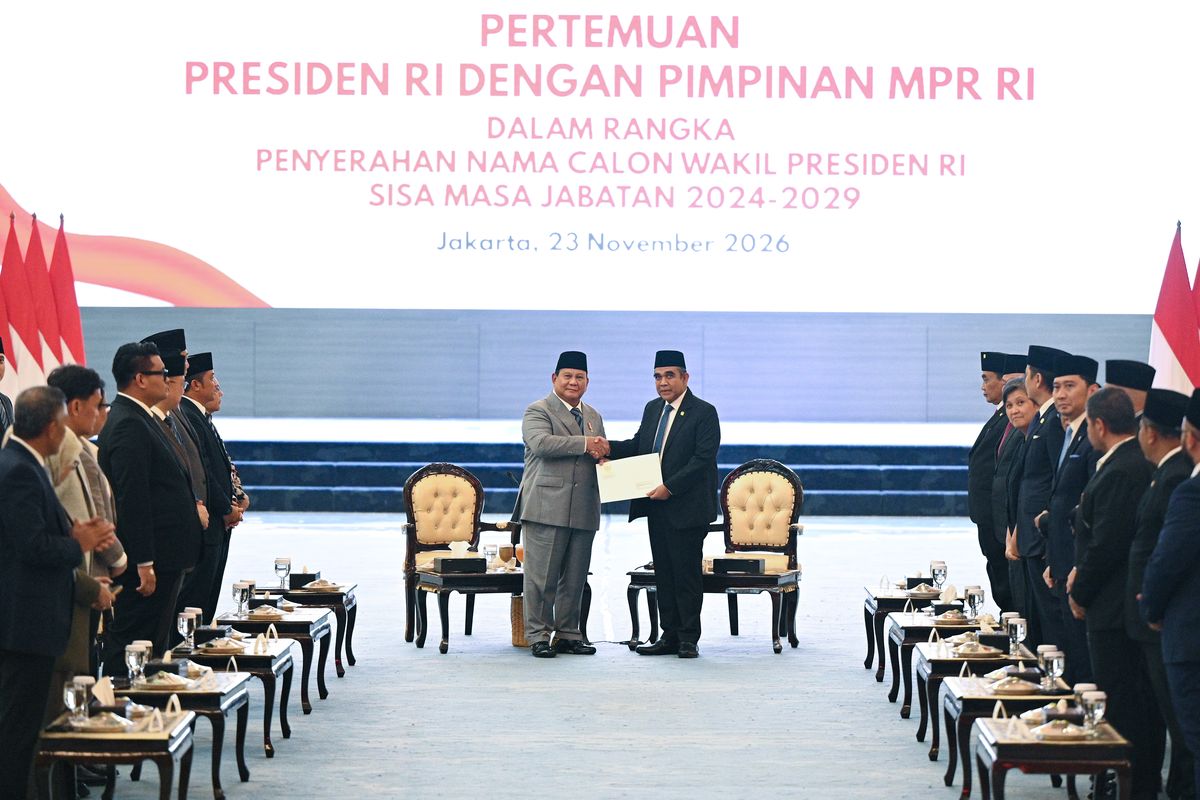
Such experiences raise questions when reflecting on administrative issues in the selection of vice presidents in Indonesia.
Why are we so preoccupied with administrative completeness? Does an increasing number of administrative requirements guarantee the quality of someone who will lead this nation?
This is where the paradox of administration lies. We seek certainty, yet often find ourselves caught in the complexities of achieving it.
Max Weber, through the concept of rational bureaucracy, explains that administration is necessary to create order, certainty, and objectivity.
However, over time, bureaucracy does not always function as initially intended.
Robert K. Merton (1940) explains the phenomenon of goal displacement, where compliance with procedures becomes the goal itself.
In the context of selecting a vice president, administrative requirements are indeed necessary to ensure that someone complies with applicable regulations.
However, issues arise when focus on administration far outweighs concern for the candidates' leadership abilities.
We may expend considerable energy discussing a person's educational documents, but relatively little on their capacity to manage national issues.
In reality, administrative completeness and leadership quality are two different matters.
Someone may meet all administrative requirements without automatically possessing the leadership competencies needed.
Each country has different educational systems and administrative governance. Variations in diploma formats are a consequence of this diversity.
The absence of a photo, date of birth, student identification number, or thesis title on a diploma does not automatically imply that the diploma is invalid.
This information may be stored in different documents or systems managed by the issuing educational institution.
Moreover, not all master's programs abroad require a thesis.
Some are based on coursework, research, or professional projects.
The fundamental question is not whether the format of the diploma matches those in Indonesia, but whether the document is authentic and the educational qualifications can be verified.
Of course, differences in document formatting should be distinguished from the issue of unmet required educational qualifications.
These are two different issues that require distinct examination mechanisms.
From a management perspective, there is a difference between an approach that prioritizes administrative uniformity and one that focuses on substantive validity.
Uniformity certainly eases examinations. However, uniformity is not the only path to achieving certainty.
Donald Moynihan, Pamela Herd, and Hope Harvey (2015) introduced the concept of administrative burden.
Administrative complexity incurs at least three types of costs: the cost of understanding requirements, the cost of meeting those requirements, and psychological costs resulting from the process.
In public official selection, these costs can even expand into social, economic, and political costs.
Prolonged administrative debates can divert public attention, drain institutional energy, create uncertainty, and shift focus from national development agendas.
Time that should be used to discuss job creation, poverty alleviation, enhancing competitiveness, and accelerating economic growth is instead consumed by administrative debates.
This phenomenon can also be explained through the concept of blame avoidance, which is the tendency of organizations or individuals to avoid the risk of blame by increasing control mechanisms.
The more documents are examined, the safer the examiner feels.
However, it does not necessarily mean that the public reaps corresponding benefits.
In management science, every organizational activity should provide added value (value creation). The same principle can be applied in managing the selection of public officials.
Every administrative requirement must have a clear function.
Does the requirement enhance legal certainty, ensure the validity of information, or reduce the risk of fraud?
If it does not add value, the requirement should be evaluated.
Utilizing technology, integrating data across agencies, and direct verification with the document-issuing institutions can be part of simplifying administration without compromising accountability.
Of course, simplification does not mean relaxing legal regulations. In fact, with more effective verification mechanisms, legal requirements can be enforced more convincingly.
Choosing a vice president is a strategic process for selecting a leader who can assist the president in achieving national development goals.
Therefore, once the legal and administrative requirements are met, attention should shift to integrity, competence, vision, the ability to coordinate various interests, and the candidate's capacity to address national issues.
Administration remains important but needs to be positioned according to its function: as an instrument to ensure the quality of the process, not as a substitute for evaluating leadership quality.
Let us not be so meticulous in examining the files of a leadership candidate that we forget to assess their ability to lead the nation.