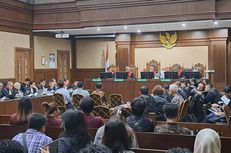
Febrie's TPPU Trial: Driver Nurman Herin's Account Used for KOIN Money Changer Operations
-
News
-
7 minutes ago
This article was translated by AI. Read the original article on Kompas.com. See Original

A chair has been left behind. Yet the shadows of those who once occupied it linger on the walls of the republic.
Amid the news surrounding Gibran Rakabuming Raka's potential dismissal as Vice President and the possibility of electing his successor (November 23–24, 2026), I read a short essay by Goenawan Mohamad (GM) titled "Crystal Generation."
The piece isn’t lengthy. Its restlessness, however, runs long.
It begins with the uproar: those who sympathize with Gibran and those who cheer his downfall.
It seems as if the history of a republic is determined by who sits on a chair and who is pushed off.
But GM appears eager to prompt us to see something different. Not the chair. Not the person who left it. But the path that took them there.
GM chooses crystal as a metaphor.
Crystal is an odd object. It sparkles, but the light isn’t its own.
It fascinates, yet must be kept away from collision. It earns a place of honor precisely because it is not allowed to come into contact with the harshness of life.
In the essay, crystal finds its meaning through two words: "without sweating."
I believe that is where the heart of this writing pulsates.
Sweat is something that never appears in a résumé.
It has no place in lists of titles, family lineage, or boards of positions.
But within it resides the story of humanity: about the paths taken, the doors closed, the defeats endured, and the hopes that must be lifted from the ground time and again.
GM juxtaposes Gibran's political journey with that of young Soekarno and Hatta.
At the age of 26, Soekarno founded the Indonesian National Party. By around 25, Hatta had faced colonial imprisonment and trials.
Their youth isn't merely a number in a calendar; it's a part of a nation's history searching for a way out of darkness.
Of course, times have changed.
Not every leader must know the coldness of prison floors. Not every politician must experience exile.
Suffering is not a diploma for leadership. And a comfortable life isn't, by default, proof of a lack of empathy.