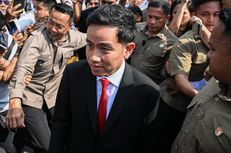
DKPP Holds Hearing on Alleged Ethical Violations in Gibran's Candidacy Today
-
News
-
1 minute ago
This article was translated by AI. Read the original article on Kompas.com. See Original

IS a president adequately supported by just one vice president? This question deserves to be revisited when discussing the effectiveness of governance in a vast country like Indonesia.
With an extensive territory, a population of hundreds of millions, and a multi-ethnic society facing diverse issues, the workload of a president is undoubtedly significant.
Governance requires task division, coordination, and effective leadership.
Therefore, the role of the vice president should not merely be a supplement to the president's role, let alone a mere symbol of the political compromise resulting from elections.
The vice president should ideally act as the president's primary assistant in running the machinery of government.
So, why must the number be limited to just one?
In the practice of regional governance in Indonesia, we have experienced models where regional heads are supported by more than one vice.
During President Suharto's administration, for example, the Governor of DKI Jakarta was supported by three vice governors, each responsible for different areas: governance, economy and development, and public welfare.
This division of responsibilities allowed the regional head to focus on leadership and strategic decision-making while the vice governors managed their respective governmental domains.
Another example can be seen in the governance practices in Papua. The vastness and complexity of geographic, social, and developmental issues require a leadership model capable of reaching out effectively across regions.
Arranging three vice governors with a territorial approach became one model of responsibility distribution in Papua: Papua, Central Papua, and West Papua.
From these regional governance experiences, we recognize at least two approaches.
First, the division of tasks based on government sectors. Second, the division of tasks based on regions.
This means that the number of deputy heads of government does not have to be singular. The number and division of their responsibilities can be adjusted according to the needs and complexities of governmental organizations.
Currently, there is a discourse proposing that the president be supported not just by one vice president but by three. This idea is intriguing, especially in the context of restructuring Indonesia's governance system.
However, our constitution still restricts the number of vice presidents to one. Article 4, paragraph (2) of the 1945 Constitution clearly states that in performing his duties, the president is assisted by one vice president.
Furthermore, Article 6A paragraph (1) states that the president and vice president are elected as a pair, directly by the people.
Therefore, increasing the number of vice presidents cannot simply be done through changes in the law. Amendments to the 1945 Constitution are a constitutional prerequisite.
If a vacancy occurs in the vice presidential position during the term, the mechanism is already regulated in Article 8, paragraph (2) of the 1945 Constitution. The president proposes two candidates, and then the MPR must select one within 60 days.