

Suspect in Presidential Wiretapping Case, Ahrie Sonta Removed from Kadivkum Polri, Here’s His Successor
-
News
-
2 minutes ago
This article was translated by AI. Read the original article on Kompas.com. See Original
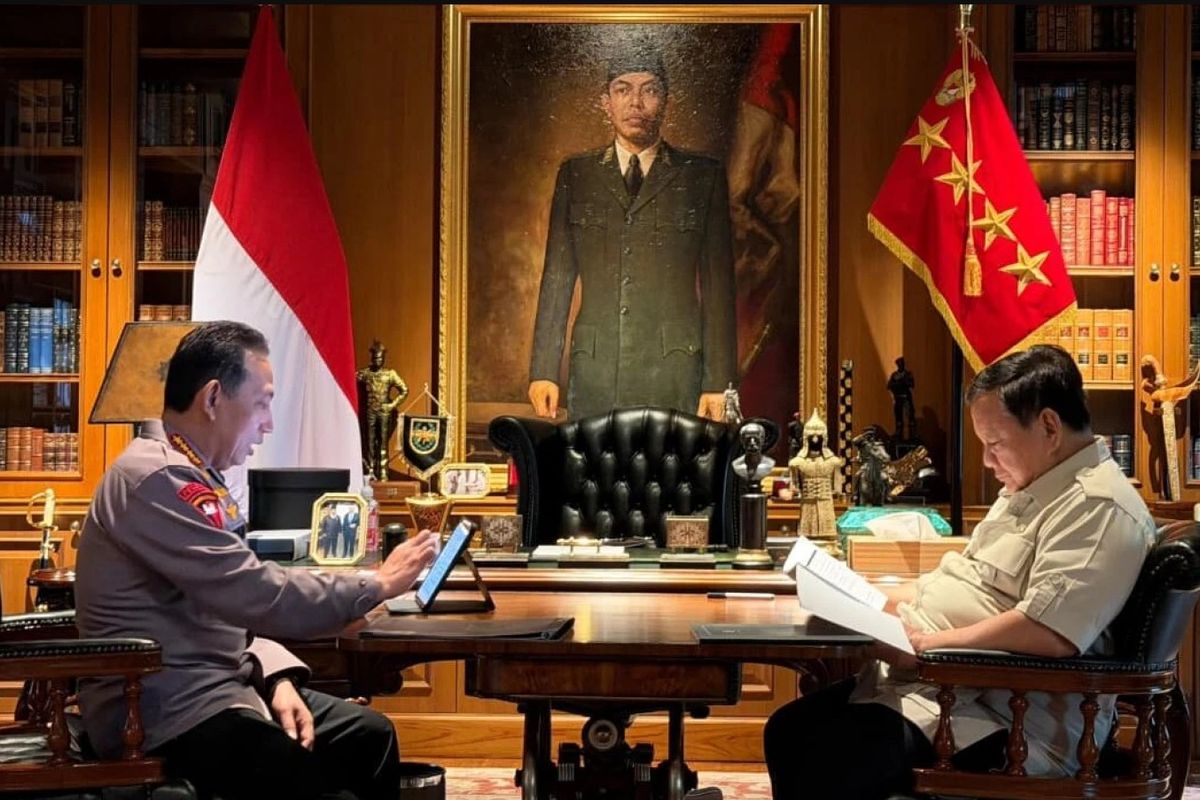
THE CASE of illegal wiretapping conducted by former National Police Chief, General Listyo Sigit Prabowo, along with three other two-star generals—EHS, SU, and ASN—against President Prabowo, as well as several other political and government figures, has sparked intense debate in the parliament.
Numerous calls have emerged for the Indonesian House of Representatives (DPR RI) to urgently draft a Wiretapping Bill.
Commission III of the DPR RI, which oversees legal and security matters, has responded positively to this proposal.
The commission's head, Habiburokhman, clearly stated that discussion will commence once the Judges Bill and the Advocates Bill are ratified in December.
Essentially, regulations regarding wiretapping are already outlined in various laws—sui generis—such as the State Intelligence Law, the Police Law, the Anti-Corruption Commission Law, the Electronic Information and Transactions Law, and the Criminal Code.
This indicates that the state and government have given due attention to this activity.
However, the existing regulations give a partial impression, as if issues surrounding wiretapping are case-by-case and differ among institutions.
From a legal perspective, such a situation can have negative consequences, as sectoral regulations leave gaps in oversight and law enforcement regarding violations that occur.
This is exemplified by the situation within the National Police, which is supposed to uphold the law.
Wiretapping is a legal activity.
It is called so not only because the authority to conduct wiretapping is granted only to law enforcement, but also because conducting wiretapping by the state incurs legal consequences.
Wiretapping involves listening to, recording, and documenting the transmission of information or electronic documents privately for the purpose of enforcing the law.
According to various regulations governing this activity, wiretapping is conducted for the purpose of investigating serious crimes such as terrorism, corruption, narcotics, and threats to national security.
Wiretapping cannot be carried out arbitrarily; it must be regulated through strict control processes, including court approval and oversight mechanisms, both internal and external.
The court approval and oversight mechanisms are two key phrases to ensure that the wiretapping mechanisms are genuinely implemented within the framework of law enforcement.
The court approval serves as a control mechanism ensuring that wiretapping is not conducted arbitrarily or violates citizens' privacy.
Wiretapping performed without court approval will result in legal consequences for the perpetrator.
This is evident in Law No. 1 of 2023 regarding the Criminal Code, particularly Article 258, which states that unauthorized wiretapping is punishable by criminal sanctions.
In Indonesia, the obligation to obtain court approval depends on the type of case, applicable sectoral regulations, and the development of legislative rules.
The commitment of Commission III of the DPR RI to draft a Wiretapping Bill is a matter that deserves warm appreciation.
The incident of illegal wiretapping without a legal basis carried out by General Listyo Sigit Prabowo and associates against President Prabowo sets a very dangerous precedent; it is clearly illegal and potentially contains elements of treason.
This incident should serve as a momentum to establish more specific (Lex Specialis) and sharper (Lex Certa) legal regulations in the form of dedicated legislation as a means of ensuring stronger legal certainty.
There are at least four crucial points in the drafting of the Wiretapping Bill: who is authorized to conduct wiretapping, the subjects and crimes that can be the object of wiretapping, the oversight mechanisms to ensure wiretapping is not misused by those executing it, and court approval as a key norm.
First, the parties authorized to conduct wiretapping are law enforcement officials or state apparatus mandated to do so.
If we look at the existing wiretapping regulations, it is primarily carried out by the police and prosecutors who perform investigation functions.
In the military (TNI)—specifically BAIS—the wiretapping conducted by military personnel is for national defense interests, namely protecting the country from potential external threats.
These authorized parties must be explicitly outlined in the law to minimize the potential for abuse of power.
Second, there should be clarity on which subjects and crimes can be the object of wiretapping.
In this context, it needs to be understood deeply that wiretapping is an extraordinary measure in gathering information—interceptions, wiretaps, phone taps, eavesdropping, surveillance, and secret monitoring.
These extraordinary measures should be limited to extraordinary crimes such as corruption, terrorism, narcotics, and offenses causing significant harm to the state and citizens.
Restrictions on which crimes can be the subject of wiretapping need to be strictly regulated to ensure that wiretapping is carried out with care and does not negatively impact citizens' privacy rights.
Third, an oversight mechanism must be established both for implementing personnel and institutions executing the wiretapping.
The institutions designated to conduct wiretapping must have internal audit mechanisms for all forms of wiretapping activity—generally conducted by the General Inspection Board.
Wiretapping should also have clear procedures, such as quality manuals, quality procedures, standard operating procedures, and technical procedures for registration, documentation, recording, reporting, and data termination or destruction.
To avoid abuse of power, technical personnel must engage in dual custody or dual control.
Personnel executing these tasks should not remain in one position for prolonged periods but must have regular rotation to minimize the potential for abuse of power and collusion.
The oversight mechanism over institutions authorized to conduct wiretapping can be exercised by the DPR RI as the legislative body overseeing everything from the procedures for acquiring wiretapping equipment at relevant ministries or institutions to mechanisms for hearings concerning wiretapping processes that have been carried out.
Wiretapping done by the military (TNI) and the State Intelligence Agency (BIN) under the State Intelligence Law falls under the authority of Commission I of the DPR RI.
Meanwhile, wiretapping by the National Police, the Corruption Eradication Commission (KPK), and the Prosecutor's Office is under the oversight of Commission III of the DPR RI.
Oversight functions from a political superstructure perspective can be exercised not only by parliament but also by Coordinating Ministries overseeing related ministries and institutions, particularly the Coordinating Ministry for Political, Legal, and Security Affairs (Kemenko Polhukam RI).
Finally, the most crucial and still part of the oversight-control framework is the urgency of court approval to conduct wiretapping.
Given the evolving dynamics, there is indeed a strengthening of aspirations from various parties for the Wiretapping Bill to be drafted and discussed urgently.
On the other hand, there is also public concern—commonly voiced by non-governmental organizations—that wiretapping regulations could violate citizens' privacy and become a tool for authorities to target political opponents.
This public concern needs to be addressed and carefully considered, along with the inclusion of clear and firm legal norms stating that wiretapping within the framework of law enforcement can only be conducted after obtaining court approval.
At the very least, this norm will lock in and mitigate against moral hazards and abuse of power in the execution of wiretaps similar to those carried out by General Listyo Sigit and associates.