
Police Chief Reshuffles Officials of Metro Jaya Regional Police and Several Precinct Chiefs, Here is the List
-
News
-
3 minutes ago
This article was translated by AI. Read the original article on Kompas.com. See Original
FOUR years ago, the term "clean-up" was closely associated with Listyo Sigit Prabowo, during his tenure as National Police Chief.
He took action against Ferdy Sambo and Teddy Minahasa, leading the public to refer to it as the clean-up of the police force 2.0 (Kompas.com, 17/10/2022). Now, that same term has taken a different connotation.
Following the Criminal Investigation Agency's designation of Listyo and three senior officers as suspects in an illegal wiretapping case involving the President, state officials, political figures, media, and business people, Deputy Chair of Commission XIII of the House of Representatives, Sugiat Santoso, urged the State Secretariat to "sterilize" the President's inner circle of personnel previously recommended by Listyo.
Deputy Minister of State Secretary Juri Ardiantoro responded that the assessment of palace employees had already taken place and is a routine activity.
The series of events unfolded rapidly. Listyo was dismissed from the position of National Police Chief after five years and eight months, the longest tenure in the post-Reformation era, and was moved to become the Head of the Presidential Staff.
About a month later, he became a suspect, was detained, and removed through a presidential decree (Setkab, 4/11/2026).
Not long after, Gibran Rakabuming Raka stepped down from the vice-presidential seat amid political pressure related to his educational documents, although he emphasized that the decision was personal.
These two separate issues collectively close a chapter involving the partnership of Prabowo Subianto and Joko Widodo, who once united to win the 2024 elections.
The question now is where this clean-up process will lead.
It could represent a healthy institutional correction, or it could slide into a witch hunt based on affiliations.
The dividing line lies in the magnitude of the actions involved. The term network itself is neutral.
It can imply a criminal conspiracy, but it can also simply refer to working relationships, connections, or appointment recommendations that are common in bureaucracy. Distinguishing between the two is the crux of the matter.
The term clean-up is not neutral in our history.
After 1965, the state filtered employees with labels such as personal and environmental cleanliness, a practice that punished individuals not for actions, but for associations.
Therefore, when some social media conversations dubbed the wiretapping incident as PKI Volume II, such an analogy is clearly exaggerated and erroneous.
The matter involving Listyo is an allegation of individual criminal action processed under charges of wiretapping, illegal access, and deletion of electronic data, not an ideological cleansing.
Even if it later evolves into a case of treason, it remains an actionable matter that must be proven, not a matter of belief or lineage.
However, the emergence of such analogies indicates a collective memory wound that has yet to heal, and the government must be sensitive to it.
A comparison with Turkey provides a clearer measure.
After the coup attempt in July 2016, President Recep Tayyip Erdogan declared a state of emergency and governed by decree.
Within months, over 100,000 public servants, soldiers, police officers, judges, and academics were dismissed or suspended, and nearly 37,000 were detained (Associated Press, 2016).
Most were removed due to alleged ties to the Gulen movement, not based on actions proven in court.
So far, Prabowo's actions are far from such a pattern.
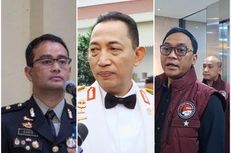
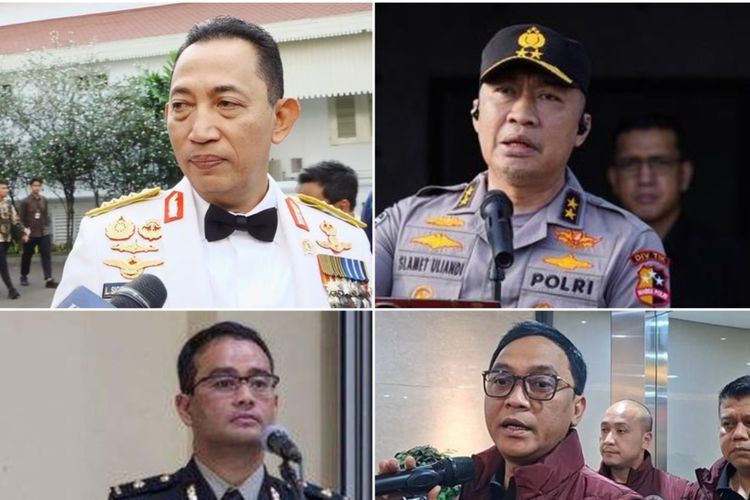
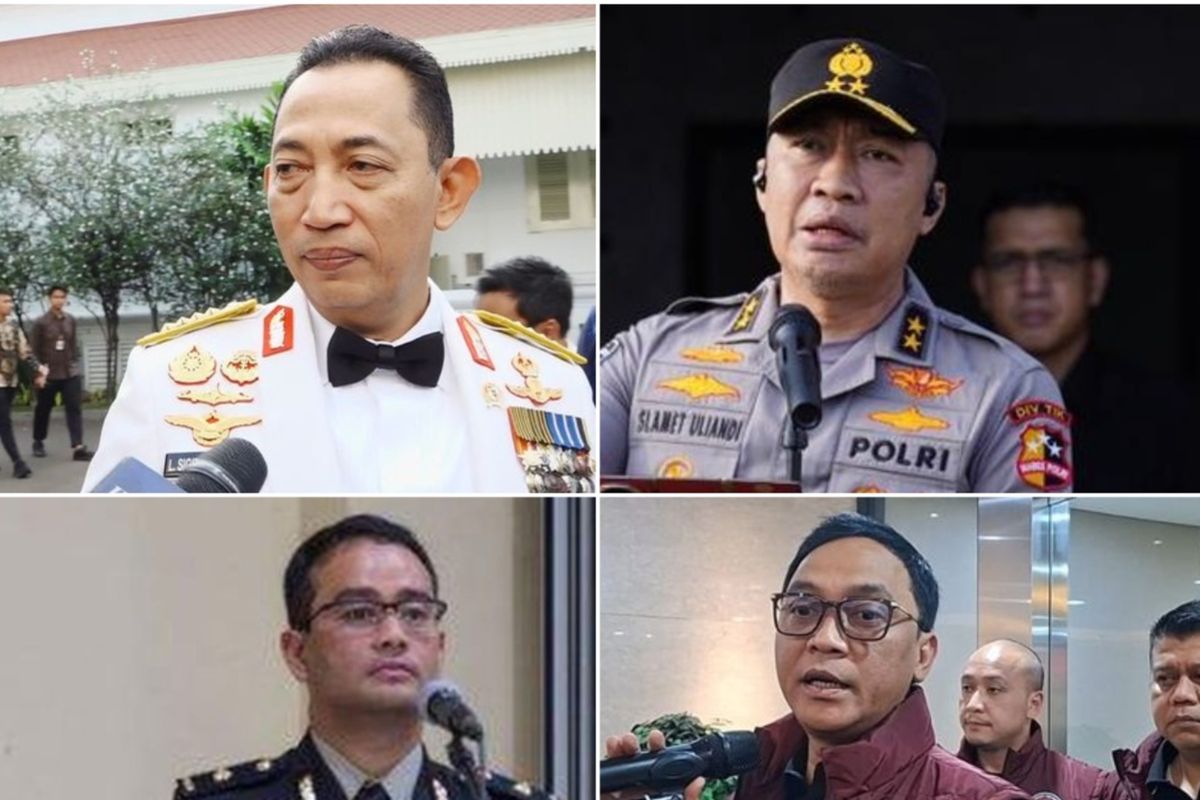
The four suspects, namely Listyo, Inspector General Ahrie Sonta Nasution, Inspector General Eko Hadi Santoso, and Inspector General Slamet Uliandi, were subsequently identified as the ones who permitted the wiretapping and data deletion.
Three of them are detained, while Slamet is under house arrest for health reasons.
All were designated through investigative proceedings with seized evidence, and their dismissals were carried out through presidential decisions.
The palace framed the employee evaluations as routine activities, not special operations, indicating that the state is still operating within its procedures.
This matter is indeed not over. Investigators have escalated the treason allegations to the investigation stage after obtaining preliminary evidence, although the National Police Chief emphasized that there are no treason suspects yet, and the findings of wiretapping do not automatically prove treason (Katadata, 12/11/2026).
New suspects could emerge. This is where the measurement is tested, as the heavier the allegations, the stricter the evidence required.
The vulnerability lies in the language. When terms like affiliated, infiltrator, and traitor enter parliamentary meetings, the measure can shift from actions to proximity.
At that point, the clean-up could transform from law enforcement into political purging, and the rule of law could devolve into a state of suspicion.
If the network is mapped out, there are at least four layers that could be impacted.
The first layer includes the four suspects and anyone else who may be implicated if the treason allegations develop to reveal more perpetrators.
The second layer encompasses personnel within the presidential circle referred to by the House, ranging from the State Secretariat, Presidential Staff Office, Bakom, to the Presidential Security Forces.
The third layer includes police officers who rose during Listyo's era and are now under National Police Chief Suyudi Ario Seto's leadership.
The fourth layer consists of the political network often referred to as the Solo circle. Only the first layer should be subjected to criminal law.
The second and third layers should be managed through open performance evaluations and integrity checks, while the fourth layer is a political domain that should not become a target for law enforcement.
The temptation to touch the fourth layer is indeed strong.
Mahfud MD questioned why the names of Jokowi and Gibran did not appear on the wiretap target list, while Jokowi opted not to comment when asked by reporters.
The chairman of Commission III of the House, Habiburokhman, even claimed to have heard boastings that the group could return to power in two years.
All of this fosters speculation, but speculation is not evidence.
If other parties are indeed involved, the path should be through transparent investigations, not public labeling.
Presidential transitions in this country always come with a change in personnel.
Habibie removed Prabowo from his position as Kostrad Commander in 1998, and Abdurrahman Wahid dismissed Wiranto from the cabinet in 2000.
What is unusual about the 2024 transition is the absence of transition itself.
Many close to Jokowi remain in strategic positions, leading to a simultaneous, harsh correction for this delay.
Two theoretical lenses help to analyze this situation. Dan Slater, in his study on party cartelization in Indonesia (2018), mentions the tendency of promiscuous power-sharing, where the president embraces almost all political forces into government until the opposition evaporates.
Milan Svolik in The Politics of Authoritarian Rule (2012) shows that coalitions among elites are always haunted by commitment issues, as each side fears their allies may turn against them.
Although Svolik writes about authoritarian regimes, this logic applies to any elite coalition.
The partnership between Prabowo and Jokowi stems from a loose power-sharing arrangement and has now fractured due to a loss of mutual trust.
From here, three possibilities emerge. First, a managed distance, whereby both sides continue to protocolarily honor each other without sharing agendas, while Prabowo relies on established parties within his coalition.
Second, an open rift, if the investigation reaches the closer circle and Jokowi's camp chooses to oppose, including through the PSI.
Third, a limited reconciliation of a transactional nature, where both sides restrain themselves for stability heading into 2029.
The first possibility appears to be the most realistic, especially since the appointment of the vice president is now entirely in the hands of the President and the MPR.
This nation has spent too long expending energy on cycles of inter-regime clean-ups.
A country that seeks to leap forward requires institutions that are stronger than networks, regardless of who owns them.
This matter should serve as a moment to tighten wiretapping rules and oversight of the authorities holding that power, rather than simply replacing one network with another.
Measured clean-ups will be remembered as recovery, while unchecked ones will be seen as a new chapter of political vengeance.
What needs to be cleaned is, in fact, actions, or merely proximity?