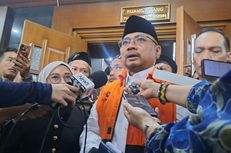


Behind the Postponement of the Exposé on the Treason Case: Homes Linked to Brigadier General Tedjo Kusumo and Commissioner Imanudin Searched
-
News
-
24 minutes ago
This article was translated by AI. Read the original article on Kompas.com. See Original

Here, we must remain sincere and clear in distinguishing between two often confused concepts.
As A.V. Dicey asserted in Introduction to the Study of the Law of the Constitution (1885), the supremacy of law and equality of all individuals before the law are essential elements of the rule of law.
Not Rule by law, which positions law as a tool for exercising power. The ruler uses law to govern others.
But rather Rule of law, because it positions law as a limitation on power. Rulers themselves must submit to the law.
Our Constitution has already chosen the latter. Article 1 paragraph (3) of the 1945 Constitution states that Indonesia is a state of law.
Article 27 paragraph (1) guarantees the equality of citizens before the law and government. Article 28D paragraph (1) guarantees equal treatment before the law.
The consequences are clear: there must not be any area of power that is practically exempt from accountability.
The higher a person's position, the greater their authority, and correspondingly, the greater the need for independent and accountable oversight. Not the other way around.
Therefore, this new Police Regulation must not merely be an answer to investigate one former Chief of Police. It should be a momentum to improve the ethical enforcement system for all members of Polri, from the lowest to the highest ranks.
If not, we are simply replacing one hole with another. Equality is a promise of law enshrined in the 1945 Constitution.
Lon L. Fuller in The Morality of Law (1964) emphasizes a simple, yet often overlooked principle: there must be consistency between announced rules and their implementation.
If the code of ethics applies to all members of Polri, but the mechanisms for oversight are ineffective in reaching the highest officials, then there is a gap between normative promises and institutional reality. The law promises equality, but in practice, it does not.
John Rawls in A Theory of Justice (1971) reminds us that justice is not only determined by individual decisions but also by the justice of institutional structures.
Thus, the issue is not merely whether a general is proven to have committed a violation. First, there must be assurance of institutions capable of investigating anyone objectively and fairly.
Equality before the law does not always require an identical composition of investigators. However, that equality mandates standards of accountability, independence, and equal protection of rights.