

Law on Asset Forfeiture: Fulfilling Promises, Suffers "Illicit Enrichment" Debt
-
News
-
1 minute ago
This article was translated by AI. Read the original article on Kompas.com. See Original

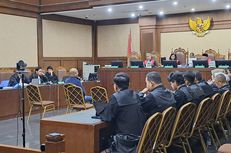
JAKARTA, KOMPAS.com - Numerous lawsuits challenging the Election Law (UU Pemilu) have repeatedly been filed. Are the issues originating from the legislative body or from the Constitutional Court (MK)?
The recurring lawsuits target Article 169 of Law No. 7 of 2017 on Elections (UU Pemilu) at the MK.
The content of the lawsuits varies, ranging from the age limit for presidential and vice-presidential candidates to educational requirements.
Most recently, a lawsuit challenged Article 169 letter q, which sets the minimum age for presidential and vice-presidential candidates at 40 years or requires them to have been elected in previous elections, including local elections.
In the petition, the applicant, Tuan Guru Deri Sulthanul Qulub, case number 432/PUU-XXIV/2026, requested that the MK amend this article to specify a minimum age requirement of 19 years, emphasizing criteria such as competence, honesty, ability to convey ideas, and intelligence.
He argued that a singular age restriction could marginalize citizens who possess the capacity and capability to contribute to governance.
Previously, a lawsuit targeted Article 169 letter r, concerning educational qualifications. The applicant, Jovi Andrea Bachtiar, represented by legal counsel Sinta Dwi Apriliyanti and Buce Abraham Beruat, case number 423/PUU-XXIV/2026, requested the MK to remove the requirement for formal education or a diploma of at least a high school equivalent for presidential and vice-presidential candidates.
The petitioner reasoned that the high school requirement in the Election Law does not automatically determine an individual's leadership, integrity, or capability in running state governance. This article was seen as restrictive of citizens’ constitutional rights to equal opportunities under the law and in governance.
"Making a high school diploma or equivalent a mandatory qualification for presidential and vice-presidential nomination represents an excessively administrative approach to assessing a person's capacity for state office," the petition stated, as quoted by Kompas.com on Saturday (14/11/2026).
Apart from these two cases, a different applicant filed a lawsuit concerning the same article about a month ago. So, why are there so many challenges to the Election Law at the MK?
Lucius Karus, a researcher from the Forum for Concerned Citizens over the Indonesian Parliament (Formappi), evaluated that the numerous lawsuits brought against the Constitutional Court reflects, at least to some extent, the quality of legislation.
The more laws that are challenged, the more it indicates that the quality of legislation in Parliament still needs improvement.
The recurring phenomenon of judicial reviews of Article 169 of the Election Law seems to serve as evidence of the low quality of this law. A quality law should leave no loopholes for public challenges," Lucius stated to Kompas.com on Friday (20/11/2026).
He noted that the poor quality of the Election Law is not only related to candidate requirements but also to several other crucial issues, such as parliamentary and presidential thresholds.
According to Lucius, the weak quality of legislation is influenced by several factors, including discussions that are suspected to be followed by political lobbying behind the scenes.