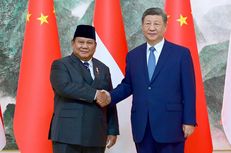
Prabowo Meets Xi Jinping, Discusses Economic Cooperation and Regional Issues
-
News
-
Just now
This article was translated by AI. Read the original article on Kompas.com. See Original

The Vice President plays a role in strengthening coordination and ensuring the President's policies are effectively implemented.
This assignment should also be designed to avoid overlapping with the authorities of relevant ministries and agencies.
Second, it strengthens the center-region relationship and government effectiveness.
One of the fundamental issues in decentralization is the suboptimal communication between the central and regional governments.
Fiscal dependencies, policy misalignments, jurisdictional conflicts, and disparities in development capacities remain challenges.
The experience of DPD leadership in channeling regional aspirations can potentially assist the President in identifying issues earlier, aligning central and regional interests, and enhancing cross-ministerial coordination.
The Vice President can serve as a strategic link to ensure national policies are not only formulated from Jakarta's perspective but also considered in light of the real conditions in the regions.
This benefit certainly depends on the capacity of the figure and the mandate given.
However, if designed correctly, this function can enhance governmental effectiveness while increasing regional trust in the central government.
Third, it broadens political and institutional bridges.
Figures from the DPD can present a relatively non-partisan perspective in national leadership.
DPD members are elected through individual elections, rather than through a party list nomination like DPR members.
This character can expand the President's communication with regional representation.
The presence of a DPD leader in government also has the potential to open channels of communication with 152 DPD members from across Indonesia.
For President Prabowo and his parties, this can create broader institutional collaboration.
However, we must avoid the presumption that the 152 DPD members form a political bloc that automatically supports the government.
Each member has their own electoral mandate and political independence.
Therefore, the potential gains may not guarantee additional votes or political support, but rather expand communication networks, information exchange, and cooperation in development agendas.
Beyond these institutional considerations, there is a compelling idea that makes alternative leadership from the DPD even more attractive, namely the paradigm of green democracy linked to deliberative democracy.
This concept encourages us to view democracy not merely as a mechanism for power transitions through elections but as a participatory, rational, transparent decision-making process that accounts for environmental sustainability.
One of the main issues facing Indonesian democracy is the high political costs.
Electoral contests require substantial resources, from nominations, campaigns, network consolidation, voter mobilization, to maintaining political support.
As the cost of acquiring and retaining power increases, so does the risk of dependency on opaque financiers and funding sources.
In the context of Indonesia's economy, which still has a strong reliance on resource-based sectors, this condition is concerning.
The linkage between high political costs, the interests of financiers, and rent-seeking economies can create incentives for excessive natural resource exploitation.
We cannot conclude that all political financing stems from environmental exploitation.
However, the structural risks of the intersection of political interests and extractive economies represent serious concerns.
When natural resources are treated as a source of rent to support power interests, the impacts extend beyond political governance.