Prabowo Attends the 33rd APEC Economic Leaders' Meeting in Shenzhen
-
News
-
6 minutes ago
This article was translated by AI. Read the original article on Kompas.com. See Original

JAKARTA, KOMPAS.com - The government must take steps to prevent similar scams like Tenun Tonic from happening again through early detection, oversight, and complaint mechanisms.
The prevalence of scams disguised as side job offers online poses a unique challenge for public protection in the digital space.
This is reflected in the Tenun Tonic case—an application that allegedly defrauded 96 victims who reported their issues to the Metro Jaya Police, claiming to offer additional work in knitting scarves.
The financial losses amount to a staggering Rp 1.9 billion.
Digital economy expert and Executive Director of the ICT Institute, Heru Sutadi, believes this phenomenon indicates that public protection in the digital realm remains weak.
According to him, the capacity for oversight and prevention of suspicious job or investment offers has yet to be fully realized.
"This shows that public protection in the digital space still has gaps," said Heru to Kompas.com on Wednesday (18/11/2026).
In fact, such protection is critical amid increasingly sophisticated scam tactics.
Often, scams are packaged as productive work-from-home opportunities, rather than traditional scams featuring high-yield investment schemes.
“People are promised income, but are instead asked to deposit money upfront,” Heru explained.
He elaborated that Indonesia already has legal instruments, including the Consumer Protection Law, the Information and Electronic Transactions Law (UU ITE), Government Regulation No. 71 of 2019, and regulations regarding the registration of Electronic System Providers (PSE).
However, the existence of regulations does not automatically guarantee protection.
Heru indicated that this case serves as a reminder of the necessity for early detection.
He stated that the Tenun Tonic scam should act as a wake-up call for the government: digital protection cannot rely solely on education but must incorporate effective oversight and enforcement.
"The issues lie in early detection, inter-agency coordination, transaction oversight, and the speed of complaint handling. Therefore, the government needs to establish an integrated monitoring mechanism involving Komdigi, OJK within their authority, the police, and consumer protection agencies," he said.
The government's work cannot end there. It must track down the flow of funds, including those related to cross-border crimes.
"What’s crucial is tracing the flow of funds and recovering victims' losses, not just prosecuting perpetrators after many have been harmed," Heru stressed.
Sociologist from Gadjah Mada University (UGM), Abe Widyanta said this issue also arises due to economic pressures, job availability, and digital literacy.
All three are locked in a vicious cycle of structural problems that afflict Indonesian society. Therefore, the government needs to undertake systemic reforms, as the state plays a significant role in enhancing economic welfare and literacy among its citizens.
The approach should not merely involve moral admonitions, such as urging citizens to be more cautious. Such calls are seen as the government abdicating responsibility to the victims.
"The government should implement more radical systemic reforms, not just moral disclaimers," Abe said.
At the very least, the government could take several steps. First, establish stringent regulations and enforce strict actions against predatory business models.
Komdigi and OJK could tighten supervision of task-based scam applications (fictional work schemes requiring upfront deposits).
"They should intervene before victims fall prey, not just receiving reports after losses reach billions of rupiah," Abe asserted.
Second, revise policies on job creation, protection for gig workers, and social safety nets to prevent citizens from being easily lured by false promises on the internet. The root of vulnerability lies in economic inequality and the lack of formal job opportunities.
Third, enhance digital literacy education in schools and public spaces.
This education should shift from technical guidance like how to create accounts, shop online, and use features, to a more critical political-economic understanding of the digital landscape.
"The government needs to educate its citizens more radically on how to read algorithms, recognize the exploitation of platform capitalism, and understand the business logic behind both free and paid applications," Abe clarified.
Heru emphasized that digital platforms must also take responsibility for the security of their ecosystems. According to him, platforms should not only pursue user numbers and ad revenues in a given country.
"They must take responsibility for the security of their ecosystem and for the losses suffered by the public," he stated.
He suggested various means through which platforms could fulfill their responsibilities.
This includes requiring identity and legality verification for those offering jobs, investments, or business opportunities, especially if they ask for upfront deposits from the public.
Furthermore, platforms should provide complaint channels, detect fraud patterns, and swiftly limit accounts or applications showing signs of violations.
"Certainly, their responsibility should be proportionate to the platform's role, but the principle is clear: platforms should not become avenues for mass scams, and they have a duty if the public is harmed," he asserted.
Additionally, he urged the public to remain vigilant.
"Do not let the intent of seeking additional income lead to losses. Asking for deposits upfront should always be seen as a red flag," he remarked.
"The government must act not only after victims have fallen but also prevent applications and digital platforms from becoming tools for mass deception. Digital protection should shift from mere literacy exhortation towards genuine oversight, prevention, and law enforcement," Heru concluded.
Meanwhile, the Chairperson of the Board of Commissioners of the Financial Services Authority (OJK), Friderica Widyasari Dewi, stated that they will strengthen coordination with several parties.
This coordination has been established with Meta, Google, and the Ministry of Communication and Digital (Komdigi).
Friderica elaborated that the coordination aims to follow up on content or ads suspected to be used as tools for scams.
The agency also conducts daily cyber patrols and requests the removal of content identified as fraudulent.
"So if something seems too good to be true, we need to approach it logically. In everyday life, there are many malicious people lurking," she noted.
She acknowledged that cross-border crime, including part-time job scams, also poses challenges as they are often organized.
Thus, handling these issues requires inter-agency coordination, including with the National Police of Indonesia (Polri).
"So indeed, this needs to be scrutinized together," she emphasized.
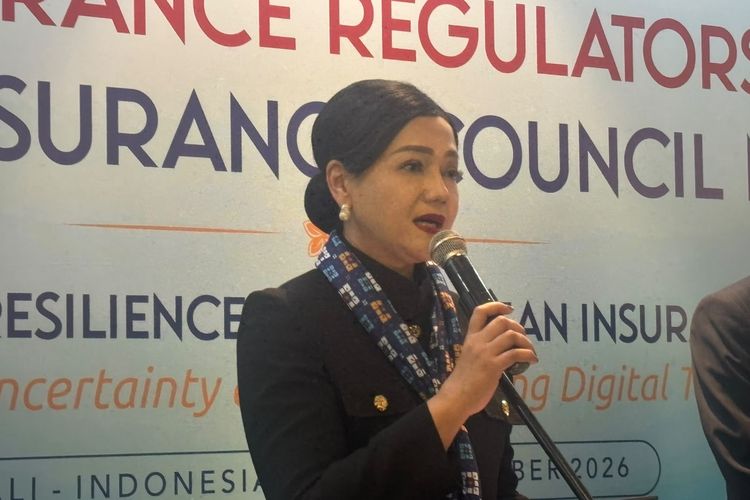 Chairperson of the OJK Board of Commissioners Friderica Widyasari Dewi
As of now, the Metro Jaya Police are still investigating the app. The formal report received by the police on November 16, 2026, from 96 victims mentions the total losses of Rp 1.9 billion.
Through its official Instagram account, Tenun Tonic promotes knitting neck scarves claimed to be completed in about 30 minutes, which can be used for additional income.
Prior to this, users were asked to pay a deposit, referred to as training fees.
Later, after the scarves were completed, users were instructed to send their knitted products to the Tenun Tonic office located at Ruko Palm Avenue Block H, Kalideres, West Jakarta.
The knitted products were then promised to receive commissions. However, many users later complained about not receiving their promised commission payments.