
Prabowo Says Aceh, North Sumatra, and West Sumatra Nearly Fully Recovered After Disasters
-
News
-
4 minutes ago
This article was translated by AI. Read the original article on Kompas.com. See Original
THERE IS a more pressing issue than who wins or loses in the dispute regarding the educational equivalency certificate of Gibran Rakabuming Raka.
This issue pertains to how the court reconciles justice with legal certainty.
The Jakarta Administrative Court declared the lawsuit of H.M. Subhan inadmissible. The Jakarta High Administrative Court upheld that decision.
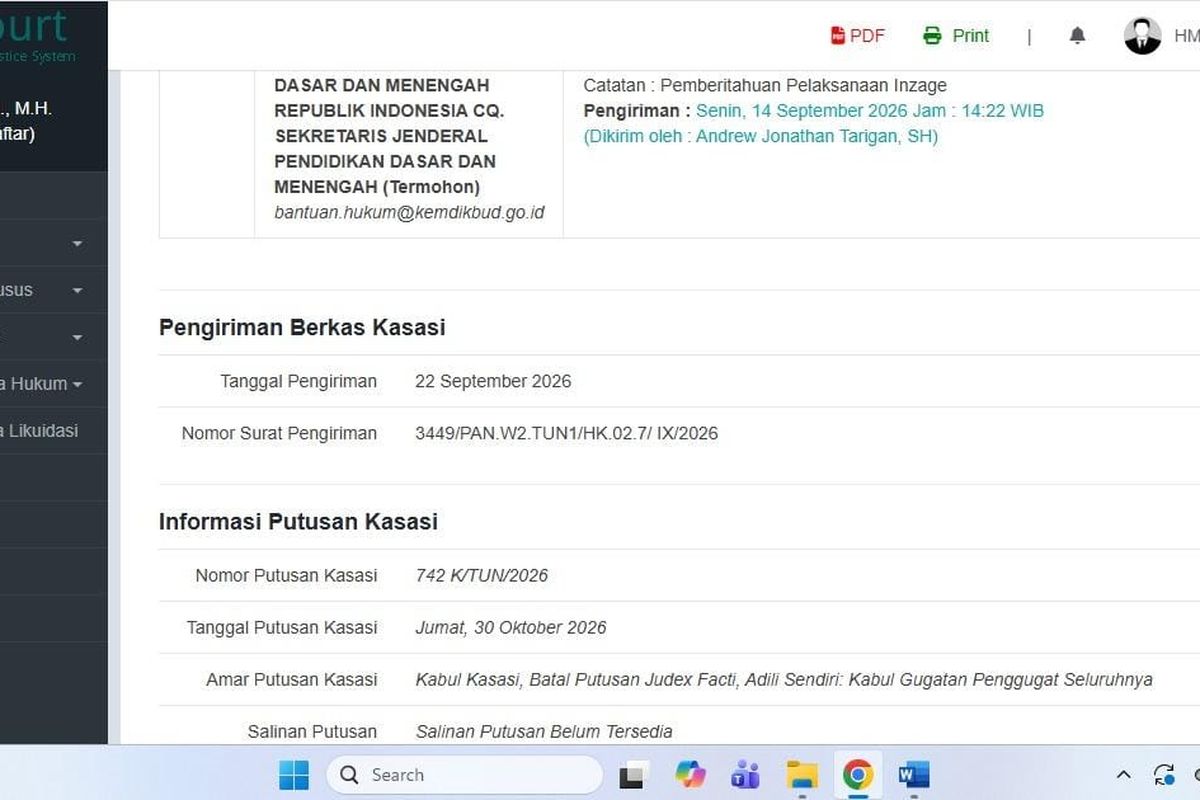
However, the Supreme Court, through Decision Number 742 K/TUN/2026, took a different approach.
The Supreme Court annulled both previous rulings, adjudicated the matter itself, and then revoked the contested educational equivalency certificate.
This difference is part of the judicial mechanism. The cassation court is indeed established to correct errors in the application of the law.
Article 51 paragraph (2) of the Law on the Supreme Court even grants authority to adjudicate cases in specified circumstances.
Therefore, the authority of the Supreme Court to adjudicate itself is not the main issue.
The attention should rather be on the legal reasoning when courts broaden the position of the plaintiff, assess objections concerning the time limit, and disregard objections regarding the interested parties.
In cases that have a significant public impact, judicial courage to uphold justice is indeed needed.
However, such courage must go hand in hand with meticulous legal application.
One significant aspect of the Supreme Court's ruling relates to the legal standing of the plaintiff.
The Supreme Court linked the validity of the educational equivalency certificate with the requirements for presidential candidacy.
From this relationship, the panel gave attention to the interests of citizens who have the right to vote and be elected.
This interpretation shows an awareness that certain administrative decisions can have consequences beyond the relationship between the issuing official and the recipient of the decision.
In a democracy, government decisions concerning public office appointments can indeed affect public trust in state governance.
However, public interest in a decision does not always align with the legal standing to challenge it.
Article 53 paragraph (1) of the Law on Administrative Justice grants the right to sue to individuals or legal entities whose interests have been harmed by an administrative decision.
This formulation does not limit harm to mere economic interests. Legal interests can take broader forms.
However, a justifiable connection must still exist between the plaintiff, the contested decision, and the harmed interests.
This is where the fundamental issue lies.
If the right to vote serves as the basis to challenge an administrative decision regarding elected officials, the criteria for that interest must be articulated clearly.
Is it sufficient for someone to merely hold the status of a voter? Must there be a specific legal consequence affecting that right? Or is a more particular relationship between the administrative decision and the plaintiff's constitutional interest required?
These questions are not intended to close the door to the courts.
On the contrary, clear criteria protect access to justice from arbitrary application.
Broadening legal standing can represent an important development in administrative justice.
However, expansion without limits risks creating uncertainty about who has the right to challenge government decisions.
The next issue concerns deadlines.
The equivalency certificate was issued in August 2019, while the dispute was only filed several years later.
This time interval does not automatically prove the lawsuit was filed late.
Article 55 of the Administrative Court Law regulates the time limits for filing lawsuits.
Meanwhile, Circular Letter Number 3 of 2015 provides guidance for third parties not directly affected by the decision, namely counting the time from when they first learned of the decision harming their interests.
Therefore, the date of issuance of the certificate is not the only determining factor.