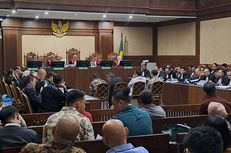


KPK Examines Former Head of BPK Central Java in Connection with Pemalang Regent Extortion Case
-
News
-
4 minutes ago
This article was translated by AI. Read the original article on Kompas.com. See Original

Judges are presumed to know the law and are obligated to apply it.
However, the authority to discover the law is not a substitute for the argumentation that demonstrates why a particular norm applies to certain facts.
This is where the quality of the ruling acquires a more objective measure.
A good ruling does not always have to follow the opinions of previous courts. Indeed, corrections to erroneous interpretations are an essential part of the cassation function.
Yet, the reasons for corrections must be sufficiently clear so they can be understood, tested, and applied consistently in other cases.
In the core of the dispute, the Supreme Court assessed that the documents serving as the basis for issuing the equivalency certificate were insufficient to prove compliance with educational requirements.
This assessment is linked to the principle of caution in administrative governance.
The principle of caution is one of the general principles of good governance as stipulated in Article 10 paragraph (1) letter d of Law Number 30 of 2014.
Government officials must adequately verify facts and documents before issuing decisions.
If legal requirements are not met or mandated verifications are overlooked, decisions can contain administrative defects.
To reach this conclusion, proof of document forgery is not always necessary.
Insufficiency of administrative evidence and forgery are two different matters.
Nonetheless, scrutiny of the certificate issued in 2019 must consider the educational equivalency requirements applicable at the time of issuance.
The assessment of legality is not sufficient if based solely on the impression that certain documents should have been available.
There must be a connection between the applicable normative requirements and the deficiencies found during the examination.
Thus, the principle of caution serves not only as a measure for decision-makers but also reminds the court of the importance of diligence when determining whether a decision meets legal requirements.
The annulment of the educational equivalency certificate raises questions about its legal consequences.
The mandate of the Supreme Court relates to the validity of the certificate and the obligation of the issuing official to revoke it.
This ruling does not automatically terminate the vice presidency.
The position of the vice president is governed by the constitution. Articles 7A and 7B of the 1945 Constitution establish the grounds and mechanisms for the dismissal of the president or vice president during their term.
Therefore, the legal consequences of administrative rulings must be distinguished from constitutional mechanisms regarding office holding.
This differentiation is not a form of protection for specific officials. It is a consequence of the division of authority among state institutions.
Each institution must act within its authority, including when handling matters that attract significant public attention.
The case of the educational equivalency certificate ultimately brings us to a broader question than the position of a vice president.
To what extent can the courts broaden access to challenge for public interest?
How is the procedural objection assessed without becoming an obstacle to justice?
What criteria should be used so that the interpretation does not change according to the identity of the litigating parties?
These questions are important because the law formed through a ruling does not cease to apply when public interest in the case diminishes.
The Supreme Court has a responsibility to maintain the unity of legal implementation.
Therefore, its considerations must serve as consistent guidelines, including in cases that do not possess political appeal.
Substantive justice is indeed needed to prevent the court from getting lost in formalities that lose their purpose.
However, legal certainty and procedural protection are not opposites. Together, they ensure that the pursuit of justice does not devolve into unpredictable exercises of authority.
The Supreme Court's authority lies not only in its courage to correct rulings but also in the clarity of reasoning that makes those corrections acceptable as law, not merely as the conclusive result of a dispute.