Malaysian Parties Await Ethics Hearing for Kombes Fahrurozi Regarding Investment
-
News
-
3 minutes ago
This article was translated by AI. Read the original article on Kompas.com. See Original

AWARDING the National Hero title to 19 figures by President Prabowo Subianto on November 10, 2026, marks an interesting note in the history of Indonesian diplomacy.
Among those receiving the award, three individuals have previously held diplomatic roles: Ali Sastroamidjojo, Mohamad Roem, and Franciscus Xaverius Seda, also known as Frans Seda.
The award serves as a reminder that the struggle to maintain Indonesia’s independence and sovereignty did not only occur on the battlefield, but also through diplomacy at the negotiation table and in various international forums to achieve global recognition, face pressures from other nations, and advocate for national interests.
The Proclamation of Independence on August 17, 1945, was a political declaration for the Indonesian nation to determine its own fate.
However, that independence still needed to be defended against attempts by the Dutch to re-establish colonial rule.
In such circumstances, armed struggle and diplomacy went hand in hand and mutually reinforced each other.
The armed struggle demonstrated the nation's resolve to retain its independence, while diplomacy sought to garner international support and strengthen the Republic's position.
International recognition was not the source of Indonesia's independence, but it became a crucial factor in solidifying the existence of this newly independent nation.
In this context, the roles of the three National Heroes awarded in 2026 come to life and serve within a distinct historical framework.
Nonetheless, they share a commonality in using diplomacy as a means to advocate for national interests.
Ali Sastroamidjojo was a pivotal figure in multilateral diplomacy and the development of Asian-African solidarity.
He was a member of Indonesia's delegation at the Round Table Conference (RTC) in 1949, served as Indonesia's Ambassador to the United States, Canada, and Mexico, and was Indonesia's Permanent Representative to the United Nations (UN).
During his tenure as Prime Minister, Ali played a significant role in organizing the Asian-African Conference (AAC) in Bandung in April 1955.
This conference was a landmark event in Indonesia's diplomatic history, bringing together Asian-African nations in a spirit of anti-colonialism, solidarity, and global peace.
Through the AAC, Indonesia showcased that a relatively newly independent nation could play a vital role in international political discourse, especially amidst the rivalry between the Western and Eastern blocs during the Cold War.
In contrast, Mohamad Roem is renowned for his efforts in negotiation diplomacy and sovereignty recognition.
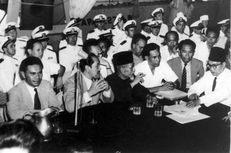
His role as the head of Indonesia’s Delegation in the Roem-Royen negotiations in 1949 illustrated how negotiations could pave the way for conflict resolution with the Dutch.
These negotiations resulted in agreements that facilitated the restoration of the Republic of Indonesia's government in Yogyakarta and the organization of RTC in The Hague.
This sequence of diplomatic processes ultimately culminated in the transfer of sovereignty by the Dutch on December 27, 1949.
Unlike the two aforementioned figures, Frans Seda primarily contributed to economic diplomacy and international relations during the era of national development.
He served as Indonesia's Ambassador to Belgium and Luxembourg and represented Indonesia in the European Economic Community (EEC) in Brussels from 1973 to 1976.
His dedication illustrates that diplomacy did not cease after obtaining international recognition of independence.
Diplomacy is also essential for expanding economic cooperation, opening trade and investment opportunities, and supporting national development.
Looking back at Indonesia's history, the awarding of the National Hero title to these three figures is not unprecedented for those who have made significant contributions in diplomacy, such as Mohammad Hatta, Haji Agus Salim, Sutan Sjahrir, Lambertus Nicodemus Palar, and Mochtar Kusumaatmadja.
Mohammad Hatta has already received the National Hero title. In addition to leading Indonesia's delegation in the RTC of 1949, Hatta is recognized as a key architect of the independent and active foreign policy principle that remains a cornerstone of Indonesia's diplomacy today.
Haji Agus Salim played an essential role in advocating for Indonesia's independence recognition, particularly through diplomatic relations with Arab nations.
Sutan Sjahrir was also instrumental in garnering international support for the Republic, including through diplomacy that brought Indonesia's issues to the UN's attention.
Another noteworthy figure, Lambertus Nicodemus Palar, championed Indonesia's interests at the UN and became the first Permanent Representative of Indonesia after the country joined the organization in 1950.
In subsequent developments, Mochtar Kusumaatmadja was awarded the National Hero title in 2025.
As an expert in international law and a former Minister of Foreign Affairs, Mochtar contributed significantly to advocating the archipelagic state concept, which later gained recognition through the UN Convention on the Law of the Sea in 1982.
Interestingly, not all of these figures were career diplomats.
Many were statesmen, politicians, and legal scholars. However, they performed diplomatic functions that significantly contributed to the nation's trajectory.
From the perspective of classical realism as developed by Hans J. Morgenthau, diplomacy is a vital instrument for advocating national interests.
A country’s power is not solely determined by military capability but also by proficiency in managing international relations.
Mohamad Roem's struggle illustrates how diplomacy was utilized when the Republic of Indonesia faced military disadvantage against the Dutch.
Through negotiations and international support, Indonesia sought to strengthen its political position without solely relying on armed might.
Meanwhile, the concept of soft power developed by Joseph S. Nye Jr. describes a nation's ability to influence others through attraction, legitimacy, values, and policies, rather than mere coercion.
In this perspective, the AAC of 1955, significantly spearheaded by Ali Sastroamidjojo, can be understood as an example of diplomacy relying on Indonesia's political and moral influence.
Through leadership and Asian-African solidarity, Indonesia was able to gain international attention despite its limited economic and military capabilities.
As for Hedley Bull in The Anarchical Society (1977), he positioned diplomacy as one of the crucial institutions that allow nations to manage relationships and maintain international order.
Indonesia's struggles through the UN, international negotiations, and the establishment of maritime law norms demonstrate how institutions and international law can be leveraged to advocate national interests.
While in the early years of independence, Indonesia's diplomatic challenges primarily included gaining international recognition and maintaining sovereignty, modern challenges have become increasingly complex.
The geopolitical rivalry between the United States and China, armed conflicts in various regions, global economic competition, climate change, and cyber security threats demand that Indonesian diplomacy be increasingly adaptive and outcome-oriented.
In this context, the active and independent foreign policy legacy of the nation’s founders remains relevant.
However, this principle must be translated into the ability to maintain independent decision-making, build mutually beneficial partnerships, and avoid excessive dependence on particular powers.
Economic diplomacy is also increasingly significant. Trade, investment, technology, energy competition, and mastery of strategic resources necessitate that Indonesia advocate national interests through international cooperation that offers tangible benefits for development.
On the other hand, the protection of Indonesian citizens abroad has become a pressing dimension of diplomacy.
Issues surrounding migrant workers, human trafficking, and armed conflict require diplomacy supported by inter-agency coordination and the ability to provide effective protection.
Furthermore, advancements in digital technology present new challenges to national sovereignty.
Threats of cyber attacks, data theft, surveillance, and dependence on foreign digital infrastructure illustrate that the struggle to maintain sovereignty now also takes place in cyberspace.
Therefore, the exemplary nature of diplomatic heroes must be translated into professionalism, integrity, mastery of strategic issues, and the ability to make diplomatic decisions that favor national interests.
The endeavor to continue the struggle of diplomacy must persist. Awarding the National Hero title to Ali Sastroamidjojo, Mohamad Roem, and Frans Seda is not merely a tribute to the lives of these three national figures.
This moment also serves as a reminder that diplomacy is a crucial part of Indonesia's struggle history.
If past generations fought for Indonesia to be recognized as a free and sovereign nation, today's diplomats face the responsibility of ensuring that sovereignty is upheld amid global changes.
The contemporary struggle in diplomacy may not always yield historic agreements like Roem-Royen, the monumental AAC conference, or international conventions such as maritime law.
However, success can be reflected in the protection of citizens, the safeguarding of national interests, the enhancement of societal welfare, and the strengthening of Indonesia's position in the international community.
In the end, heroism does not always emerge from the battlefield.
There is also heroism that arises from the courage to negotiate, the intelligence to read the interests of other nations, and the steadfastness in defending national interests.
Because in Indonesia's history, struggle has not only been waged with arms but also through the elevation of the nation’s dignity at the diplomacy table.