
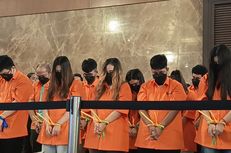
DPR Members Demand Polri to Uncover Key Actors in Scam Syndicate in the Philippines Involving 141 Indonesians
-
News
-
6 minutes ago
This article was translated by AI. Read the original article on Kompas.com. See Original
What is more concerning is when suspicion becomes immune to scrutiny. A connection is considered evidence; while lack of connection is seen as proof that everything is being concealed.
If every result always confirms initial suspicion, investigation loses its meaning.
Democracy requires vigilance. Yet, good vigilance is willing to accept evidence, including evidence that conflicts with initial prejudices.
The main issue is not just the potential magnitude of a former president's influence. What is more pressing is how to distinguish that influence from state authority.
Article 4 paragraph (1) of the 1945 Constitution clarifies that the president wields governmental power according to the constitution. Article 17 regulates the ministers who assist the president.
Meanwhile, other state officials and institutions exercise authority based on their respective legal provisions.
When a policy is questioned, the scrutiny should begin with those who set it. What is its legal basis? What was the process? Who provided the counsel? Is there a conflict of interest?
These questions do not preclude potential outside intervention. Rather, from testable answers, the suspicion of intervention can be evaluated more clearly.
If intervention is proven unlawful, those involved must be held accountable according to their roles.
However, officials who establish or carry out decisions are not automatically exempt from responsibility simply because they are influenced by others.
Here is where the irony arises. The more frequently every policy is linked to a former president, the less attention remains for those currently wielding authority. Yet, they are the ones who must explain decisions before the public.
None of this is a reason to halt evaluations of Jokowi. His policy legacy, meritocracy, and the independence of state institutions can and should be critiqued. Such critiques will be stronger when distinguishing facts, suspicions, and judgments.
We also need to differentiate between decisions that benefit someone and decisions made at his behest. Both may be related, but they are not identical.
Without that distinction, debate easily turns into a competition to guess the figures behind the scenes.
There is a paradox worth considering. Those who wish to see the end of Jokowi's influence often continue to place him at the center of almost every political narrative.