
DPR Members Demand Polri to Uncover Key Actors in Scam Syndicate in the Philippines Involving 141 Indonesians
-
News
-
6 minutes ago
This article was translated by AI. Read the original article on Kompas.com. See Original
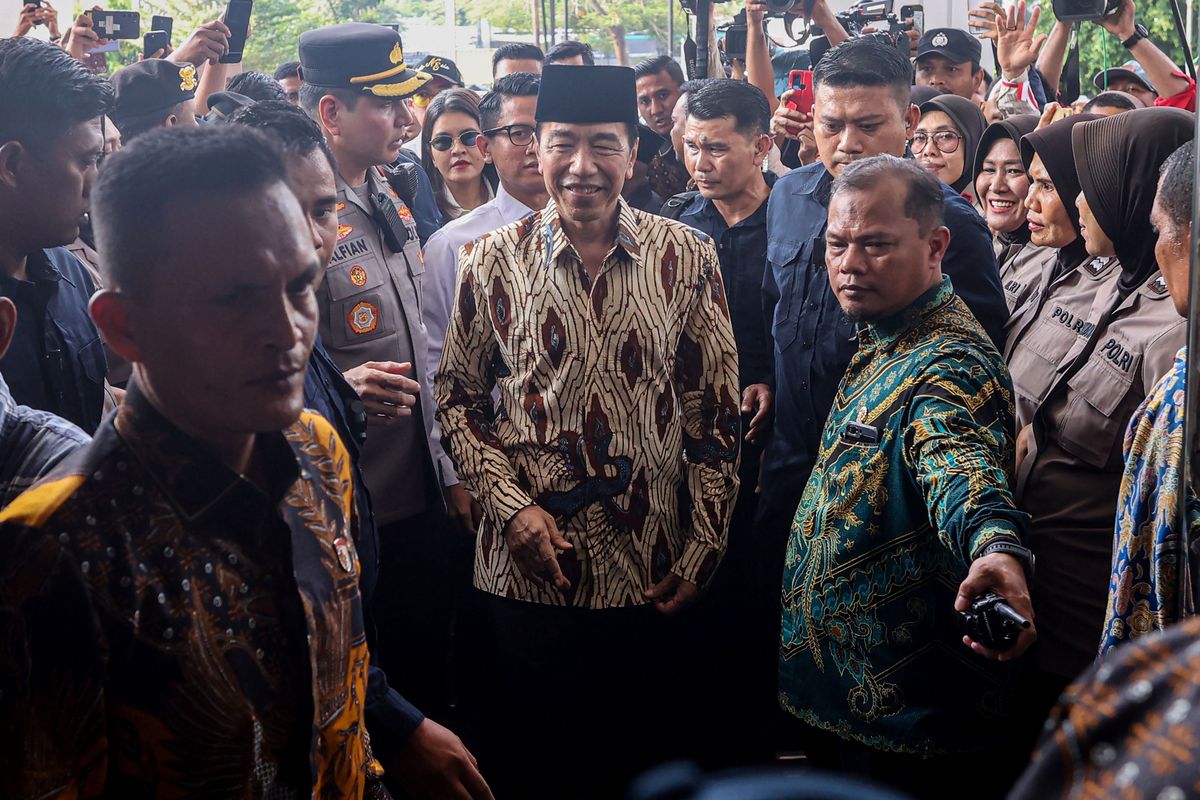
JOKO Widodo has been away from the Presidential Palace for more than two years. However, in political discussions, his name seems to remain ever-present.
When officials change, discussions about Jokowi arise. When parties clash, traces of Solo are sought. When policies provoke protests, questions about who is whispering in their ears quickly surface.
Once, it was said that all roads lead to Rome. In some of our political debates, that road seems to curve toward Solo.
This tendency is not entirely without reason. However, if nearly every event can be explained through a former president, another question emerges: where is the accountability of those currently in power?
Power does not always end when a term expires. Political relationships, habits, and networks of interest can persist beyond changes in government.
Michel Foucault's thinking helps explain why power cannot simply be understood as residing solely in the hands of formal office holders.
Ten years leading a country surely leaves an influence. Moreover, Jokowi's family members still hold public office.
Denying the possibility of informal influence is as careless as assuming every new decision must come from him.
There are historical reasons why society is sensitive. The Constitutional Court's Decision Number 90/PUU-XXI/2023 concerning the age requirements for presidential and vice-presidential candidates, followed by the Honorary Council of the Constitutional Court's Decision Number 02/MKMK/L/11/2023, which imposed sanctions on Anwar Usman removing him from his position as Chief Justice, are part of a political experience that raises issues of trust in the independence of state institutions.
This experience deserves reflection and evaluation. However, that alone does not prove Jokowi's involvement in every policy since the end of his term. Influence may exist; its forms and consequences still need to be explored.
The term “Solo Gang” has become a concise way to describe suspicions of informal power networks. Political jargon is often more memorable than lengthy descriptions of elite relationships.
Such networks do not necessarily need offices, managers, or member lists. Precisely because of their informal nature, scrutiny needs to be more careful: who connects with whom, what actions are taken, and how do those actions influence specific decisions?
Here, David Hume's thoughts about caution in understanding cause and effect become relevant. Just because two events are close does not mean one caused the other.
An official may have once been close to Jokowi, then made a controversial decision. That relationship can be an initial clue, not a final conclusion.
There may be influences, political pressures, or converging interests. But it's also possible that the decision arose from the official's own considerations. Not every mistake requires outside direction.
What is more concerning is when suspicion becomes immune to scrutiny. A connection is considered evidence; while lack of connection is seen as proof that everything is being concealed.
If every result always confirms initial suspicion, investigation loses its meaning.
Democracy requires vigilance. Yet, good vigilance is willing to accept evidence, including evidence that conflicts with initial prejudices.
The main issue is not just the potential magnitude of a former president's influence. What is more pressing is how to distinguish that influence from state authority.
Article 4 paragraph (1) of the 1945 Constitution clarifies that the president wields governmental power according to the constitution. Article 17 regulates the ministers who assist the president.
Meanwhile, other state officials and institutions exercise authority based on their respective legal provisions.
When a policy is questioned, the scrutiny should begin with those who set it. What is its legal basis? What was the process? Who provided the counsel? Is there a conflict of interest?
These questions do not preclude potential outside intervention. Rather, from testable answers, the suspicion of intervention can be evaluated more clearly.
If intervention is proven unlawful, those involved must be held accountable according to their roles.
However, officials who establish or carry out decisions are not automatically exempt from responsibility simply because they are influenced by others.
Here is where the irony arises. The more frequently every policy is linked to a former president, the less attention remains for those currently wielding authority. Yet, they are the ones who must explain decisions before the public.
None of this is a reason to halt evaluations of Jokowi. His policy legacy, meritocracy, and the independence of state institutions can and should be critiqued. Such critiques will be stronger when distinguishing facts, suspicions, and judgments.
We also need to differentiate between decisions that benefit someone and decisions made at his behest. Both may be related, but they are not identical.
Without that distinction, debate easily turns into a competition to guess the figures behind the scenes.
There is a paradox worth considering. Those who wish to see the end of Jokowi's influence often continue to place him at the center of almost every political narrative.
A former president may seem perpetually present, even when there is no evidence that he participated in decision-making.
Perhaps the more critical question is not why Jokowi's name keeps surfacing, but rather why state institutions have yet to convince the public that they can make decisions independently.
The answer is not to ask the public to reduce their questions, but rather to improve the transparency of processes, the clarity of policy rationale, and oversight mechanisms.
Not every issue in Jakarta must find its way back to Solo. If the traffic lights are out, it may be better to check the power grid before concluding something about the political network.
A mature republic is one that does not stop questioning power. It knows how to scrutinize suspicion while also knowing to whom responsibility should be addressed.
We must be careful not to become so preoccupied with the shadows of past power that we fail to diligently oversee the power that operates before our eyes.