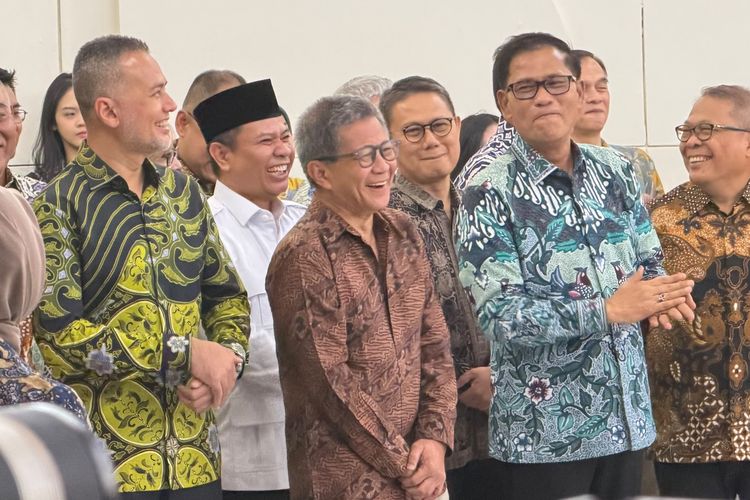


Minister Dudung: A Strong Country is Not One that Instills Fear, but One that Earns Trust and Love
-
News
-
11 minutes ago
This article was translated by AI. Read the original article on Kompas.com. See Original
There are also self-sufficiency policies in food and energy, along with social aid packages and other pro-people policies. Most recently, Prabowo has sought to implement free university education at state universities.
All of this previously served as an antithesis to the capitalist free market doctrine, which has failed to fairly provide for the welfare of the people. Populist policies demand full state intervention.
Thus, the state must be strong. The state cannot lose to those who have distanced the people from their prosperity.
There is actually nothing surprising about the discursive logic of Prabowo's populist policies. What may be surprising is Prabowo's spirit, courage, and the seemingly hurried acceleration.
Prabowo is a president who, even before taking office, has written a book. The economic-political policies he pursues have been clearly articulated in the books Paradox of Indonesia and Its Solutions (2022) and Nation Transformation Strategy (2023).
Prabowo claims he wants to fight for a just economy, an economy anchored in Pancasila, as the founding fathers intended. Not neoliberal capitalism, which has resulted in Indonesia's paradox: a nation rich in resources but with a majority of its people living in poverty.
Prabowo refers to this as “constitutional economy,” which points to the 1945 Constitution Article 33 (original). An economy based on kinship, not free market doctrine.
Prabowo criticizes “laissez-faire.” In countries that adopt “laissez-faire,” the rich indeed grow, but the poor grow much faster.
However, he acknowledges the weight of the issues at hand. The octopus seed that entrapped and siphoned Indonesia's wealth has been embedded in Indonesia's soil since colonial times.
Governments may change, but the people’s economic aspirations conceptualized by the national founders have never gained victory in the field. The ideals of independence drift further away from the soil of Indonesia.
Herein lies the ideological meeting point between Prabowo and the Activist Trio. The direction of Prabowo's economic-political policies intersects with the ideas of democratic socialism that figures like Rocky Gerung, Syahganda, and Jumhur have long championed.
Thus, they start from a shared ideological perspective. They are all “our people,” not “others.” To me, it makes sense when ideological flirting occurs, culminating with the Activist Trio entering the palace.
Therefore, their critical logic must also change. The Activist Trio was once fierce in their opposition to a neoliberal government.
When the regime's direction changes fundamentally, their fierceness should change as well or, in other words, undergo a “transformation.” In Rocky's words, “only the position changes.”
Meanwhile, Prabowo fully realizes that executing state-based socialism with fiscal stakes of hundreds of trillions of rupiah requires substantial political support, along with a strong defensive discursive bulwark.
Without this, the economic-political policies implemented to change Indonesia's paradox will be easily shaken.
Thus, the integration of the Activist Trio into the echelons of power is a very calculative socio-political design.
I view it as a strategic effort by Prabowo to consolidate an “intellectual fortress” to strengthen the foundations of argument and ideological justification for his populist policies.
Borrowing Gramsci’s terms, this move is a concrete effort to form a new hegemony agent by shifting the position of the Activist Trio, who were originally counter-hegemony agents.
Let’s examine one of the most crucial points of the Activist Trio in the palace: the labor division of discourse.
The appointment of Syahganda Nainggolan as Head of Bakom signals strong that the management of presidential public communication is undergoing a total overhaul.
Syahganda is directly tasked by the President to translate the philosophy of people-oriented economic policies into simple language the public can understand.
Thus, Syahganda will lead the orchestration of the discourse war in public space, not just polishing the image. He must capture symbolic capital in the sense of Bourdieu.
He is primarily responsible if public perceptions diverge from the President's perceptions, whereas the President’s policies genuinely favor people's interests. The public should crowd to support Prabowo, not distance themselves from him.


















