

Minister Dudung: A Strong Country is Not One that Instills Fear, but One that Earns Trust and Love
-
News
-
11 minutes ago
This article was translated by AI. Read the original article on Kompas.com. See Original
PUBLIC SPACE has been abuzz with unusual power consolidation maneuvers in early October 2026. President Prabowo Subianto has not only reshuffled his cabinet but also appointed a significant number of members to the Presidential Advisory Council (Wantimpres).
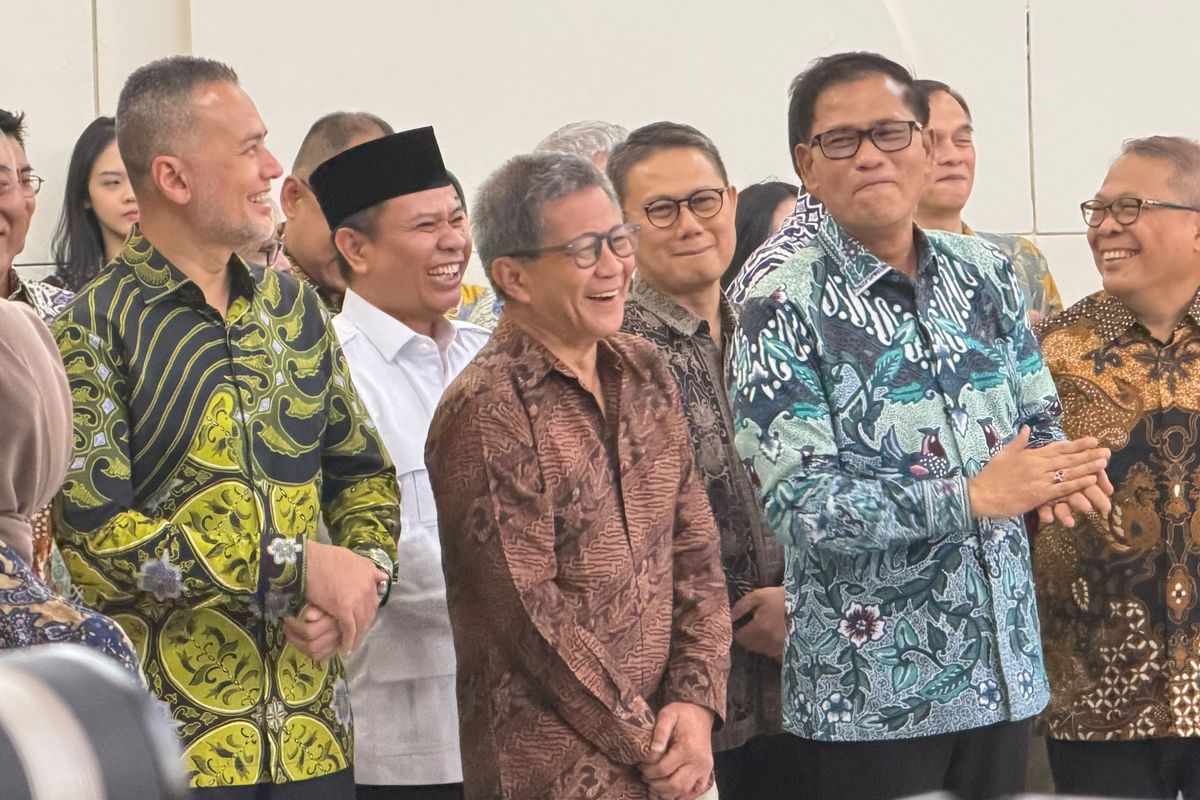
There are certainly many intriguing aspects to the President's political steps. However, the most attention-grabbing move is the entry of Rocky Gerung as a member of Wantimpres.
This is understandable. Up to now, Rocky has been hailed as an independent figure who is highly critical of power. He is an icon of intellectual resistance.
In Gramsci's terms, Rocky is a counter-hegemony agent. His critical thinking is seen as a representation of public voice.
As a result, some in the public lament Rocky's stance. They will no longer see Rocky express his sound reasoning so blatantly.
I attempt to read this from a different perspective.
Rocky must be considered alongside his two "ideological companions" who have also entered the palace. They are Syahganda Nainggolan and Jumhur Hidayat.
Syahganda has been appointed by the President as the Head of the Government Communication Agency (Bakom), replacing M. Qodari who has been shifted to a member of Wantimpres.
Jumhur Hidayat entered the palace earlier as Minister of Environment. Rocky and Syahganda were even present at Jumhur's inauguration.
The three activists and critical thinkers have been friends for a long time. On many occasions, they have voiced their criticisms of the power, particularly during Joko Widodo's administration.
In fact, due to their activism, both Syahganda and Jumhur spent time behind bars during Joko Widodo's era.
For the purpose of this article, I will refer to these three activists as the “Activist Trio.”
For a public accustomed to seeing the Activist Trio—especially Rocky Gerung—as the antithesis of power, Prabowo's decision to bring them into the palace and their willingness to join certainly invites skepticism.
Various criticisms and condemnations flooded public space in the aftermath of the appointments, especially directed at Rocky, even permeating dinner table conversations.
The public accused that their rationality and steadfastness in voicing criticism ultimately succumbed to the compromises of office. Is that true?
I try to understand this by examining the ideological aspects and political communication calculations. From this angle, I suspect that Prabowo's move is not a strategy to tame opposition actors. Likewise, the Activist Trio's decision to enter the palace is not a defeat of idealism.
It seems overly demeaning to the Activist Trio with their significant stature to assume they could be tamed by positions. Although it is not difficult for the public to point out activists with notable names who have succumbed to the embrace of power.
I still believe that the actions of Prabowo and the Activist Trio transcend the logic of pragmatic power-sharing. I see it as a structured effort to institutionalize an "intellectual fortress" to secure President Prabowo's ideological vision.
Since the beginning of his leadership in Indonesia, Prabowo has hit the ground running with various programs steeped in a sense of “state populism.”
Ernesto Laclau (2005) argues that populism is not a substantive ideology but a discursive logic that consolidates various unmet social demands into a collective political entity called "the people" facing the status quo (neoliberal apparatus).
In the context of Indonesia, Prabowo is forming what Laclau refers to as an “equivalential chain” by synthesizing various people's issues into a single populist redistributive policy nexus. The state assumes control and speaks on behalf of the people.
For instance, the Free Nutritious Meals policy (MBG). This populist program consumes a staggering budget of Rp 218.77 trillion (after a sharpening of expenses) in the 2026 fiscal year, targeting 74.56 million beneficiaries (BGN, Press Release, 17/09/2026).
The equivalence network is structurally expanded through the planned establishment of 80,000 Red and White Village Cooperatives (KDKMP).
This program is expected to require a total working capital investment of between Rp 240 trillion and Rp 400 trillion (with an estimated capital of Rp 3 billion - Rp 5 billion per cooperative unit).
There are also self-sufficiency policies in food and energy, along with social aid packages and other pro-people policies. Most recently, Prabowo has sought to implement free university education at state universities.
All of this previously served as an antithesis to the capitalist free market doctrine, which has failed to fairly provide for the welfare of the people. Populist policies demand full state intervention.
Thus, the state must be strong. The state cannot lose to those who have distanced the people from their prosperity.
There is actually nothing surprising about the discursive logic of Prabowo's populist policies. What may be surprising is Prabowo's spirit, courage, and the seemingly hurried acceleration.
Prabowo is a president who, even before taking office, has written a book. The economic-political policies he pursues have been clearly articulated in the books Paradox of Indonesia and Its Solutions (2022) and Nation Transformation Strategy (2023).
Prabowo claims he wants to fight for a just economy, an economy anchored in Pancasila, as the founding fathers intended. Not neoliberal capitalism, which has resulted in Indonesia's paradox: a nation rich in resources but with a majority of its people living in poverty.
Prabowo refers to this as “constitutional economy,” which points to the 1945 Constitution Article 33 (original). An economy based on kinship, not free market doctrine.
Prabowo criticizes “laissez-faire.” In countries that adopt “laissez-faire,” the rich indeed grow, but the poor grow much faster.
However, he acknowledges the weight of the issues at hand. The octopus seed that entrapped and siphoned Indonesia's wealth has been embedded in Indonesia's soil since colonial times.
Governments may change, but the people’s economic aspirations conceptualized by the national founders have never gained victory in the field. The ideals of independence drift further away from the soil of Indonesia.
Herein lies the ideological meeting point between Prabowo and the Activist Trio. The direction of Prabowo's economic-political policies intersects with the ideas of democratic socialism that figures like Rocky Gerung, Syahganda, and Jumhur have long championed.
Thus, they start from a shared ideological perspective. They are all “our people,” not “others.” To me, it makes sense when ideological flirting occurs, culminating with the Activist Trio entering the palace.
Therefore, their critical logic must also change. The Activist Trio was once fierce in their opposition to a neoliberal government.
When the regime's direction changes fundamentally, their fierceness should change as well or, in other words, undergo a “transformation.” In Rocky's words, “only the position changes.”
Meanwhile, Prabowo fully realizes that executing state-based socialism with fiscal stakes of hundreds of trillions of rupiah requires substantial political support, along with a strong defensive discursive bulwark.
Without this, the economic-political policies implemented to change Indonesia's paradox will be easily shaken.
Thus, the integration of the Activist Trio into the echelons of power is a very calculative socio-political design.
I view it as a strategic effort by Prabowo to consolidate an “intellectual fortress” to strengthen the foundations of argument and ideological justification for his populist policies.
Borrowing Gramsci’s terms, this move is a concrete effort to form a new hegemony agent by shifting the position of the Activist Trio, who were originally counter-hegemony agents.
Let’s examine one of the most crucial points of the Activist Trio in the palace: the labor division of discourse.
The appointment of Syahganda Nainggolan as Head of Bakom signals strong that the management of presidential public communication is undergoing a total overhaul.
Syahganda is directly tasked by the President to translate the philosophy of people-oriented economic policies into simple language the public can understand.
Thus, Syahganda will lead the orchestration of the discourse war in public space, not just polishing the image. He must capture symbolic capital in the sense of Bourdieu.
He is primarily responsible if public perceptions diverge from the President's perceptions, whereas the President’s policies genuinely favor people's interests. The public should crowd to support Prabowo, not distance themselves from him.
Politically, this move is important and urgent for Prabowo, considering the approval ratings have sharply dropped linearly in recent months.
According to the Indonesian Political Indicator survey earlier in the year, satisfaction with the President’s performance stood at 79.9 percent.
In the SMRC survey in March 2026, it dropped to 66.4 percent, eventually landing at a psychological threshold of 51 percent by mid-2026.
This constitutes a heavy challenge for the Activist Trio as “our people.” Syahganda, as well as Rocky, cannot continue to speak sporadically from podcast to podcast as they did before.
The narrative built by the Activist Trio thus far is to clearly distinguish between “the President's pro-people ideological vision” and “the management failures of the cabinet.”
In forum after forum, mainly Rocky and Syahganda have articulated a clear separation of these two categories.
This Gramscian narrative cleverly shifts the burden of public accountability. By distinctly separating between “the President's ideological vision” and “the cabinet's management,” if there are failures in programs—such as the closure of several Nutritional Fulfillment Service Units (SPPG) due to standardization issues—the criticism will be precisely directed toward the relevant technical ministries.
This is believed to effectively maintain the President’s political legitimacy in a safe zone, while concurrently forcing the cabinet to work under constant oversight.
By controlling communication through Bakom (Syahganda's role) and advisory functions in Wantimpres (Rocky's role), they now possess an official platform to continually produce narratives legally and massively.
Moreover, the equally astute division of discursive labor involves Jumhur Hidayat's role as Minister of Environment.
As a figure with a strong mass base in the labor sector and connections with indigenous communities, Jumhur serves as a social safety anchor for the regime at the grassroots level.
Expansive state economic policies often clash with ecological issues and communal rights.
By placing one of the Activist Trio in the environmental sector, the palace endeavors to shift the paradigm of national development: to turn the wheels of people-oriented economy without sacrificing ecological sustainability.
Jumhur carries the mission of forming a “habit of our heart”—instilling environmental awareness as part of the daily lives of the community.
From a practical political perspective, Jumhur's presence minimizes the potential for agrarian conflict and large-scale labor demonstrations, as the communication channels between civil groups and policymakers are now directly bridged by an “ordal” (insider) with a good track record in their eyes.
Of course, this reading faces a heavy test in the reality of daily governance. Rocky Gerung has repeatedly asserted that he has not changed.
He has merely shifted positions from outside to inside the system. His critical function has not altered, akin to an ethical council that oversees policies to ensure they do not stray from the President's initial vision.
However, the public has placed high expectations alongside deep suspicion.
The political history of Indonesia records how many critical intellectuals suddenly lose their edge when confronted with the comforts of protocol, state facilities, and a rigid bureaucratic circle.
The Activist Trio now bears the burden of a consistency test. They must prove to the public that their presence in the palace is as “ideological officers” to guide the flow of power with a radical people-oriented narrative, rather than being co-opted by the interests of pragmatic elites.
There are no guarantees that Prabowo's ideological vision will be read, understood, and accepted by those around him.
Rocky himself has repeatedly stated this. And, it is possible these individuals may actually change the Activist Trio.
The empirical test of this premise will be visible in the coming months. The dynamics of spending hundreds of trillions of rupiah in the field will test whether this intellectual fortress can influence and correct the administration's course, or merely undergo domestication into an instrument justifying power actions.


















