
National Police Chief Feels Betrayed by Listyo Sigit and Associates for Intercepting Prabowo
-
News
-
3 minutes ago
This article was translated by AI. Read the original article on Kompas.com. See Original

JAKARTA, KOMPAS.com - The global oil market is once again under pressure amid ongoing supply disruptions from the Middle East that have yet to fully recover.
The International Energy Agency (IEA) reports that benchmark oil prices have risen over the past few weeks following renewed conflicts in the Middle East, which have further disrupted oil exports from the region.
Previous market pressures had eased somewhat due to various measures implemented to offset supply shortages.
 Illustration of diesel prices.
These included the release of IEA emergency reserves, increased exports via routes bypassing the Strait of Hormuz, higher production from non-Gulf countries, partial restoration of oil flows from the Persian Gulf, and weakened global demand – all helping to relieve market tensions.
However, the situation is starting to change again.
In remarks penned on Friday (September 18, 2026), IEA’s Head of Industry and Oil Markets Division, Toril Bosoni, warned that if Gulf region supplies remain constrained in the coming months while commercial stocks continue to decline, higher oil prices and further demand drops may be necessary to balance supply and demand.
Six months after the onset of the Middle East conflict, oil production and exports from the Gulf remain significantly restricted.
The IEA notes that oil flows through the Strait of Hormuz averaged just 7.6 million barrels per day (bpd) in August 2026.
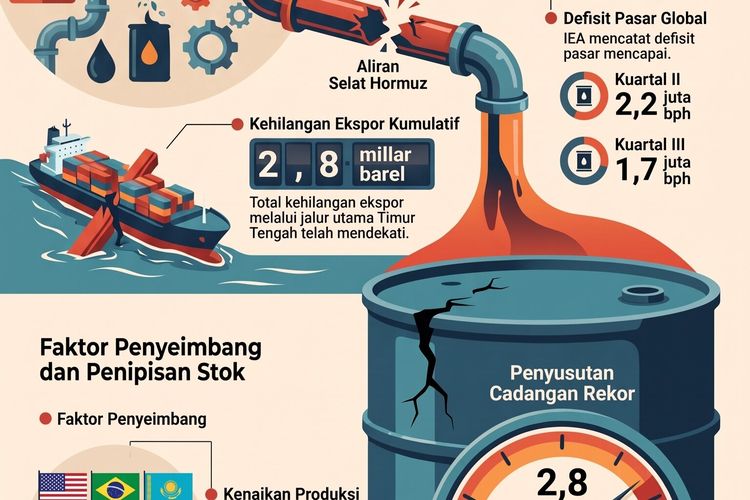
This figure remains 13.1 million bpd below pre-war levels. Cumulatively, lost exports through this route have approached 2.8 billion barrels.
Nonetheless, the impact on the overall oil market balance is not fully reflected by the apparent supply loss via the Strait of Hormuz.
The IEA estimates an oil market deficit of 2.2 million bpd in Q2 2026 and 1.7 million bpd in Q3 2026. These deficits are lower than the lost volumes through the Strait due to several offsetting factors.
One key factor was the market conditions before the conflict erupted.
The oil market entered the crisis with relatively abundant supply. According to IEA data, global oil supply in 2025 averaged 1.4 million bpd higher than demand.
In fact, the supply surplus exceeded 2 million bpd in the second half of 2025, leading to stock builds, especially in China.
Thus, stockpiles accumulated prior to the conflict have served as buffers as Middle Eastern supplies began to falter.
Beyond stockpiles, some Gulf producers have worked to divert exports through alternative routes.
Saudi Arabia and the United Arab Emirates (UAE) have increased oil shipments via ports that do not rely on the Strait of Hormuz.
Exports from Saudi Arabia’s Red Sea port of Yanbu and UAE’s Fujairah port on the Gulf of Oman rose from 4.1 million bpd in February to 7.8 million bpd in June 2026.