

National Police Chief Feels Betrayed by Listyo Sigit and Associates for Intercepting Prabowo
-
News
-
3 minutes ago
This article was translated by AI. Read the original article on Kompas.com. See Original

JAKARTA, KOMPAS.com - The global oil market is once again under pressure amid ongoing supply disruptions from the Middle East that have yet to fully recover.
The International Energy Agency (IEA) reports that benchmark oil prices have risen over the past few weeks following renewed conflicts in the Middle East, which have further disrupted oil exports from the region.
Previous market pressures had eased somewhat due to various measures implemented to offset supply shortages.
 Illustration of diesel prices.
These included the release of IEA emergency reserves, increased exports via routes bypassing the Strait of Hormuz, higher production from non-Gulf countries, partial restoration of oil flows from the Persian Gulf, and weakened global demand – all helping to relieve market tensions.
However, the situation is starting to change again.
In remarks penned on Friday (September 18, 2026), IEA’s Head of Industry and Oil Markets Division, Toril Bosoni, warned that if Gulf region supplies remain constrained in the coming months while commercial stocks continue to decline, higher oil prices and further demand drops may be necessary to balance supply and demand.
Six months after the onset of the Middle East conflict, oil production and exports from the Gulf remain significantly restricted.
The IEA notes that oil flows through the Strait of Hormuz averaged just 7.6 million barrels per day (bpd) in August 2026.
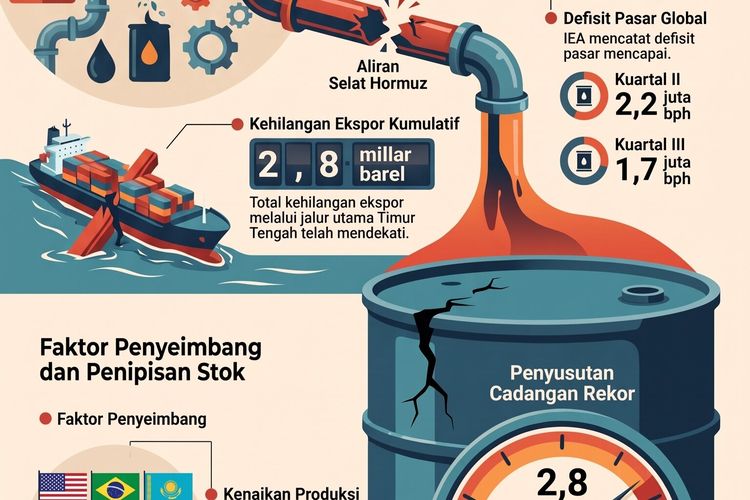
This figure remains 13.1 million bpd below pre-war levels. Cumulatively, lost exports through this route have approached 2.8 billion barrels.
Nonetheless, the impact on the overall oil market balance is not fully reflected by the apparent supply loss via the Strait of Hormuz.
The IEA estimates an oil market deficit of 2.2 million bpd in Q2 2026 and 1.7 million bpd in Q3 2026. These deficits are lower than the lost volumes through the Strait due to several offsetting factors.
One key factor was the market conditions before the conflict erupted.
The oil market entered the crisis with relatively abundant supply. According to IEA data, global oil supply in 2025 averaged 1.4 million bpd higher than demand.
In fact, the supply surplus exceeded 2 million bpd in the second half of 2025, leading to stock builds, especially in China.
Thus, stockpiles accumulated prior to the conflict have served as buffers as Middle Eastern supplies began to falter.
Beyond stockpiles, some Gulf producers have worked to divert exports through alternative routes.
Saudi Arabia and the United Arab Emirates (UAE) have increased oil shipments via ports that do not rely on the Strait of Hormuz.
Exports from Saudi Arabia’s Red Sea port of Yanbu and UAE’s Fujairah port on the Gulf of Oman rose from 4.1 million bpd in February to 7.8 million bpd in June 2026.
However, flows decreased again following Houthi attacks in the Red Sea. In August 2026, exports via these routes fell to 5.5 million bpd.
The IEA reports that the increased flows through alternative routes have compensated for more than 500 million barrels or about 2.8 million bpd of lost supply from the Strait of Hormuz since the conflict began.
Market pressure rose again after attacks on Saudi Arabia’s East-West pipeline — which transports oil to Yanbu — forced its shutdown in early September.
Meanwhile, oil exports through the Strait of Hormuz have shown signs of improvement thanks to U.S. military support facilitating transit through the contested waterway.
Yet, the IEA notes that oil flows through the Strait remain below pre-war levels.
Supply shortages from the Gulf have also been partly offset by higher output from producers outside the region.
The IEA records a cumulative supply increase of 420 million barrels, or about 2.3 million bpd, from non-Gulf countries since the war began.
From February to August 2026, the largest production gains came from the U.S. ( 520,000 bpd), Brazil ( 470,000 bpd), Kazakhstan ( 440,000 bpd), Venezuela ( 300,000 bpd), and Nigeria ( 200,000 bpd).
During the same period, global biofuel supplies also rose seasonally by 890,000 bpd.
This production growth has been an important factor helping markets absorb Gulf supply losses.
Adjustments have not only occurred on the supply side but also in demand.
The IEA estimates that global oil demand over the past six months averaged 5.8 million bpd lower than in February 2026. Cumulatively, this reduction equals more than one billion barrels.
China accounts for the largest drop in demand.
China’s oil demand, based on implied consumption over the past six months, was 1.7 million bpd lower than in February 2026 and 1.1 million bpd below the same period the previous year.
This decline is also visible in China’s crude oil imports by sea, which fell from 11.5 million bpd in February to 6 million bpd in June 2026.
Lower Chinese imports have eased pressure on other crude-importing countries in Asia.
Demand reduction has also occurred in other markets. In the Middle East, petrochemical and aviation activities have been curtailed.
Several governments, especially in Asia, have introduced fuel use restrictions and emergency conservation policies. Elsewhere, product shortages and higher prices have dampened consumption.
These pressures have led to a significant decline in global oil consumption.
The IEA reports that global oil demand fell by 5.3 million bpd in Q2 2026 compared to the same period last year.
This marks the first quarterly decline in oil demand since the Covid-19 pandemic.
Gasoil products contributed significantly to this drop, with consumption falling 1.2 million bpd year-on-year. At the same time, combined deliveries of naphtha, LPG, and ethane decreased by 1.8 million bpd.
For all of 2026, the IEA now forecasts a contraction in global oil demand of 2.5 million bpd.
The Middle East and Asia are expected to account for roughly 80 percent of the decline.
Despite increased supply from various sources and reduced demand, market buffers in the form of oil inventories continue to shrink.
The IEA notes that global oil stocks have fallen at an average rate of 2.8 million bpd over the past six months.
Current inventories are 507 million barrels lower than at the start of the conflict.
IEA member countries have also released more than 300 million barrels from emergency reserves as part of a collective action announced on March 11, 2026.
Stocks of crude outside OECD countries have decreased by 105 million barrels, with about 65 percent of that drop in Chinese tank inventories and the rest mainly in oil in transit.
These developments are tightening market buffers further.
"Global oil inventories have declined at a record pace of 2.8 million barrels per day over the past six months," the IEA said.
With stocks continuing to deplete, market attention is increasingly focused on the recovery of oil flows through the Strait of Hormuz and alternative routes.
The IEA emphasized that the rapid stock drawdown heightens the urgency of fully reopening the Strait of Hormuz and alternative shipping lanes.
The agency also warns that any further disruptions hindering full production and export recovery could significantly impact oil markets globally.