

Gibran Plans to "Fight": Is There Still a Way to Validate His Certificate?
-
News
-
20 minutes ago
This article was translated by AI. Read the original article on Kompas.com. See Original
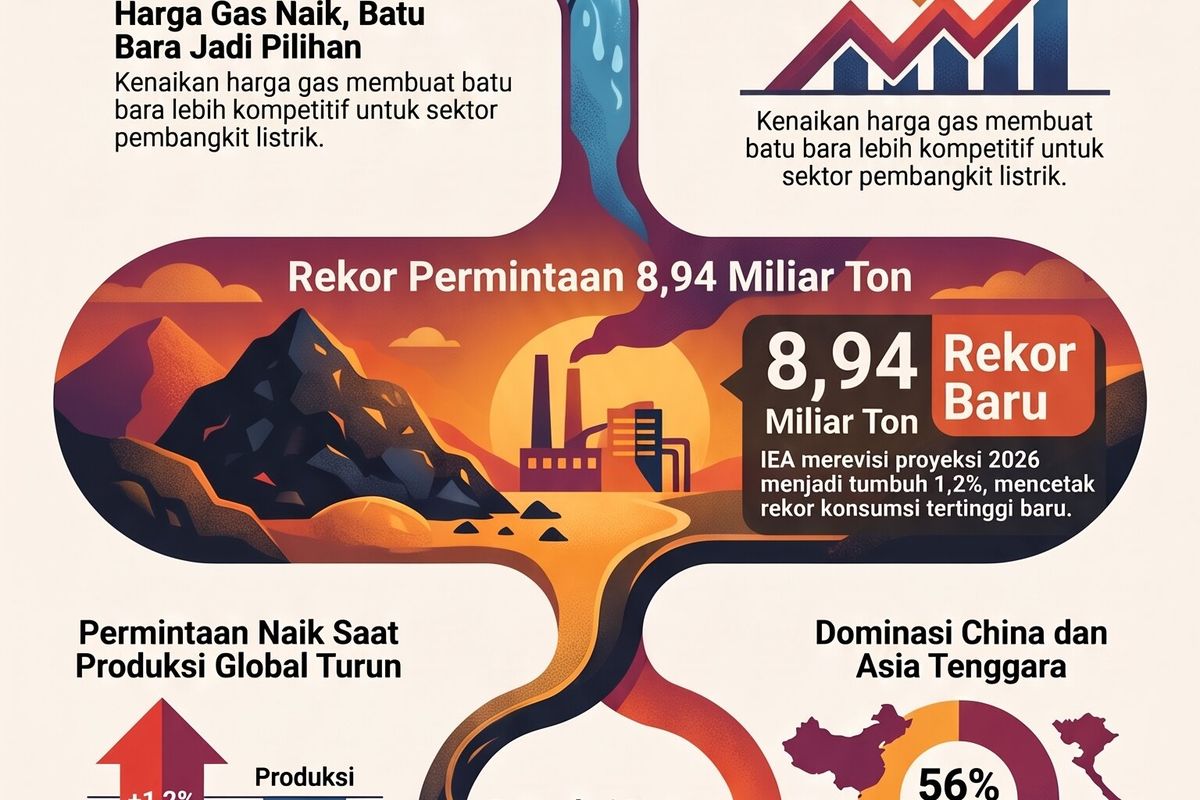
In 2025, global coal consumption reached a record high after a 0.3 percent increase. This occurred despite declines in coal-fired power generation in both China and India for the first time in around 50 years.
These reductions were offset by increased consumption in other markets, including the United States, and by coal-intensive industries such as nickel production in Indonesia and coal-based chemical production in China.
For 2026, the Middle East conflict is one of the key factors reversing the market trend.
China holds a pivotal role, accounting for over 56 percent of global coal consumption.
In 2025, China's coal consumption reached 4.956 billion tons. Its power sector alone consumes about one-third of global coal supply.
For 2026, IEA projects a 1 percent increase in China’s coal consumption to roughly 5 billion tons. Factors supporting coal use in China’s power sector include rising electricity demand, lower wind power production, and higher LNG prices.
Higher oil prices also have an effect; IEA notes that elevated oil prices boost the economics of coal-based chemical production in China.
However, the incremental demand from this sector is expected to be limited, as many coal-to-chemicals plants are already operating near full capacity.
Meanwhile, steel and cement production in China, which peaked in 2020, is forecasted to continue declining through 2026. This means coal demand growth in China is not uniform across all sectors.
The Middle East conflict has not only shaken oil and gas markets but also reshaped global coal demand.
India is another source of growth.
After a temporary drop in coal use in 2025 due to weather conditions favoring hydropower, IEA expects India’s coal demand to return to its historical growth trend in 2026.
Coal consumption in India is projected to rise 4.2 percent to 1.353 billion tons.
Supporting factors include growth in electricity demand and industrial use. The IEA identifies pig iron, direct reduction iron (DRI), and cement production as India's three main coal-consuming industrial sectors.
Weather influences also play a role.
IEA expects a strong El Niño in 2026 to increase cooling demand while suppressing hydropower generation in several Asian countries, potentially boosting coal-fired power generation.
Vietnam is among countries affected by this mechanism. Its coal demand for power generation is supported by heatwaves and the need to replenish coal stockpiles.
Across the ASEAN region, coal consumption is projected to reach about 574 million tons in 2026, with Indonesia and Vietnam as primary growth drivers.
The gas price shifts caused by the Middle East conflict also impacted Asian countries that had been reducing coal use.