

Gibran Plans to "Fight": Is There Still a Way to Validate His Certificate?
-
News
-
20 minutes ago
This article was translated by AI. Read the original article on Kompas.com. See Original

JAKARTA, KOMPAS.com - The Middle East conflict has not only shaken up oil and gas markets but also reshaped global coal demand.
Directly, coal shipments rarely pass through the Strait of Hormuz.
The International Energy Agency (IEA) notes that almost no coal shipments traverse this strait, as the Middle East is neither a major coal producer nor consumer.
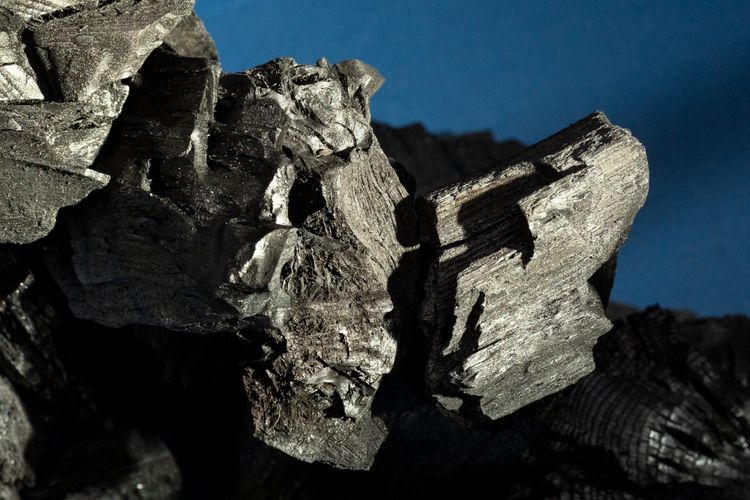 Coal illustration.
However, disruptions to liquefied natural gas (LNG) shipments through the Strait of Hormuz have tightened gas supplies and driven prices up.
This situation has prompted some countries with gas-fired power plants alongside coal-fired capacity to increase coal use once again.
The impact is evident in revised global coal consumption projections.
In its Coal Mid-Year Update 2026, the IEA has adjusted previous forecasts that anticipated a slight decline in global coal demand in 2026. Now, coal consumption is expected to grow by 1.2 percent to 8.94 billion tons in 2026, marking a new record.
The ripple effects began in the natural gas market.
IEA explains that the Middle East conflict has significantly reduced LNG shipments via the Strait of Hormuz. Although these disruptions don’t directly hinder coal supply, they have pushed natural gas prices higher.
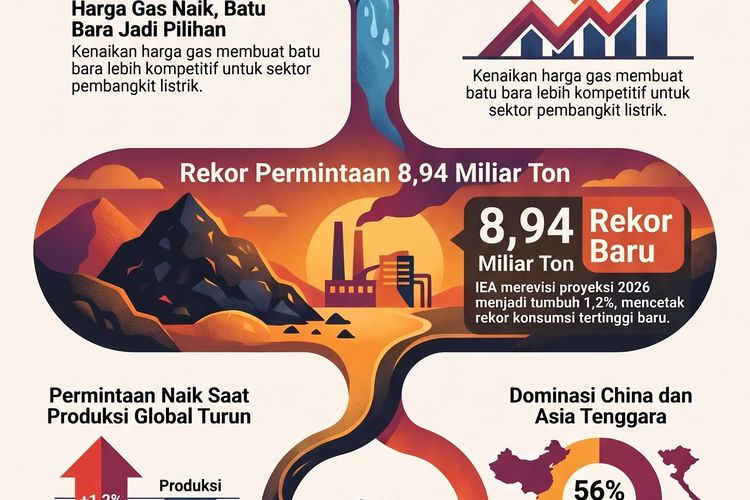
In several countries, coal serves as the main alternative to natural gas for power generation. As gas prices rise, coal-fired power plants become relatively more competitive.
IEA notes this trend has driven increased coal-fired electricity production in countries that still maintain both gas and coal power generation capacity.
The effects have been observed in China, South Korea, Japan, Europe, and other markets. The IEA also points to regulatory actions in some countries that have reinforced this shift toward coal.
Thus, the mechanism is not that coal supply is disrupted by the Strait of Hormuz, but that interruption to one energy source affects the economics of another.
The power generation sector plays a crucial role here. In 2025, coal-fired power generation accounted for 5.954 billion tons of global coal consumption.
The electricity sector is also the largest coal consumer worldwide.
These changes in energy market conditions have led to a significant revision of IEA forecasts.
In its December 2025 annual report, IEA had projected a slight global coal demand decline in 2026. However, subsequent developments—chiefly the Middle East conflict and weather factors—prompted an upward revision.
Global coal demand is now expected to rise 1.2 percent to 8.94 billion tons in 2026, exceeding 2025 consumption of 8.84 billion tons.
In 2025, global coal consumption reached a record high after a 0.3 percent increase. This occurred despite declines in coal-fired power generation in both China and India for the first time in around 50 years.
These reductions were offset by increased consumption in other markets, including the United States, and by coal-intensive industries such as nickel production in Indonesia and coal-based chemical production in China.
For 2026, the Middle East conflict is one of the key factors reversing the market trend.
China holds a pivotal role, accounting for over 56 percent of global coal consumption.
In 2025, China's coal consumption reached 4.956 billion tons. Its power sector alone consumes about one-third of global coal supply.
For 2026, IEA projects a 1 percent increase in China’s coal consumption to roughly 5 billion tons. Factors supporting coal use in China’s power sector include rising electricity demand, lower wind power production, and higher LNG prices.
Higher oil prices also have an effect; IEA notes that elevated oil prices boost the economics of coal-based chemical production in China.
However, the incremental demand from this sector is expected to be limited, as many coal-to-chemicals plants are already operating near full capacity.
Meanwhile, steel and cement production in China, which peaked in 2020, is forecasted to continue declining through 2026. This means coal demand growth in China is not uniform across all sectors.
The Middle East conflict has not only shaken oil and gas markets but also reshaped global coal demand.
India is another source of growth.
After a temporary drop in coal use in 2025 due to weather conditions favoring hydropower, IEA expects India’s coal demand to return to its historical growth trend in 2026.
Coal consumption in India is projected to rise 4.2 percent to 1.353 billion tons.
Supporting factors include growth in electricity demand and industrial use. The IEA identifies pig iron, direct reduction iron (DRI), and cement production as India's three main coal-consuming industrial sectors.
Weather influences also play a role.
IEA expects a strong El Niño in 2026 to increase cooling demand while suppressing hydropower generation in several Asian countries, potentially boosting coal-fired power generation.
Vietnam is among countries affected by this mechanism. Its coal demand for power generation is supported by heatwaves and the need to replenish coal stockpiles.
Across the ASEAN region, coal consumption is projected to reach about 574 million tons in 2026, with Indonesia and Vietnam as primary growth drivers.
The gas price shifts caused by the Middle East conflict also impacted Asian countries that had been reducing coal use.
Japan is forecast to experience a 1 percent decline in coal consumption in 2026 to 161 million tons. However, higher gas prices have led to more coal-fired electricity generation than previously estimated.
South Korea shows a more pronounced shift. The IEA now expects South Korea’s coal demand to increase 6 percent to 119 million tons in 2026.
This is partly due to limited nuclear power availability. In the first quarter of 2026, coal-fired electricity generation in South Korea rose 30 percent year-over-year.
IEA notes that restarting nuclear reactors by the end of the year could slow coal use growth by reducing dependence on coal-fired power plants.
This shift in demand comes even as global coal production is expected to decline.
The IEA forecasts a roughly 1 percent drop in coal output in 2026, though production will remain above 9 billion tons for the third consecutive year.
The production decline is partly due to high stock levels at the end of 2025 and policies limiting output in some countries.
China has also reduced production after a May 2026 mining accident in Shanxi Province triggered emergency safety inspections. Coal output in China during June and July fell about 10 percent compared to the same period last year.
This has narrowed the gap between global coal production and consumption. According to the IEA, the recent period of large-scale global coal stockpiling has come to a temporary end.
This rebalancing has supported prices.
Newcastle thermal coal FOB prices reached 115 US dollars per ton in February 2026, up 7 percent since December 2025. The average Newcastle FOB price peaked at 139 dollars per ton in June before falling to 131 dollars per ton in August.
Despite the rise, prices remain well below the 2022 energy crisis levels, when key benchmark coal prices hit around 400 US dollars per ton.
Coal market developments in 2027 will heavily depend on conditions in the Strait of Hormuz and the LNG market.
If LNG flows through the Strait of Hormuz return to pre-conflict levels and gas prices fall from 2026 highs, the IEA projects global coal demand will decline by 0.4 percent to 8.91 billion tons in 2027.
This would reflect a narrowing price gap between gas and coal that in 2026 encouraged power plants to switch from gas to coal.
Expanded renewable energy and cheaper LNG are also expected to pressure coal-fired power generation.
Conversely, if LNG shipments through the Strait of Hormuz remain restricted, coal demand could rise further.
In other words, coal market trends in 2027 remain closely tied to gas market dynamics and Middle East geopolitical developments.
The IEA also highlights weather patterns, fuel prices, and energy security issues as continuing sources of uncertainty for global coal demand.