

Misconception Behind the Welfare of Healthcare Workers
-
News
-
7 minutes ago
This article was translated by AI. Read the original article on Kompas.com. See Original

BANGKOK, KOMPAS.com - AirAsia founder Tony Fernandes stated that the low-cost carrier has strong liquidity to withstand the surge in jet fuel prices.
Fernandes made the remarks on Friday (18/9/2026) amid investor concerns about AirAsia's financial condition, which pushed the airline's share price close to its lowest level in nearly four years.
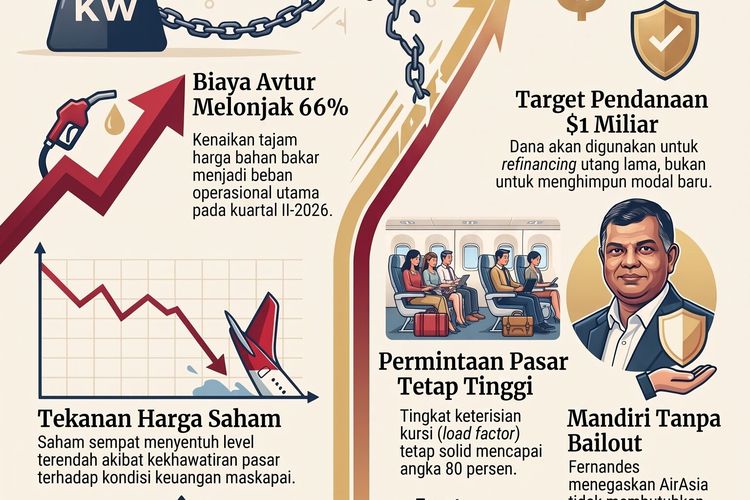
According to Reuters, speaking at a media briefing from Bangkok, Thailand, Fernandes revealed that AirAsia has cash management capabilities and is preparing financing exceeding 1 billion US dollars, or approximately Rp 17.74 trillion (assuming an exchange rate of Rp 17,738 per US dollar).
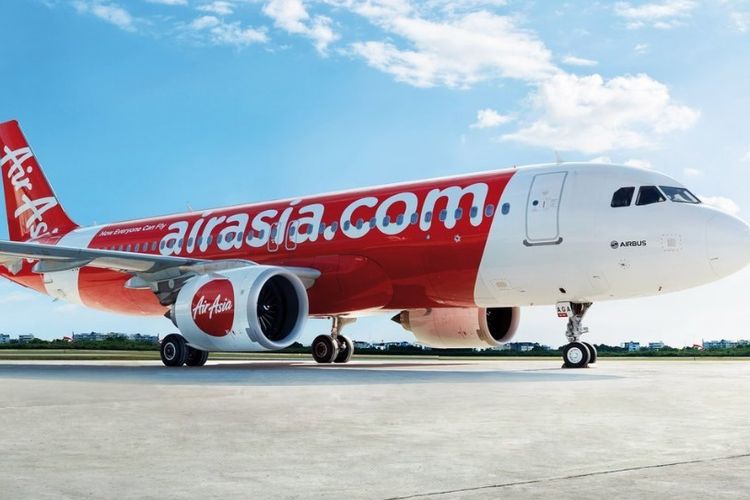 AirAsia airline. Just One Word: How to Book a Flight Ticket if You Have No Last Name
Most of this funding will be used to refinance existing debt. The fundraising is targeted to be completed by December 2026 or January 2027.
"We have strong liquidity," Fernandes said.
He compared AirAsia's current situation to the pressures the airline faced during the Covid-19 pandemic.
"The Covid situation was far, far worse than what we are facing now. Back then, we couldn’t fly, but now we can, and demand is very high," Fernandes explained.
In other words, Fernandes emphasized that the Covid-19 pandemic was a much graver challenge than the present conditions.
During the pandemic, AirAsia couldn’t operate normally; now, flight demand remains robust.
Fernandes' statement comes amid the government’s and investors’ growing attention to AirAsia’s financial health, as it is the largest low-cost carrier in Southeast Asia.
Two days before the briefing, Reuters reported that the Malaysian government had inquired with Malaysia Airlines and Batik Air about the possibility of these carriers absorbing AirAsia’s domestic market share.
According to sources cited by Reuters, this move is part of scenario planning as the government monitors AirAsia's financial stability.
AirAsia controls approximately 60 percent of Malaysia’s domestic market, making its financial condition a key concern in the country’s aviation industry.
Investor concerns are also reflected in AirAsia’s stock performance; its share price has dropped around 24 percent since the Reuters report was published on Wednesday (16/9/2026).
AirAsia’s shares hit their lowest level since December 2022, having lost more than 70 percent of their value this year.
AirAsia is under pressure as aircraft fuel prices have increased due to the conflict in Iran.
This fuel price spike has impacted airlines worldwide.
Reuters noted that the surge in jet fuel prices contributed to the collapse of the heavily indebted US airline Spirit Airlines in May 2026.
Additionally, Latvian airline airBaltic filed for bankruptcy protection under Chapter 11 on Monday (14/9/2026).
For AirAsia, rising fuel prices directly increase operational costs.
Reuters reported that AirAsia’s fuel expenses jumped 66 percent in the second quarter of 2026 compared to the previous quarter, with an average fuel price of 183 US dollars per barrel.
At an exchange rate of Rp 17,738 per US dollar, this equates to about Rp 3.25 million per barrel.
AirAsia does not engage in fuel hedging, which means the increases directly impact its costs.
This situation makes rising jet fuel prices a critical focus in the airline's cost management.
Fernandes said the second quarter of 2026 was the toughest period for AirAsia but expects improvement as the airline adjusts fares to offset higher fuel costs.
Financial data shows the significant liabilities AirAsia must manage.
As of June 30, 2026, current liabilities amounted to 18.4 billion ringgit, or around 4.52 billion US dollars, equivalent to approximately Rp 80.18 trillion.
Meanwhile, AirAsia’s cash and bank balances stood at 954 million ringgit.
The disparity between current liabilities and cash reserves is a focal point concerning the airline’s funding requirements.
This month, AirAsia said it is advancing talks with several financial institutions and aims to raise up to 1 billion US dollars from the international debt market, around Rp 17.74 trillion.
Additionally, the airline targets obtaining a local credit facility of 700 million ringgit.
The funds will primarily be used to restructure debt.
Fernandes emphasized that this is not a capital raising effort.
"This refinancing is not about raising new capital. The goal is to reduce costs," he explained.
In other words, refinancing is intended to lower expenses rather than accumulate new funds.
He mentioned that AirAsia is in talks with a major global bank regarding bond transactions.
The airline has also received a funding offer of 1 billion US dollars or about Rp 17.74 trillion from Middle Eastern investors.
According to Fernandes, the term sheet has been signed, with due diligence still underway.
However, AirAsia is still considering the offer while waiting for better terms.
Amid government scrutiny over AirAsia’s finances, Fernandes denied that the airline requires a bailout.
Malaysia’s Ministry of Finance has appointed Alton Aviation Consultancy to assess AirAsia’s financing needs.
This step was taken as the government considers potential support for the airline, given its role in the local economy.
Reuters had earlier reported on this funding assessment in the current month.
However, Fernandes stated that AirAsia has not received any government support in the past 25 years.
"We have never received government support in the last 25 years. And until today, we haven’t, and that’s it," Fernandes said.
He also said there have been no discussions with the government regarding support.
"We don’t need a bailout, rescue funds, or anything like that," Fernandes asserted.
These statements came as the Malaysian government monitors AirAsia’s financial condition and evaluates various scenarios related to its operational continuity.
Fernandes also highlighted AirAsia’s market position in Malaysia’s domestic aviation sector.
He noted that no airline could replace AirAsia's 100 aircraft in the country overnight.
"No one can replace 100 AirAsia aircraft in this country overnight," Fernandes stressed.
He explained that replacing them would require the cost structure, brand, market presence, and network that AirAsia possesses.
"You have to have our cost structure, brand, market, and network," he added.
To cope with cost pressures, AirAsia is aggressively restructuring.
The airline has cut poorly performing routes, returned 25 older aircraft to lessors, and renegotiated contracts with vendors.
These efforts aim to reduce operational costs.
Fernandes confirmed no AirAsia aircraft have been repossessed or forcibly returned by lessors.
Regarding its fleet, AirAsia is accelerating the deployment of A321LR and A321XLR aircraft.
This strategy aims to replace the more fuel-inefficient A330 planes.
AirAsia is also preparing an announcement related to Airbus within the next month.
Fernandes said the announcement will concern the airline’s growth and strategy.
"We anticipate a quite exciting announcement with Airbus in the coming month regarding our growth and strategy," Fernandes said.
Despite fuel price pressures and funding needs, Fernandes said AirAsia’s flight demand remains strong.
The airline’s load factor reached 80 percent in the third quarter of 2026.
The load factor measures the percentage of available seats filled with passengers.
Fernandes also mentioned strong booking trends for the fourth quarter of 2026.
He expressed optimism about AirAsia’s operations in Indonesia, the Philippines, and Thailand.
These remarks coincided with AirAsia’s efforts to adjust airfares in response to rising fuel costs.
AirAsia’s situation is under scrutiny by the Malaysian government due to its dominant domestic market share.
Reuters reported that the Malaysian government asked Malaysia Airlines and Batik Air whether they could absorb AirAsia’s domestic market share.
Sources told Reuters that this inquiry is part of scenario planning.
Separately, Malaysia’s Ministry of Finance has appointed consultants to assess AirAsia’s funding needs.
Fernandes reiterated that the airline has strong liquidity and is preparing debt refinancing.
He also firmly stated that AirAsia does not require a government bailout or rescue.
During the briefing, Fernandes noted that the second quarter of 2026 was the toughest for the airline due to rising jet fuel costs.
However, he expects conditions to improve as fares adjust and cost management strategies bear fruit.
AirAsia continues restructuring, including cutting underperforming routes, returning older aircraft, and renegotiating vendor contracts.
The airline targets funding exceeding 1 billion US dollars, primarily to refinance existing debt.