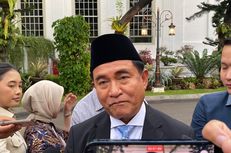
Yusril on Gibran's Effort to Validate Diploma in PTUN: It's Pointless, MA Decision is Final
-
News
-
2 minutes ago
This article was translated by AI. Read the original article on Kompas.com. See Original

The constitution serves as the highest legal source and as an instrument to regulate the distribution and separation of power.
It also functions as a tool of social control and must be able to respond to changes in the times.
Not only is power limited, but citizens’ rights are also protected through the constitution.
The UUD 1945 provides the framework for protecting human rights and citizens’ freedoms as part of the rule of law principle.
The presence of the UUD 1945 is actually close to our daily lives. When we talk about citizens’ rights, education, freedom, governance, and the relationship between society and the state, all these cannot be separated from the constitutional framework.
The constitution does not stand alone. It is part of Indonesia’s journey in building an independent and sovereign state.
The UUD 1945 is regarded as a national document containing fundamental agreements concerning politics, law, education, culture, economy, welfare, as well as the state’s objectives. The constitution also serves as a national identity and symbol of unity.
For this reason, the UUD 1945 should not only be understood as a set of articles. We need to see it as the fundamental agreement on how communal life should be conducted.
This understanding deepens when we consider the relationship between the Preamble and the articles of the UUD 1945. Both constitute a unified constitutional norm.
Although the Preamble has a higher level of abstraction as it contains the nation’s ideals and goals, it is inseparable from the constitutional articles that serve as legal rules.
References: