

MPR: Amran Sulaiman's High School Diploma Valid Despite Name Discrepancy
-
News
-
6 minutes ago
This article was translated by AI. Read the original article on Kompas.com. See Original
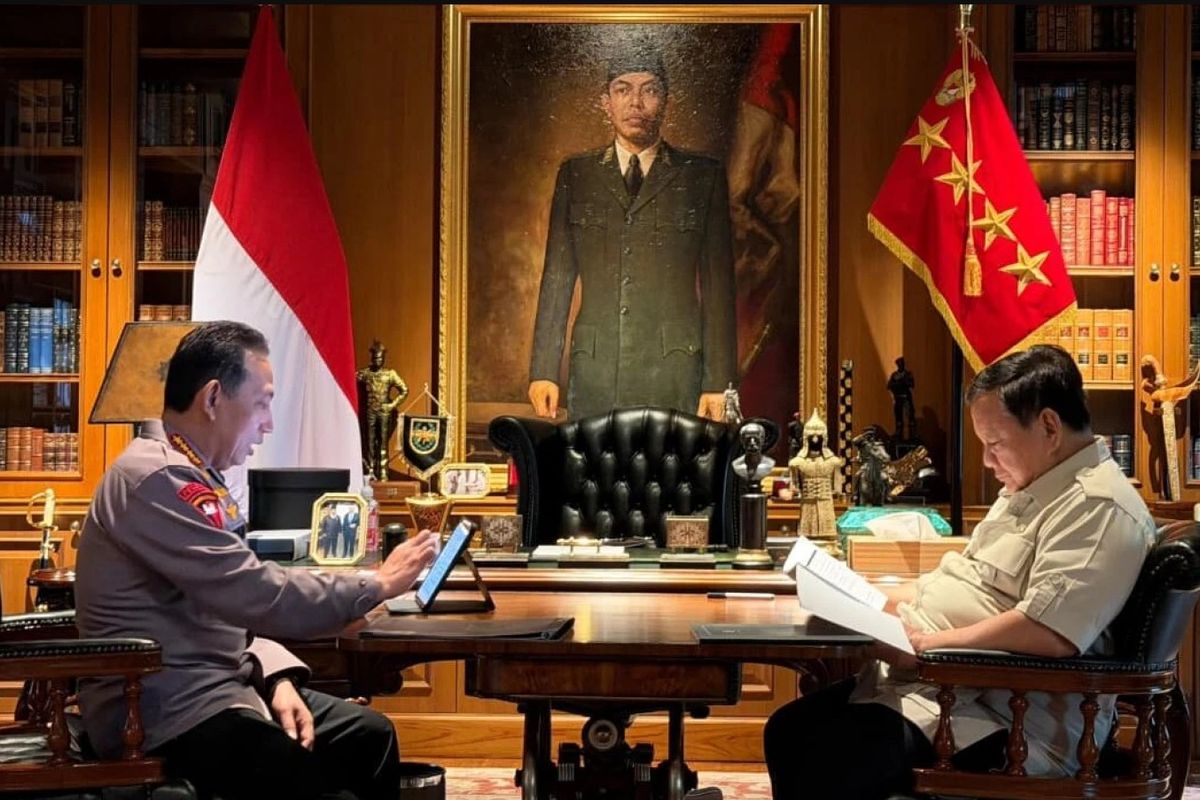
WHAT exactly is the content of the conversation of President Prabowo Subianto allegedly intercepted by several police generals?
This question has garnered increasing public interest after the allegations of interception escalated to accusations of treason.
Calls for the police to release the results of the interception have emerged. The public certainly wants to know what really happened.
Moreover, accusations of treason are no small matter. They concern the continuity of a legitimate government and the legal fate of several individuals suspected of committing crimes against state security.
This curiosity is understandable. In a democratic country, the public has the right to seek explanations regarding alleged abuses of power by state officials.
However, not everything known to investigators must be disclosed to the public. Nor should every piece of evidence in state custody be exhibited to the people.
The issue is not merely whether the results of the interception should be opened, but how far the law permits such disclosure.
One of the functions of criminal procedural law that is often overlooked is to limit state power.
Public attention tends to focus more on the success of authorities in uncovering crimes rather than on the methods used to do so.
In fact, the manner in which the state enforces the law is just as important as the outcomes of that enforcement.
Article 136 of Law Number 20 of 2025 on the Indonesian Criminal Procedure Code (KUHAP) grants investigators the authority to intercept communications for the purpose of investigation.
The implementation of this authority is subject to legal regulations regarding interception.
The phrase for the purposes of investigation carries a limitation on the intended use of this authority.
Interception is not a power that can be used at the discretion of officials.
Similarly, when investigators seize the recordings from interceptions, control over those recordings is intended for the purpose of examining the case, not for investigators to act as if they own the information and can use it at will.
For instance, when police seize an individual’s cell phone, it does not mean all the photos, messages, and conversations stored within can be made public.
The same logic applies to the results of the President’s interception.
Control over the recordings does not automatically grant the authority to publish them.
The power to seize is distinct from the power to broadcast.
In a rule-of-law country, every use of authority must be accountable in its foundation, purpose, and effects.
This includes situations where investigators intend to disclose information obtained from an action whose legality is currently under scrutiny.
KUHAP has introduced significant developments in the system of criminal evidence in Indonesia.
Article 235 paragraphs (3), (4), and (5) emphasize the authenticity and legality of evidence acquisition as conditions for proof. Judges have the authority to assess this.
Evidence declared unauthentic or obtained unlawfully must be excluded in trial proceedings.
This provision reflects the exclusionary rule doctrine, which entails the dismissal of evidence obtained unlawfully.
The state must not only find evidence of a crime but also ensure that this evidence is obtained in accordance with the law.
However, in cases of illegal interception, there are more complex issues at play. At least two legal positions regarding interception results need to be distinguished.
Firstly, recordings used to prove the crime of the person being intercepted.
In this condition, the legality of the interception presents a fundamental issue for accepting the recordings as evidence.
Secondly, recordings used to prove the crime of the individual conducting the interception.
In this construction, the existence of recordings can serve as traces of the crime being investigated.
Similar to counterfeit money in a counterfeiting case, its existence is essential to proving the crime that created it.
This distinction is important. We should not interpret the prohibition on unlawfully obtained evidence as a ban on proving the crimes that generated that evidence.
Nevertheless, lawful seizure does not automatically negate any legal defects in the prior acquisition of the recordings. Judges must still assess authenticity, relevance, legality, and intended use.
This is why debates about the validity of interception results should be resolved through evidentiary mechanisms, not through press conferences.
Accusations of treason increase public scrutiny regarding this interception case.
The public wants to understand how the interception of the President can be linked to crimes against state security.
However, illegal interception and treason are two criminal offenses with different elements. Proving illegal interception does not necessarily prove the occurrence of treason.
Discussions regarding impeachment, changes in leadership, or critiques of the government do not automatically classify as treason.
Prosecutors must prove the elements of the crime charged, the intent behind the actions, and the criminal liability of each defendant.
In this context, caution regarding the conversation recordings becomes crucial.
A phrase that sounds suspicious when heard in isolation may carry a different meaning when considered within the context of the entire conversation.
The relationship between speakers, the situation during the conversation, and their connections to specific actions all contribute to its interpretation.
Furthermore, issues of recording integrity, speaker identity, potential manipulation, and the chain of custody of evidence arise.
In a politically charged atmosphere, a snippet of recording can lead to a faster social conviction than a legal conclusion.
Premature disclosure can shift the burden of proof from the courtroom to public opinion, causing people to be prematurely deemed guilty before being given a chance to defend themselves.
The presumption of innocence is not a protection against crime; it is a safeguard against the possibility of the state wrongly accusing someone of criminal activity.
An issue that nearly gets lost amid calls for the disclosure of interception results is the protection of those targeted by the interception.
If the interception is proven illegal, doesn’t revealing all of its results to the public potentially exacerbate the victim's losses?
The President is indeed a public figure. However, being a public official does not mean losing all personal space.
Not everything discussed by a president is a public matter.
The President's communications may involve diplomatic relations, national defense, security, and government policies that should not yet be publicly disclosed.
Let alone the rights of those communicating with him.
Article 28F of the 1945 Constitution guarantees the right to obtain information. At the same time, Article 28G paragraph (1) guarantees protection of the personal self, dignity, and dignity, and sense of security.
Both of these constitutional guarantees must be placed proportionally.
Article 17 of Law Number 14 of 2008 on Public Information Disclosure allows for exceptions regarding information whose disclosure may obstruct law enforcement, endanger national defense and security, or expose personal secrets.
However, such exceptions must not be exercised arbitrarily.
Article 19 of the same law requires a review of the consequences before any information is declared closed.
Even if the President agrees to disclose the results of the interception against him, that consent does not automatically resolve all legal issues.
There are still third-party rights, state interests, and evidentiary needs that must be considered.
The state has an obligation to protect the victim of interception, not to exacerbate their losses through the dissemination of information previously obtained illegally.
So, where should the results of the interception be disclosed?
The law has provided a forum to reconcile the interests of proof with public openness, namely the courts.
Article 13 of Law Number 48 of 2009 on Judicial Power asserts that court sessions are generally open to the public, unless the law stipulates otherwise.
In the courtroom, prosecutors can present recordings relevant to the accusations.
Defendants and their legal advisors can contest the validity, integrity, or context of such evidence.
Experts may offer explanations while judges assess the evidentiary weight.
There is an opportunity for examination and rebuttal.
Such opportunities are not adequately available in press conferences.
The public generally accepts explanations from parties constructing the case.
Open courts allow the public to monitor the evidentiary process without usurping the judges' role.
However, judicial openness does not mean that everyone is free to obtain, reproduce, and disseminate all evidence.
Legally protected information must still be safeguarded without reducing the defendant’s right to challenge the evidence presented against them.
Judicial openness is intended to facilitate justice supervision, not to allow every individual’s secrets to be consumed by the public.
Rejecting the publication of all interception results does not justify a closed investigation.
The police still have an obligation to provide adequate explanations regarding the developments of the case.
The public has the right to know the framework of the alleged crime, the basis for the challenged authority, allegations of misuse of state facilities, and steps for accountability being pursued.
If it is necessary to disclose certain substantive aspects of the recordings, it must have a legal basis, relevance to the case, and be conducted only as far as is justifiable.
In essence, there is a more fundamental issue than merely knowing the content of the President’s conversations.
How can interception instruments in state control be suspected of being used outside of law enforcement interests?
Why was the oversight mechanism incapable of preventing such alleged deviations? What guarantees do citizens have to avoid similar treatment?
If a head of state’s communication can be allegedly intercepted illegally, the public should question how sufficient the legal protections are for ordinary citizens’ communications.
That is where the true public interest lies.
Therefore, open the interception case transparently, clearly explain the legal framework, and present relevant evidence in court.
Allow the public to oversee how the law works.
However, there is no need to disclose all the results of the interception merely to satisfy public curiosity.
It is truly ironic that a state investigating privacy violations is repeating the violations it seeks to adjudicate.
Ultimately, the rule of law is not only tested by its courage to uncover crimes but also by its ability to restrain itself from breaking the law while exposing those crimes.