
Police Asked to Trace Data Flow from President Prabowo's Wiretap
-
News
-
1 minute ago
This article was translated by AI. Read the original article on Kompas.com. See Original
JAKARTA, KOMPAS.com - The designation of former National Police Chief General Listyo Sigit Prabowo and five other police officers as suspects in an alleged conspiracy against President Prabowo Subianto raises several legal questions.
Police stated that the alleged conspiracy originated from a conspiracy that continued with a meeting to map influential figures, analyze the political situation, and included wiretapping and surveillance.
This series of actions now forms the basis for investigators to establish the suspicion of preparations for a conspiracy.
However, the activities of mapping influential figures and gathering information raise questions about the boundary between intelligence activities and criminal conduct.
Furthermore, the strength of various physical and electronic evidence must be assessed for its relevance to the alleged conspiracy.
So, has the case construction presented by police met the elements of the crime of conspiracy?
How strong is the evidence held by investigators to substantiate the allegations?
National Police Criminal Investigation Agency Chief Commissioner Asep Safrudin announced the appointment of six suspects in the alleged conspiracy case on Monday (23/11/2026).
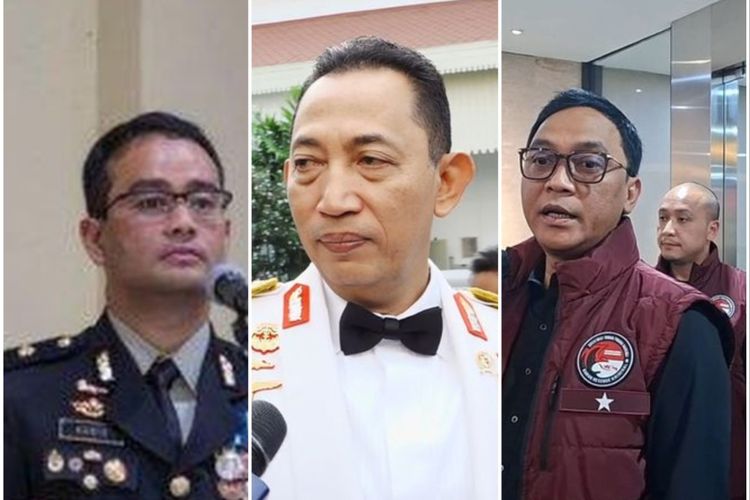
They are Listyo Sigit Prabowo, Inspector General Slamet Uliandi, Inspector General Eko Hadi Santoso, Inspector General Ahrie Sonta Nasution, Brigadier General Tedjo Kusumo, and Commissioner Iman Imanuddin.
“Investigators have named six individuals as suspects in the alleged conspiracy crime,” Asep said at a press conference at National Police Headquarters.
According to Asep, the case began from a conspiracy allegedly conducted by the suspects.
On October 3, 2024, before Prabowo was inaugurated as president, Slamet Uliandi is said to have led a meeting attended by Eko Hadi Santoso, Ahrie Sonta Nasution, and Tedjo Kusumo.
In that meeting, they discussed various topics, ranging from government direction, influential figure mapping, crisis analysis, government policies, a prospective National Police Chief, to the political crisis of 1998 that led to President Suharto's resignation.
Police suspect that this meeting was part of the preparations for the conspiracy.
One action mentioned to have followed was the wiretapping of several figures.
“The results of the wiretapping were followed up with surveillance activities by suspect TK (Tedjo Kusumo) under the orders of suspect ASN (Ahrie Sonta Nasution) against several state officials, heads of state institutions, and other political figures,” Asep stated.
The disclosure of this case construction raises the issue of the boundary between political analysis or intelligence activities and conspiracy criminal acts.
Meetings discussing political situations, mapping influential figures, and analyzing governance cannot be categorically labeled as conspiratorial to attack or topple the government.
Criminal law expert from Trisakti University, Abdul Fickar Hadjar, states that Article 160 of the Indonesian Penal Code defines conspiracy as the intent to conduct an attack that has been manifested through preparations for such acts.
According to Fickar, the forms of preparation can include planning an attack, gathering weapons or logistics, training, and recruiting participants.
In the case of Listyo Sigit, Fickar views the series of meetings, one of whose conclusions was wiretapping, as interpreted as preparatory actions for carrying out a conspiracy.
“The series of meetings that concluded with wiretapping is interpreted as preparatory actions for conspiracy,” Fickar told Kompas.com on Tuesday (24/11/2026).
However, this interpretation needs to be tested by examining the relationship between the meetings, the wiretapping, and the alleged attack objectives.
Information gathering activities do not automatically constitute conspiracy preparations unless proved directed towards realizing an attack as defined in criminal terms.
Professor of Law at Al-Azhar Indonesia University Suparji Ahmad also cautions that the application of conspiracy laws should not be overly broad beyond the statutory definitions.
He noted that Article 160 of the National Penal Code defines conspiracy as the intent to carry out an attack that has been realized through preparations for such actions.
Meanwhile, Article 191 addresses conspiracy against the President and/or Vice President, while Article 193 concerns conspiracy aimed at overthrowing the government.
Article 196 also regulates wicked agreements to commit conspiracy offenses.
“This means investigators must prove intent, purpose, concrete actions, and the involvement of each suspect,” Suparji told Kompas.com on Tuesday.
He contends that meetings discussing political developments, influential figure mapping, or analyzing future governance do not automatically constitute conspiracy.
According to Suparji, investigators must establish the existence of a specific objective and real connection between the actions taken and the alleged attack on the President or attempts to unlawfully overthrow the government.
“The existence of funding, organizing demonstrations, or harsh criticism of the government does not alone satisfy the elements of conspiracy,” he stated.
Suparji emphasized that preparing constitutional changes through lawful mechanisms cannot be criminalized as conspiracy.
In addition to evaluating the series of actions taken by the suspects, Suparji highlights the timing of the alleged actions that serve as the basis for the investigation.
The meeting cited as the start of the case construction occurred on October 3, 2024, before Prabowo was inaugurated as President on October 20, 2024.
Meanwhile, the National Penal Code took effect on January 2, 2026.
According to Suparji, the alleged actions occurring in 2024 must be assessed based on the laws in force at the time of the actions, considering transitional provisions and any more favorable terms for perpetrators.
“The alleged planning that began before President Prabowo’s inauguration on October 20, 2024, requires careful legal examination,” he said.
Besides the case construction, the strength of the evidence is also an important aspect that needs to be examined in the legal process.
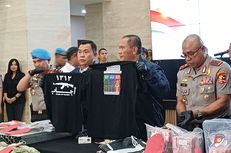
The police have stated that there are several pieces of physical evidence, including shirts and flags, as well as electronic evidence.
The existence of these items raises questions about their relevance to the conspiracy allegations.
T-shirts, flags, and electronic devices need to be assessed based on context, intended use, and their relationship to the alleged actions.
Furthermore, electronic evidence cannot simply be presented through confiscated devices.
The content of the data, communications, and usage context need to be examined to ensure their connection to the alleged conspiracy and preparations.
Suparji asserted that investigators need to present a clear evidentiary construction, including communications, funding flows, instructions, digital evidence, and each individual's concrete involvement.
“Investigators need to show the evidentiary construction that can be tested, including communications, funding flows, instructions, digital evidence, and each person's concrete involvement,” he stated.
According to Suparji, the alleged involvement of certain parties in mobilizing or utilizing demonstrations must also be substantiated through legal facts.
Funding or organizing actions do not inherently indicate the commission of conspiracy offenses.
Suparji also cautions that the handling of conspiracy cases should not ensnare movements that are genuinely organic.
He stated that demonstrations, government criticism, and the expression of aspirations are constitutional rights of citizens guaranteed by Article 28E Paragraph (3) of the 1945 Constitution and Law Number 9 of 1998.
Therefore, he argues, it is inappropriate to generalize all public demonstration movements as part of conspiracy actions simply because there are allegations of certain parties' involvement in driving or exploiting those actions.
Suparji mentioned that allegations of groups riding on public movements must be proven through legal facts, not merely assumptions or opinions.
In this case, he finds it crucial for investigators to clarify whether there truly exists an organized connection between the alleged wiretapping, mass mobilization, content dissemination, and conspiracy plans.
“Avoid letting genuine public aspirations be caught up in a process of criminalization. Conversely, if there are parties proven to have deliberately infiltrated, provoked, or incited the public to commit criminal acts, their actions must be accountable under the law,” he said.
He emphasized that criticism of the government and demonstrations are not automatically conspiracy.
Law enforcement must distinguish between citizens exercising their constitutional rights and parties proven to have engaged in unlawful actions.
“Criticism is not conspiracy, demonstrations are not conspiracy, and political differences are not conspiracy,” Suparji stated.