
Results of Verification of Sugiono and Amran to Be Presented at MPR Joint Meeting
-
News
-
5 minutes ago
This article was translated by AI. Read the original article on Kompas.com. See Original
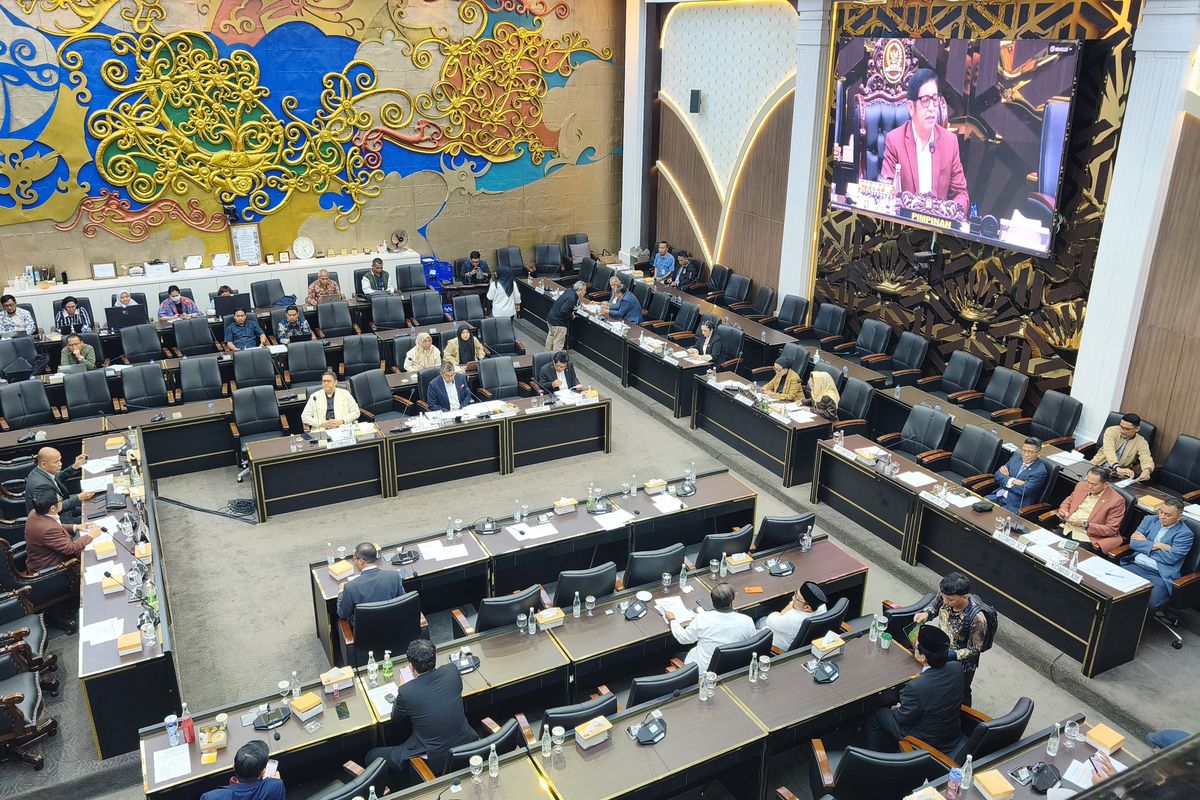
MEMBERS of the People's Representative Council, or parliament, within a parliamentary system are expected to express themselves abundantly.
Etimologically, the term parliament originates from the French word 'parler', meaning to speak—a verb.
In our country, members of the DPR are also referred to as representatives of the people. This is fundamentally true, although recently it has been conflated with the notion that DPR members are representatives of political parties.
Decades ago, Iwan Fals reminded representatives to 'speak up loudly, do not just remain silent.'
The song "Letter to the Representatives" is iconic, embodying the hopes of the people represented by members of the DPR.
Representatives sometimes do speak loudly. Most recently, the public witnessed members from various factions not only talking but also lobbying to initiate a declaration regarding the diploma scandal of Vice President Gibran Rakabuming Raka.
This 'speaking' effort successfully pressured Joko Widodo’s eldest son to resign from his position as vice president.
However, in their eagerness to speak, the members of the DPR sometimes forget to listen.
Neglecting the crucial task of 'listening' has repercussions.
On November 23, 2026, the Constitutional Court ruled that the establishment of Law No. 5 of 2026 concerning the National Police did not meet the provisions as stipulated in the 1945 Constitution, thus it must be declared formally defective.
The Court gave a one-year deadline from the date of the ruling for corrections to be made.
Otherwise, the hasty revision of the National Police Law will be deemed unconstitutional and devoid of binding legal force.
The Court accepted part of the petition from Zulfikar Putra Utama, a researcher at the parliamentary monitoring institution, Indonesia Parliamentary Center (IPC).
He challenged Law No. 5 of 2026 on grounds that it violated the constitution and Law No. 12 of 2011 concerning Legislative Procedure.
The urgency for representatives to listen more was evident from the considerations stated by Constitutional Judge Ridwan Mansyur.
To uphold the principle of transparency, according to the Court, lawmakers must ensure public access to information related to the formation of the law a quo.
Additionally, they must "guarantee maximal and meaningful public participation as realization of Article 22A of the 1945 Constitution,” explained Ridwan (mkri.id, 23/11/2026).
Maximal or broad and meaningful participation from the public is a necessity in the legislative process within the DPR.
This requires a willingness to listen and consider ideas, input, suggestions, and criticisms.
Members of the DPR and the institution itself must legowo (open-minded) to consider the diverse aspects within society.
Therefore, once again quoting Iwan Fals, "Please listen to our voices, and then convey them. Do not hesitate, do not be afraid of obstacles."
This seems to be a consistent issue; on matters as critical as listening, the DPR frequently falters.
Indonesia Corruption Watch (ICW) reported they were not invited to discuss the Asset Forfeiture Bill.
The response from the Legal Commission of the DPR reflected an administrative problem.
"ICW has never offered themselves as a resource person. If we invite them, it would not be fair to other members of the public who have requested to engage but haven't been invited yet. They didn't send any written input," said the Chairman of the DPR's Legal Commission, Habiburokhman (Kompas.com, 20/11/2026).
This issue of not being invited and not proposing engagement, as mentioned by ICW and DPR, is not merely an administrative matter but highlights the disconnect between political organizations (parties and the DPR) and civil society.
Both are constrained by high-status concerns.
Law No. 5 of 2026 concerning the National Police was passed on June 9, 2026. This is a revised law on the National Police, marking another amendment since Law No. 2 of 2002 was introduced.
The formation of Law No. 5 of 2026 was remarkably swift. The DPR initiated the bill on May 20, requiring just three weeks for the DPR to pass the revised National Police Law.
Looking back, this revision responded to recommendations from the Police Reform Acceleration Commission (KPRP) delivered to President Prabowo on May 6, 2026.
This means that the law was finalized within 33 days from the time the recommendations were made by the Commission led by Jimly Asshiddiqie.
The legislative process for Law No. 5 of 2026 was quicker than that of the capital city relocation law during Joko Widodo's era.
From the time President Joko Widodo sent the letter on September 19, 2021, the draft bill on the new capital was approved as law on January 18, 2022, taking approximately 3.5 months.
Due to its speed, questions about meaningful public participation in the formation of Law No. 5 of 2026 have also arisen.
According to the Chairman of the DPR's Legal Commission, Habiburokhman, the legislative process for Law No. 5 of 2026 was undertaken through a lengthy approach, involving various elements of society, academics, professional organizations, and student groups.
The DPR's Legal Commission claims to have held at least 12 public hearings, visited various regions, invited legal experts and civil society groups, and received over a hundred written inputs from the public.
If we dissect what content and substance were added in Law No. 5 of 2026, we would engage in an intense debate.
One positive point mentioned is in Article 32A. Paragraph 1 of this article states, "In the organization and development of professional education, the National Police must create an educational curriculum that includes provisions for the protection of human rights, democracy, and the application of humanitarian principles in every police action".
The obligation to develop a curriculum that addresses human rights, democracy, and humanism signifies progress.
Moreover, Article 19 paragraph 1 was amended to read, "In carrying out their duties and authority, members of the National Police must always act based on legal norms and adhere to religious norms, propriety, ethics, and uphold human rights".
Subsequently, Article 19 paragraph 2 states, "In emergency situations that threaten personal safety, life, and/or public interest while executing their duties and authority, members of the National Police may take necessary actions proportionate to the threat and minimally cause harm to others."
In addition to this, there are also “benefits” for police members, increasing the pension age to 56 years.
Moreover, police members who are 57 years old when this law comes into effect will have their retirement age extended until they reach 59 years old.
Police members who will turn 58 this year (2026) may also have their retirement extended until they reach 59 years of age.
Article 30 paragraph 5 has also been revised to specify: enlisted personnel and non-commissioned officers’ maximum retirement age is 59 years; while first lieutenants, middle-ranking officers, and high-ranking officers have a maximum retirement age of 60 years.
Specifically for four-star generals, the maximum retirement age is 60 years but can be extended by one year based on needs determined by Presidential Decree.
All materials and substantive results from the revision of Law No. 5 of 2026 could be rendered void or annulled if the legislative body does not make corrections within one year from the date the ruling was read by the Constitutional Court. The revoked articles will be reinstated.
Legislative output from the DPR has been sluggish. In 2025, 52 draft laws entered the National Legislative Program.
The DPR claims to have completed 21 draft laws. However, according to PSHK records, by the end of the session on December 9, 2025, only 9 draft laws were enacted into law.
The year 2025 was a grim year in the history of the DPR. In late August 2025, a massive demonstration erupted over the housing allowance for DPR members reaching Rp 50 million per month.
This facility was ultimately canceled even though funds that had already been disbursed since October 2024 were not returned to the state.
Moreover, there was an incident involving a DPR member speaking crudely and lacking empathy, which incited public outrage. The DPR has continuously faced various problems.
Nevertheless, every day is a learning opportunity. The incidents that occurred at the end of August 2025 and the Constitutional Court's ruling regarding the formation of Law No. 5 of 2026 being formally defective are too important to overlook.