

National Police: Brigadier General Tedjo Kusumo Monitors Several Police Chief Candidates and Palace Insiders
-
News
-
2 minutes ago
This article was translated by AI. Read the original article on Kompas.com. See Original
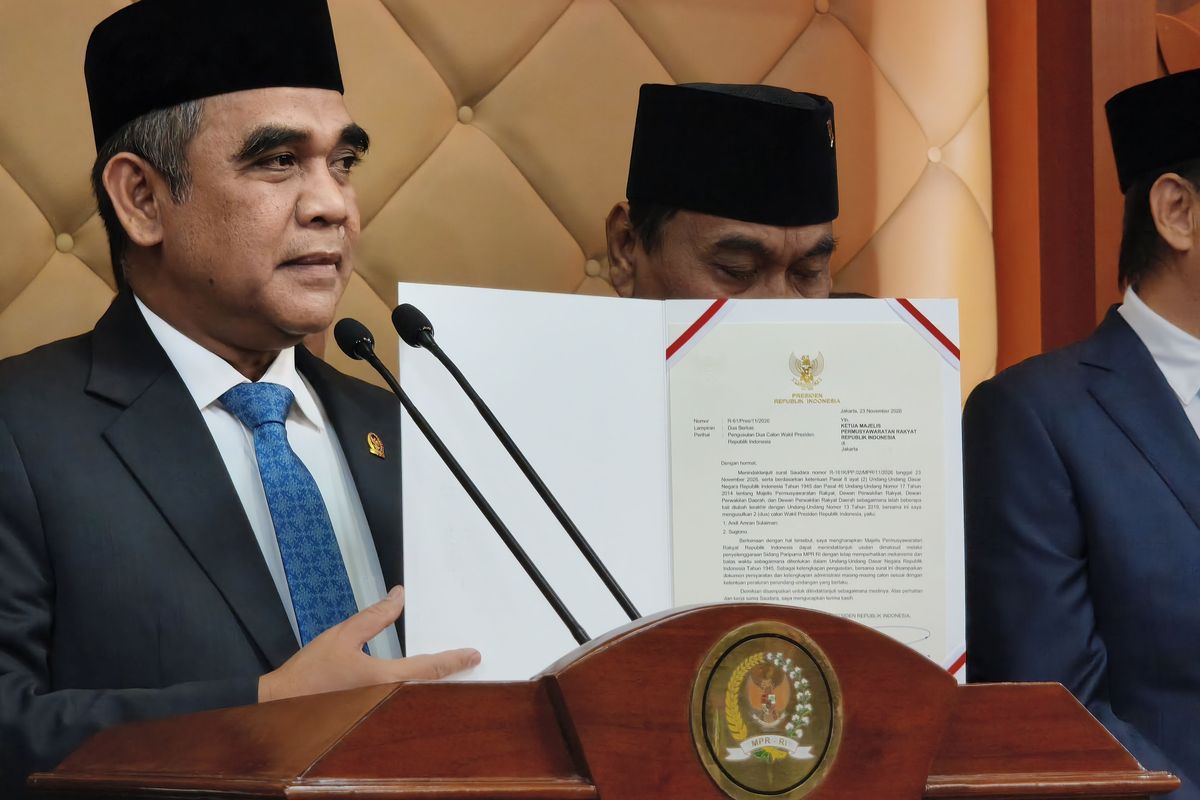
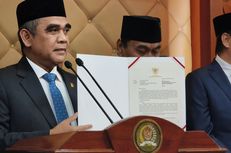
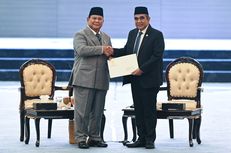
MONDAY afternoon, November 23, 2026, President Prabowo Subianto arrived alone at Senayan. He brought history with him. A letter containing two names in his hand.
Andi Amran Sulaiman and Sugiono. The letter is brief, but its significance is profound. It closes one chapter of uncertainty while opening a more decisive one.
Now, the ball is in the hands of the People’s Consultative Assembly (MPR). The Constitution assigns us a task that sounds simple but carries a heavy weight: to choose one from two.
The one elected will not just fill an empty seat. He will be the answer to a bigger question: where will this government take the trust of its people?
As a member of the MPR and chairman of the Regional Representative Council (DPD), who is intimately involved with the realities in the villages, I wish to weigh these two names openly.
This is not to compare individuals, but to assess the needs of the times.
The 1945 Constitution merely mentions the vice president as the president’s assistant.
It is brief, nearly without details. But our history teaches us that a strong vice president is not the one with the widest authority, but the one most deeply rooted among the people.
Today, the new vice president bears an unwritten task not stipulated in any article: to restore the people’s trust in the government.
A change partway through always leaves questions. The public wants to know: is this merely a change of personnel or also a change in direction?
Public trust is like a granary. It is filled grain by grain, but can be emptied overnight.
It is not built through billboards and speeches, but through tangible evidence felt through affordable prices, upheld law, and a government present when called upon.
Thus, the measure of choosing a vice president today is not who is closest to power.
The measure is who is most capable of filling that granary of trust.
I want to start with an honest appreciation for Mr. Sugiono. He represents a new generation of national leadership.
Mr. Sugi is a fighter, young, loyal, and tested in safeguarding the President’s trust.
At a relatively young age, he has already been entrusted with strategic tasks in both government and the party.
His presence on this list is good news for our political regeneration.
A healthy nation prepares leaders before they are needed. Whoever the outcome, Sugiono’s name is a future asset that should be nurtured, not abandoned.
However, choosing a vice president for the remainder of the 2024–2029 term is a matter for today. And today, in my view, this republic needs something different.
As a regional representative, I must be honest about what I see on the ground.
This republic today needs a vice president with calloused hands, accustomed to the fields, and who knows the exact scent of the sweat of the people struggling on the streets and at the edges of the rice fields.
That figure, in my assessment, is Andi Amran Sulaiman.
Amran has filled the granary of the people’s trust. He has planted seeds one by one.
With outstanding performance. The food self-sufficiency target set by the President was achieved much quicker than anticipated.
Throughout 2025, not a single permit for medium rice imports was issued.
The government’s rice reserves reached five million tons, the highest level since the republic was established, to the point where Bulog’s warehouses became full and additional storage had to be rented.
For mothers in the markets and farmers in the villages, this is not just a statistic. This is security.
At the national level, this food self-sufficiency is another form of national resilience.
As countries around the world are haunted by supply chain disruptions due to political upheavals and climate change, we are thankful to be more at ease with the availability of supplies and stocks domestically.
The second piece of evidence lies in his courage. Amran works without a veil. He is unafraid to expose hundreds of brands of mixed rice that have long deceived consumers.
He has brought fertilizer counterfeiters to justice, as well as those selling land in fertilizer packaging, defrauding farmers out of trillions of rupiah.
Thousands of permits for unscrupulous fertilizer retailers have been revoked. He even cleaned up his own house at the Ministry of Agriculture. Those who play will be dealt with strictly.
The third piece of evidence lies in his listening ears. Amran opened a public complaint channel and followed up on reports from students about scarce fertilizers and illegal onions.
Hundreds of complaints have been submitted and verified directly in the field. This is the face of a state that listens, is present, and does not bow to mafias.
These three pieces of evidence converge at a crucial point for the republic: matters of sustenance. The most basic needs of human beings.
Food is the heart of the Asta Cita, and Amran stands right at that heart.
He has revived the spirit of Article 33 of the 1945 Constitution, recognizing that branches of production which dominate people's livelihoods should be controlled by the state for the prosperity of the people, not for a handful of rent-seekers. This is the tangible manifestation of Indonesia First.
I do not close my eyes. There are still those who doubt the self-sufficiency figures.
Such doubts are legitimate in a democracy and should be answered with open and verifiable data.
A strong trust indeed must arise from transparency, not from unilateral claims.
That is why I have high hopes for Mr. Amran. Not because of his regional background, but because of the direction and ideals of the nation.
In the national leadership system, choosing the right person is only half the journey.
The other half is ensuring trust in that figure translates into trust in the system.
Because individuals may change, but a good system will continue to function. For that, I offer four notes.
First, a vice president with a clear mandate. The vice president is not a spare tire. The vice president is not a decoration of democracy. As I wrote in a previous article earlier.
The vice president is a force multiplier. Thus, the President can give him concrete mandates.
For instance, leading a cross-ministerial agenda for food sovereignty and rural economy. The people trust a leader whose tasks are clear and whose results can be demanded.
The right vice president expands the President’s reach, fills in the gaps that are unaddressed, and stitches up loose ends.
Second, a bridge between the center and the regions. Our rice fields, cropland, and seas are found in the regions. The elected vice president needs to establish a lasting partnership with the DPD and local governments.
In this way, food policies do not get stuck at the desks of bureaucrats in Jakarta but reach the edges of the rice fields. It must be acknowledged that there has been a distance between the Palace and the people in the regions.
A special assignment for a high-performing vice president can eliminate that distance.
Moreover, every issue that arises in the regions always has implications for trust in the center. Therefore, regional issues are not merely local government problems.
They are shared problems. The center must be present, at the very least through the vice president.
Third, a transparent election within the MPR. I hope the MPR provides space for both candidates to present their ideas openly before the election.
The people have the right to know not only who they are choosing but also why they are choosing him.
Even though they do not participate directly, the voices and tendencies of the people must still pulse in the assembly’s deliberations.
This also serves as public accountability for MPR members entrusted to exercise sovereignty wisely and correctly.
Whoever is chosen, the MPR must carry out the constitutional mandate clearly and with dignity.
Those who lose votes should not lose their honor. Those who win should not lose their humility.
The selection of a vice president is a national agenda. It is not a celebration in Senayan. Therefore, what we uphold is not the vice presidential seat, but the people’s trust in the state.
The seat can change in one session. Trust, once cracked, takes a generation to mend.
So let our choice later emerge from the village to the nation, from food to sovereignty, from the region for Indonesia.