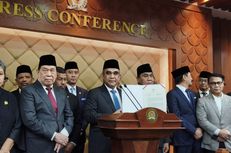

MPR to Visit Schools of Vice Presidential Candidates Amran and Sugiono for Diploma Verification
-
News
-
2 minutes ago
This article was translated by AI. Read the original article on Kompas.com. See Original
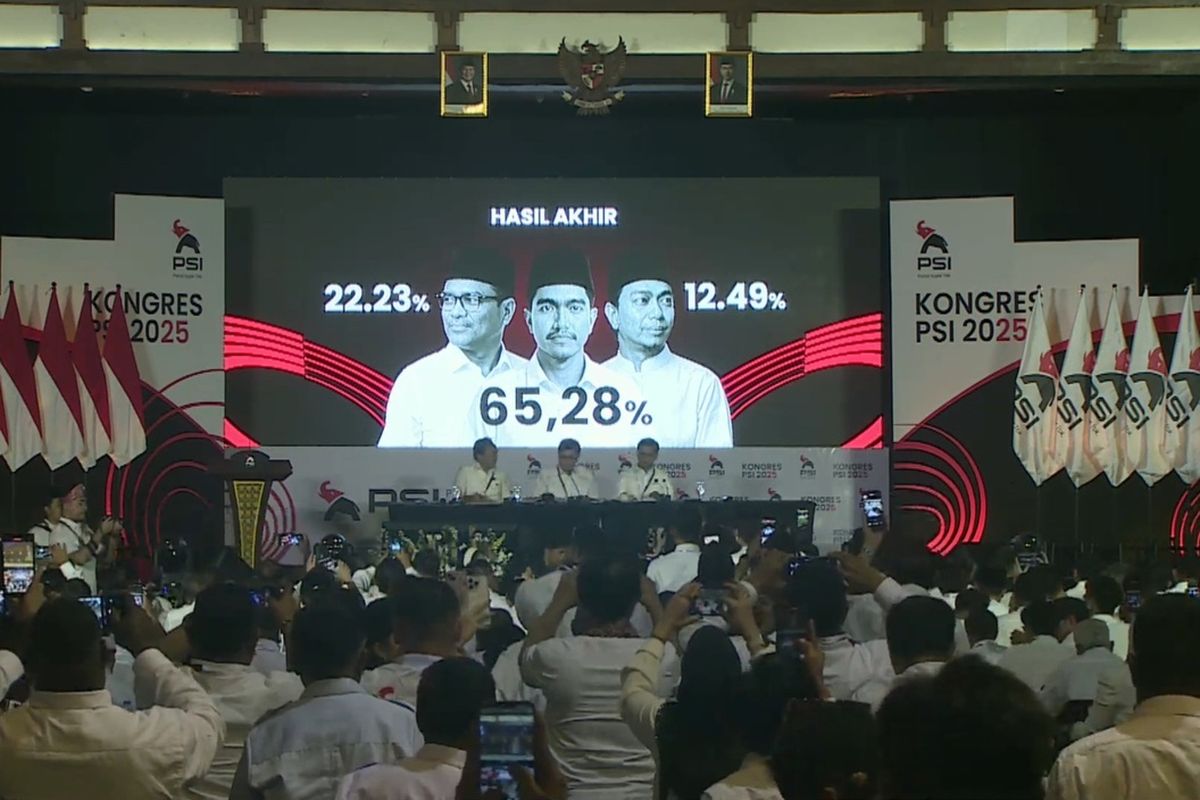
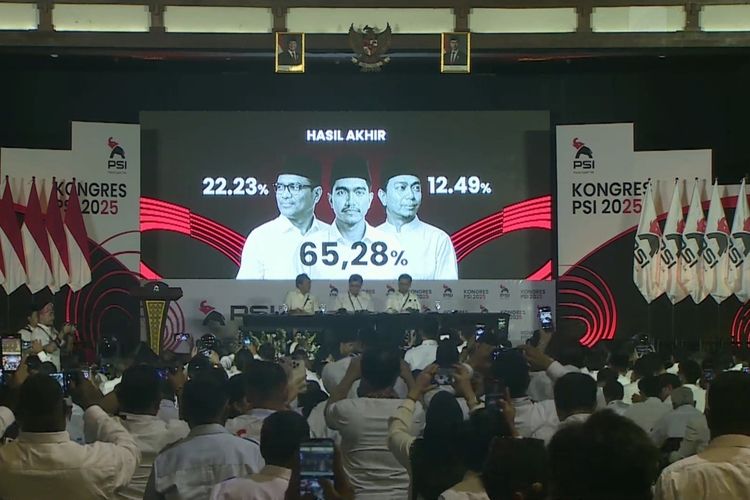
JAKARTA, KOMPAS.com - The resignation of several officials, including Gibran Rakabuming Raka as Vice President, has not deterred the Indonesian Solidarity Party (PSI) from continuing to support President Prabowo Subianto's administration.
Grace Natalie, Secretary of the PSI’s Advisory Council, stated that the party will keep backing Prabowo's policies that prioritize the interests of the people.
On the other hand, the absence of party officials in the cabinet is seen as an ideal time for the party, symbolized by an elephant, to assume the role of opposition.
Political analyst from Sebelas Maret University (UNS), Agus Riewanto, believes this situation is tied to the advantages and disadvantages that PSI must weigh.
So, what are the potential gains or losses for PSI if they choose to stay or not support the government at all?
Agus views that one of the benefits under consideration is the strategic positioning close to power.
Supporting the government means being closer to this position rather than becoming the opposition.
It is not impossible for PSI to still find room to secure several strategic positions, even if they are not at the ministerial level.
"PSI gains proximity to power, allowing them to place officials in commissioner roles, special staff, and government programs," Agus told Kompas.com on Sunday (22/11/2026).
Moreover, he noted that PSI's image is relatively safe, presenting themselves as a youth party pro-stability, not as troublemakers.
"Supporting the government also facilitates PSI in building structures down to the village level and attracting donations. Most importantly, PSI can claim the government's successes as their own, which will be crucial for the 2029 elections," he added.
Conversely, if PSI opts to become the opposition and criticize President Prabowo's policies, the party may lose access to power.
It could also be seen as disloyal by Jokowi-Prabowo voters, risking alienation from the larger coalition.
He admits that being in opposition provides a critical and independent image.
However, this does not yield significant impacts for a small party.
"Without a seat in parliament, criticisms go unheard and yield no seats. For PSI, surviving is a survival strategy," he explained.
Similarly, political analyst from UIN Syarif Hidayatullah Jakarta, Adi Prayitno, believes PSI lacks the DNA to be an opposition party.
So far, PSI does not have a history of such a role.
It is not surprising that PSI will continue to support Prabowo, even in the absence of their officials in the cabinet.
"This is a forced choice for PSI. There is no alternative for them but to befriend the powers that be, as they lack experience to be in opposition. It may be uncomfortable to support while feeling unrecognized in power," Adi stated.
Additionally, Adi acknowledges that being an opposition party is not easy.
Opposition parties must have strong human resources, experience, and resilience outside of power.
According to Adi, this contrasts sharply with PDI-P, which has deep-rooted support over the years.
"PDI-P has proven its mettle through the acidic trials of political life as an opposition. During the New Order, PDI-P was treated discriminatorily. In the SBY era, they became a true opposition party. However, PSI lacks such experiences, even though they have never passed parliamentary thresholds," clarified Adi.
Meanwhile, political analyst and Executive Director of the Indonesian Survey Institute (LSI), Djayadi Hanan, points out that there are consequences of political pressure when political parties take a clear opposition stance—despite the electoral incentives for opposition currently being quite high.
This political pressure makes it difficult for parties to consolidate effectively toward the presidential election.
Djayadi remarked that there is no reason for PSI to take a stand against the government aggressively, as their electoral support tends to strengthen even without being an outright opposition.
"Therefore, for PSI, it is more beneficial to remain in government, even if they can be more critical, especially regarding popular programs or policies seen as struggling with governance and implementation issues like MBG and KDMP," he emphasized.
According to Agus, supporting Prabowo is the most rational and pragmatic choice.
Looking at its roots, PSI is a party nurtured by Jokowi, who is still within the circle of Prabowo's power.
Not to mention, the current challenge concerning the parliamentary threshold that they are still striving to meet.
"Cutting support means cutting access to Jokowi and the administration. PSI has yet to meet the parliamentary threshold in 2024. Therefore, PSI still needs resources, platforms, and power networks to survive until 2029. Supporting the government gives access to these resources," Agus stressed.
In line with this, political communication analyst from Esa Unggul University, Jamiluddin Ritonga, stated that maintaining support for the administration is more advantageous for PSI during the various dynamics shaking the party.
According to him, the party led by Jokowi's youngest son, Kaesang Pangarep, is not strong enough to oppose the government.
"Therefore, as I said, they do not want to show confrontation with the government, in this case, Prabowo. If they do, they will face difficulties themselves," Jamiluddin explained.
Nevertheless, Jamiluddin notes that this commitment does not lead to PSI laying out a single scenario.
PSI continues to prepare a "backstage" while showing its "front stage" to those in power.
He acknowledged that drama is always present in the political world.
In one scenario, PSI will demonstrate its commitment to supporting the government.
However, in another scenario, the party will consistently work on consolidative strategies for the 2029 elections.
This is not without reason.
PSI is currently in a difficult position.
Declaring a different path from President Prabowo Subianto would be too risky and could potentially weaken the party's base.
"It would certainly weaken them. Because PSI is not represented in parliament. If they position themselves as an opposition on the front stage, who would want to listen to PSI, which is not present in parliament?" Jamiluddin remarked.
"However, on the backstage, I am confident they will continue to consolidate to strengthen their position, so that by 2029, both in legislative and presidential elections, they will have greater political power," he added.