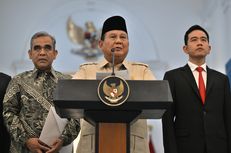


DKPP Hearing: KPU Denies Restrictions on Silon Access to Bawaslu
-
News
-
3 minutes ago
This article was translated by AI. Read the original article on Kompas.com. See Original

A complaint about public services can travel a long way in a short amount of time.
Initially arising from an individual's experience, it is then shared, commented on, cut into short videos, and repackaged with a title designed to incite outrage.
By the time it reaches the decision-makers' table, the complaint may have transformed into a red graph with annotations stating: negative sentiment is on the rise.
This graph warrants attention. But what exactly is it measuring?
The number of citizens experiencing issues, the volume of people discussing it, or the frequency of a story being repeated?
This question becomes increasingly important as artificial intelligence, or AI, is employed to help decode public conversations.
The ability to rapidly process information provides governments with opportunities to be more responsive.
At the same time, misunderstanding the relationship between digital conversations and societal conditions can lead to decisions that appear data-driven but are fundamentally flawed.
Governments need precision to understand when timelines reflect societal wounds, when they amplify attention to a specific event, and when both occur simultaneously.
Negative information has a draw that must be clearly understood.
Research by Robertson and colleagues published in Nature Human Behaviour in 2023 found that using negative words in headlines increased readers' likelihood of clicking on news in their experimental study.
This finding illustrates the connection between language and attention in specific contexts.
It does not, however, prove that people enjoy the suffering of others.
Individuals may follow bad news because they feel threatened, seek certainty, or want to ensure that injustice is not ignored.
Anger can also be an expression of concern. Therefore, interpreting an uptick in negative conversations as a decline in societal character is an oversimplification.
Difficulties arise when such attention is translated into measures of social conditions.
News about a single incident may be discussed by people from various regions who have not directly experienced the issue.
While that conversation holds meaning, it must be articulated before being used as a basis for policy.
Research from the Pew Research Center in 2019 offers insight into this issue.
In a study of adult Twitter users in the United States, the top 10 percent of most active users generated around 80 percent of posts.
This figure represents a snapshot of the country, platform, and moment in time.