When the Wrong is Justified by the Masses
-
News
-
25 minutes ago
This article was translated by AI. Read the original article on Kompas.com. See Original

“Who will eventually occupy the Vice President's seat?”
MAYBE that question now floats amidst the lively discussions of national politics, buzzing on grassroots social media, and serving as the focal point of speculation about the direction of our country's leadership.
Amidst the various names being circulated, the public is not only waiting to see who will take the seat of power but also gauging where the government's compass will point.
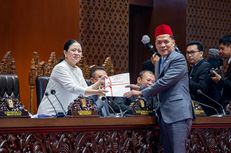
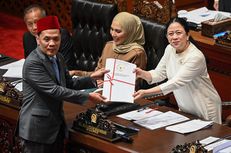
The resignation of Gibran Rakabuming Raka from the position of Vice President of the Republic of Indonesia on November 12, 2026, marked by his submission of a resignation letter directly to the leadership of the People's Consultative Assembly (MPR) of the Republic of Indonesia and accepted by MPR Chairman Ahmad Muzani, opens a new chapter in Indonesia's statehood.
The vacancy of the Vice President's position is not just a change of figure in the power structure, but a moment to reexamine how the state determines the right person to accompany the President in governing.
The MPR has scheduled a plenary session to fill the vacancy of the Vice President through a mechanism of election, appointment, and inauguration on December 9, 2026.
This schedule was postponed by a week from its original plan of December 2, 2026, after considering a proposal from President Prabowo Subianto.
This change also allows the President to consult and consider more thoroughly the two names of candidates that will be submitted to the MPR.
In this dynamic, public discourse has begun to be animated by several names seen as having political closeness and experience working with President Prabowo.
Three names that have emerged in conversations are Ahmad Muzani, Sugiono, and Sufmi Dasco Ahmad.
All three have political track records and institutional relationships with both the Gerindra Party and the Prabowo government.
However, in determining the Vice President, political closeness should not be the only variable considered.
Intellectual capacity, institutional experience, coordination skills, and understanding of public policy complexities must also be benchmarks.
Nominating someone for a public position is certainly a part of the political freedom of the community and the dynamics of democracy.
Political parties, social groups, academics, and various national elements have the space to express their views.
However, constitutionally, the mechanism for filling the Vice President's vacancy is stipulated in Article 8 paragraph (2) of the 1945 Constitution of the Republic of Indonesia.
The President proposes two candidates to the MPR, which then selects one to fill the Vice Presidency until the end of the term.
Thus, this process is not simply a decision of the President, but a constitutional mechanism involving both the President and the MPR.
Academic capacity and intellectual competency become increasingly relevant when discussing the need for national leadership, especially for someone who will occupy the Vice President's position as the “number two” in this republic.
The Vice President must be more than just able to read political winds, maintain coalition harmony, or mediate elite interests.
Moreover, they must have the skills to understand state issues, as this role is not merely an assistant to the President but a vital part of the national leadership architecture that also determines the direction of government administration.
The challenges facing our nation are not simple.
Strengthening the rule of law, bureaucratic reform, improving the quality of legislation, overseeing state budget usage, and ensuring equitable development require leadership that is not only politically savvy but also possesses strong policy reasoning.
This means that popularity cannot substitute for competence. Political victory does not automatically confer the skills to govern a country.
We need a figure who can connect political calculations with policy rationality and translate governmental visions into measurable, effective decisions that favor public interests.
However, technocratic competence should not be narrowed down to academic prowess, a series of degrees, or mere mastery of governance theories.
Academic qualifications do not inherently guarantee someone's success in a public office.
National leadership demands a combination of intellectual intelligence, political maturity, integrity, and social sensitivity.
For a Vice President, the ability to dialogue with political elites must go hand in hand with a willingness to listen to the voices of grassroots communities.
The state does not exist solely in planning documents, statistical figures, and meeting rooms of ministries, but also in the realities of community life that often escape the attention of decision-makers.
Poverty, disparities in public services, education issues, limited access to health care, agrarian conflicts, and regional development gaps cannot be resolved through coordination meetings at the central level alone.
These issues require leadership that is able to absorb aspirations, understand root problems, and transform them into concrete and accountable policies.
Meaningful participation must not stop as a mere slogan in policy formation; it should become the ethos of governance: listening before deciding, involving before establishing, and ensuring that state policies truly address community needs.
We are not looking for a Vice President who can merely win the hearts of elites or charm the public through popularity.
We need someone who can earn the trust of the people and possesses the intellectual capacity and technocratic competence to manage the complexities of state issues.
There is a dimension often overlooked in discussions about the selection of a Vice President, namely the substantial coordinative responsibilities attached to the role.
The Vice President is not merely a ceremonial companion to the President or a substitute when the President is indisposed.
In Indonesia's constitutional practice, several regulatory frameworks also place the Vice President in a strategic position within various councils and national bodies.
First, the Regional Autonomy Council (DPOD).
Based on Law No. 23 of 2014 on Regional Government and Presidential Regulation No. 91 of 2015, the Vice President sits as Chairman of the DPOD.
This institution provides advice to the President concerning regional planning, funding for special autonomy implementation, financial balancing issues between central and regional governments, and matters related to regional governance.
Second, the Coordinating Body for the Acceleration of Special Autonomy Development in Papua.
According to Presidential Regulation No. 121 of 2022, which was amended by Presidential Regulation No. 102 of 2025, the Vice President serves as the Chair of the Papua Steering Body. This institution has strategic responsibilities in synchronization, harmonization, evaluation, and coordination of accelerating development and implementing special autonomy in Papua.
Third, the National Committee for Sharia Economy and Finance (KNEKS).
According to Presidential Regulation No. 28 of 2020, the President serves as Chairman while the Vice President acts as Vice Chairman and Daily Chairman.
This position places the Vice President in charge of coordinating the development of national sharia economy and finance, including strengthening the halal industry and the sharia economic ecosystem.
In Indonesia's constitutional and governmental system, the Vice President (Wapres) is not just tasked with assisting the President as regulated in Article 4 section (2) of the 1945 Constitution.
In various regulatory frameworks, the Wapres is also provided with positions as chair, vice-chair, daily chair, or member within various national coordination bodies.
These positions indicate that the Vice President bears coordinative responsibilities intersecting with strategic governance issues.
Here lies the need for technocratic capacity. The Chairman of DPOD must understand decentralization issues and fiscal relationships between central and regional governments.
The Chairman of the Papua Steering Body must be able to comprehend development complexities, regional disparities, and special autonomy governance.
Meanwhile, the Daily Chairman of KNEKS must understand inter-ministerial coordination and the direction of national economic development policies.
In other words, the Vice President position cannot solely rely on political legitimacy.
This position also demands the capacity to understand cross-sector issues, build inter-institutional coordination, and ensure that government policies can be effectively implemented.
In the midst of political dynamics that sometimes drain governmental energy, the presence of a Vice President with the capacity for political consolidation becomes an essential need.
The government must not continue to be trapped in elite interest competitions, inter-ministerial communication conflicts, or political tug-of-war that hinder the implementation of development agendas.
Political consolidation does not mean homogenizing views or eliminating differences. In a democracy, differences are unavoidable.
However, these differences must be managed through healthy institutional mechanisms so that they do not turn into conflicts that sacrifice public interests.
However, consolidation should not be interpreted as merely securing coalition support or strengthening power stability.
Genuine consolidation must be able to return the government's energy to its primary objectives: improving public services, strengthening the economy, reducing inequality, and ensuring community welfare.
Let not political stability only yield calmness among elites, while grassroots issues remain unresolved.
Stability should be a prerequisite for policy effectiveness, not an end in itself.
In his speech titled: “Moral Responsibility of the Intellectuals,” delivered at the commemoration of the First Alumni Day of the University of Indonesia on June 11, 1957, Mohammad Hatta articulated thoughts that remain relevant in understanding Indonesia's leadership needs: “Knowledgeable leadership is distinctly lacking in our country and society right now.”
This statement from Bung Hatta carries a fundamental message that leadership must not be solely based on popularity, political proximity, or power retention.
The state requires leaders who possess knowledge, capabilities, and moral responsibilities to manage public issues.
This thinking is relevant as Indonesia is determining who will fill the Vice President's position.
We must not get caught up in questions of who is closest to the President or who is the strongest politically.
A more substantive question is who has the capacity to assist the President in managing the complexities of governance and ensuring that state policies truly meet community needs.
Nonetheless, all of these qualifications must still be tested through integrity, track record, independent thinking, and the ability to produce impactful policies for society.
Academic degrees must not replace accountability, just as political proximity must not substitute for competence.
Ultimately, filling the Vice President's position must be a moment to enhance the quality of national leadership.
The President needs a companion who not only maintains political stability but also understands the law, masters government coordination, and has sensitivity to community issues.
More importantly, whoever is eventually selected must understand that the Vice President's position is not just a political honor but a constitutional mandate with a significant responsibility.
The Vice President must assist the President not only in maintaining government stability but also in ensuring that every state policy has direction, legal basis, effectiveness, and aligns with the interests of the people.