

Special Court Police: A Test of Judicial Independence
-
News
-
Just now
This article was translated by AI. Read the original article on Kompas.com. See Original
JAKARTA, KOMPAS.com - The designation of a suspect in a treason case is not a straightforward matter.
Law enforcement must ensure that each element of the crime is fulfilled, from the actions taken to the existence or absence of indications of conspiracy and preparations to carry out the act of treason.
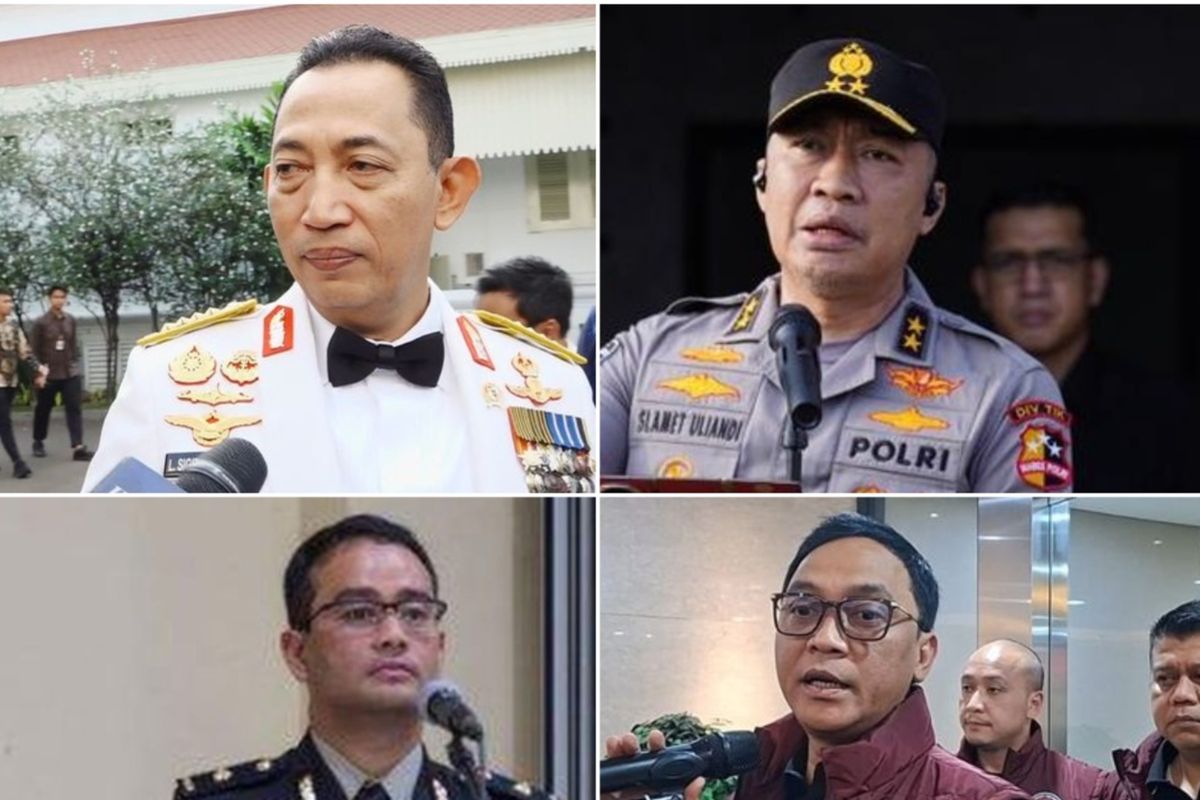
The handling of the case involving the eavesdropping on President Prabowo Subianto by four police generals, including former Chief of Police General Listyo Sigit, is now entering a critical phase.
The police held an internal case exposé on Thursday (19/11/2026), delving into three aspects: conspiracy, preparation, and initial actions.
Subsequently, the police plan to present the case construction to the Attorney General's Office.
Amidst this process, fundamental questions arise regarding the boundary at which an act can be classified as treason.
So, what elements must investigators prove before designating someone as a suspect in a treason case?
Criminal law expert from Trisakti University, Abdul Fickar Hadjar, stated that law enforcement must be able to identify significant elements related to the two crimes, encompassing eavesdropping previously developed in the context of treason.
The police, according to Fickar, must find a correlation between the two, determining whether the eavesdropping leads to plans for assassination, detention, or other actions that would prevent the president from performing his duties.
“The most significant element is the correlation between eavesdropping and efforts that end in actions to assassinate or detain or undertake other actions to incapacitate the president in managing the country,” Fickar told Kompas.com on Thursday (19/11/2026).
Fickar noted that this could involve hostage-taking against the president, through blackmail to force certain actions or inactions.
He explained that there is a burden of proof that investigators need to meet before naming a suspect.
Considering the heavy criminal penalties, investigators need evidence linking the actions to treason, including forms of hostage-taking.
“There are evidential elements connecting to hostage-taking. This evidence can be obtained from witness testimonies, expert statements, documentary evidence, and other indications,” he elaborated.
Regarding the case exposé, he suggested that the process should involve independent experts to sharpen the assembly of evidences supporting the claims.
According to Fickar, it is also crucial to involve public prosecutors.
“Ultimately, it is the prosecutor who will structure a solid indictment supported by convincing evidence of the crime,” Fickar clarified.
Meanwhile, legal expert from Dharma Andalas University, Desi Sommaliagustina, emphasized that treason has specific elements and objectives that must be proven.
Every act of eavesdropping, clandestine information gathering, or actions taken without proper procedure cannot automatically be classified as treason.
Article 191 of Law No. 1 of 2023 regulates treason against the President and/or Vice President with the intent to kill, remove freedom, or incapacitate the President and/or Vice President from governing.
Article 192 governs treason against the Unitary State of the Republic of Indonesia with the intention of transferring part or all of Indonesia's territory to foreign power or separating from the Republic.
Article 193 addresses treason against the government with the intent to overthrow it.
Investigators must prove whether there is intent as articulated in these articles, as well as how the acts committed relate to the objectives deemed illegal by law.
Desi argued that illegal eavesdropping could be a serious offense without necessarily being classified as treason.
Conversely, if an investigation uncovers evidence of an intention to incapacitate the President’s ability to govern or to overthrow the government, then the elements of treason can be examined based on relevant provisions.
Statements made by state officials regarding indications of treason must be considered as part of the investigative development, not as a legal verdict.
This principle aligns with Article 28D paragraph (1) of the 1945 Constitution, which guarantees acknowledgment, protection, and fair legal certainty as well as equal treatment before the law.
The presumption of innocence must also be respected.
Being labeled a suspect does not prove that someone is guilty.
“Proving guilt is the authority of the court through lawful judicial processes,” Desi remarked.
She also cautioned against careless use of the term treason.
It should not evolve into a political instrument to shape public perception before the proof process is complete.
“The state must be firm against security threats, but firmness should not compromise legal precision,” Desi asserted.
Separately, Professor of Law at Al-Azhar University Indonesia, Suparji Ahmad, cautioned against hastily framing the case as treason.
Illegal eavesdropping and treason are two distinct criminal constructs.
Each has different purposes and elements, as stipulated in the Penal Code.
Treason requires proof of a specific intent and actions that satisfy legal criteria.
“It is insufficient to base it solely on the status of the person who was eavesdropped, the identity of the alleged eavesdropper, or the evolving public suspicion,” Suparji explained.
Fickar also clarified that law enforcement must distinguish between illegal eavesdropping and espionage.
Eavesdropping is part of coercive efforts in enforcing criminal law that must have court authorization, similar to searches and seizures.
If eavesdropping is conducted without judicial permission, the act can be classified as illegal.
Espionage involves spying activities.
However, these activities are not automatically deemed criminal if they are carried out without harming others or public interests.
“If conducted without harming others (public interest), it can be permissible,” Fickar noted.
Desi proposes that the reform of the police serves as a critical juncture in this ongoing case.
She argues that the case should not conclude with the designation of suspects.
More importantly, it involves how the internal oversight system operates, how eavesdropping authority is granted, and whether there’s accountability for official orders.
Law No. 2 of 2002 concerning the Indonesian National Police provides a clear foundation for the duties and authorities of the police.
Article 13 outlines three primary tasks of the police: maintaining security and public order, enforcing law, and providing protection, guidance, and service to the community.
“These authorities must be exercised according to law. There is no justification for officials to use the authority granted by the state outside the purposes and limits set by legislation,” Desi elaborated.
If allegations of abuse of authority are proven, accountability should not be limited to field personnel.
Investigators need to unveil the chain of command, the source of orders, the mechanisms for obtaining and using tools, and those who may know or be involved.
Accountability must also be viewed from three dimensions.
First, criminal accountability based on the Penal Code and the ITE Law according to proven elements of acts.
Second, ethical and disciplinary accountability.
Government Regulation No. 2 of 2003 regarding Police Officer Disciplinary Regulations and Police Regulation No. 7 of 2022 related to the Profession Ethical Code and Police Ethics Committee provides a framework for assessing police conduct.
Third, institutional accountability through evaluating oversight systems, protocols for eavesdropping technology use, and control mechanisms over officials’ authorities.
Oversight cannot rely solely on internal mechanisms.
The House of Representatives, through its supervisory role, as well as other relevant supervisory bodies must ensure that law enforcement proceeds objectively and accountably.
“Police reform cannot solely be conducted through changes in personnel or organizational structure. Reform must address power culture, oversight systems, transparency in technology use, and accountability for all official commands,” Desi emphasized.
Additionally, eavesdropping oversight must be established through a system that ensures legality, necessity, proportionality, access restrictions, usage recording, and independent auditing.
It should also be remembered that the right to privacy is not an exclusive right of the President or state officials.
“Journalists, activists, academics, entrepreneurs, civil society organizations, and all citizens have the same constitutional protections. Legal safeguards should apply to everyone without distinction of position or status,” Desi concluded.