
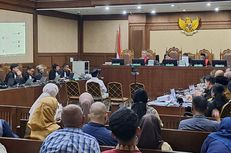
Judge Grills Gus Alex on DPR Members' Money Requests: Why Didn't You Say No?
-
News
-
14 minutes ago
Writer
This article was translated by AI. Read the original article on Kompas.com. See Original
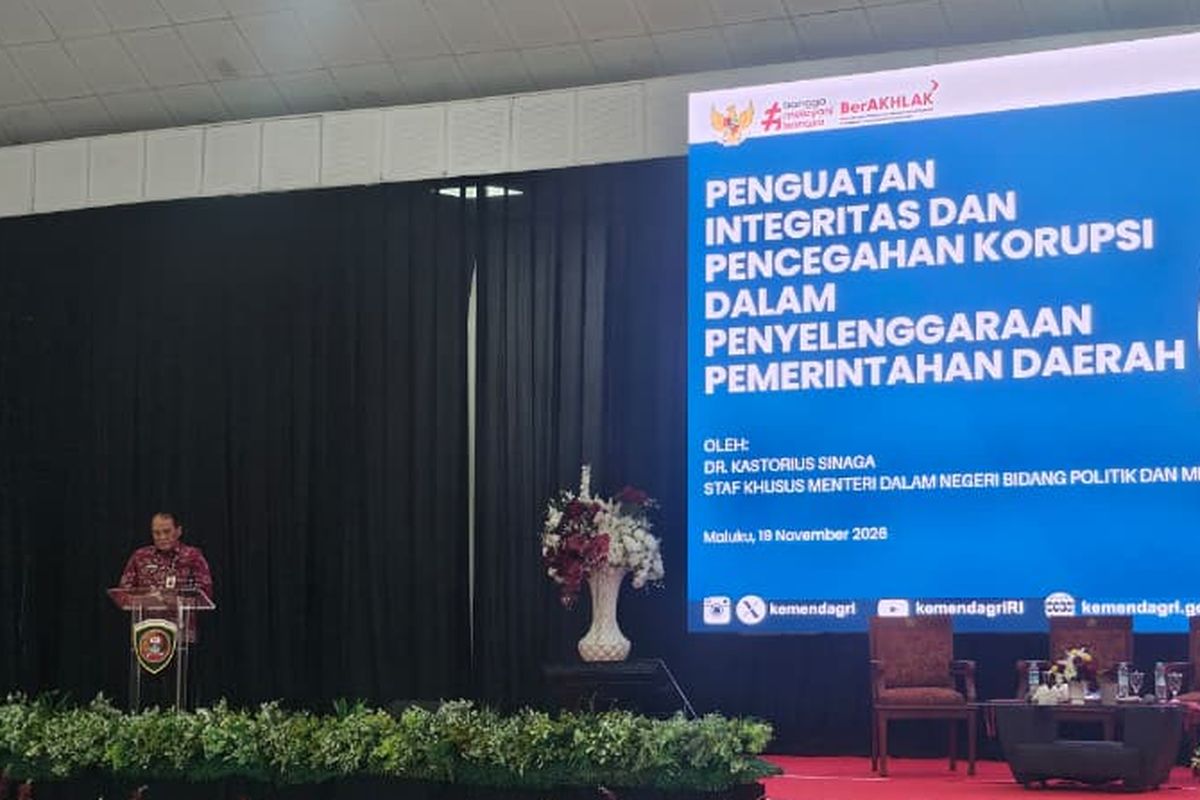
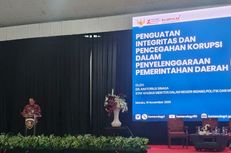
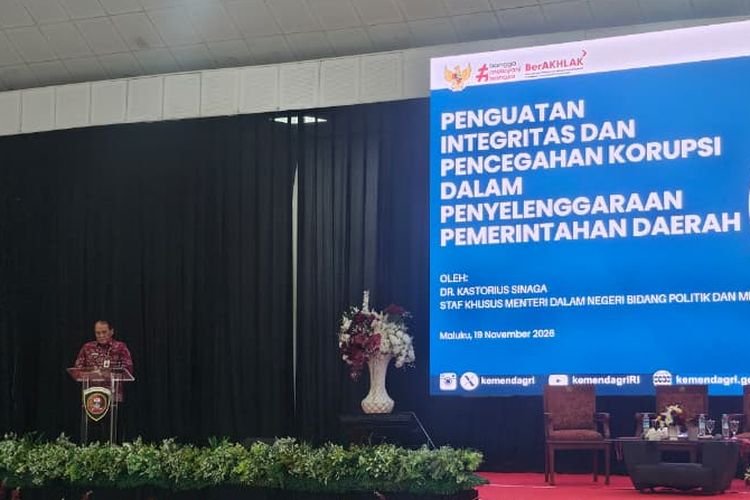
AMBON, KOMPAS.com – The Ministry of Home Affairs (Kemendagri) is strengthening corruption prevention in the regions through the Reinforcement of Integrity and Prevention of Corruption in Local Government Implementation forum in Maluku and North Maluku Province on Thursday (19/11/2026).
"This meeting should serve as a momentum to improve governance, build integrity, and prevent deviations from the outset," said Special Staff to the Minister of Home Affairs for Politics and Media, Kastorius Sinaga, during the event on Thursday.
He detailed that, based on data from the Corruption Eradication Commission (KPK) from 2004 to October 2026, there have been 227 regional heads embroiled in corruption.
Among those, there are 31 governors and vice governors, along with 196 regents, mayors, and their deputies.
Therefore, Kastorius believes that the corruption prevention forum is crucial for bringing together budget planners, procurement managers, internal supervisory officials, and regional legislators at one table with the Kemendagri and other supervisory institutions.
This step aligns with the mandate of Law Number 23 of 2014, which designates Kemendagri as the facilitator and supervisor of local government implementation, as well as its role in the National Strategy for Corruption Prevention through coordination, synchronization, monitoring, and evaluation of prevention actions.
He outlined four root causes of corruption risk in the regions, namely leadership and political factors, policies and governance, supervision and accountability, as well as data and integrity.
High political costs, transactional relationships, and conflicts of interest among regional heads, local parliaments (DPRD), bureaucracy, and providers are identified as gateways for deviations.
Meanwhile, scattered and unintegrated supervisory data hampers early detection.
Risk mapping for 2025–2026 indicates that procurement of goods/services dominates with a proportion of 61.1 percent and a case value of IDR 7.3 billion, followed by public servant management at 27.8 percent and financial management at 11.1 percent.
"Corruption involving regional heads is not an isolated incident, but rather an issue that recurs every year," said Kastorius.
Therefore, prevention is prioritized at the planning stage for procurement, selection of providers, and controlling conflicts of interest. Kastorius emphasized that Kemendagri's stance in this matter has never wavered.
"Minister of Home Affairs Tito Karnavian has never tired of reminding regional heads: avoid corruption, as positions are mandates, not opportunities," he stated.
"He also continues to emphasize the importance of improving the quality of local spending. Every rupiah from the regional budget (APBD) is the people's money that must return to the people in the form of real welfare, while supporting the realization of President Prabowo Subianto's Asta Cita," he added.
To measure the effectiveness of the forum, Kemendagri requests that the outcomes be translated into six concrete actions in the regions: mapping risks in eight priority areas and special sectors; strengthening controls from planning through payment.
Additionally, placing Internal Government Supervisory Apparatus (APIP) as an early warning provider and strategic partner for regional leaders while maintaining their independence; integrating supervisory data and resolving complaints and recommendations; formulating measurable action plans complete with accountability, deadlines, and evidence of completion; and conducting periodic monitoring.
"The joint commitment signed today must not stop at the signing. That commitment must be seen in actions, decisions, and results that can be accounted for," he asserted.
Kastorius added that the success of prevention is not measured by the number of events, but by improvements in governance, reduced risks, resolved root problems, and recovered losses.
He also reminded the role of the DPRD through their legislative, budgeting, and supervisory functions to ensure every allocation from the regional budget (APBD) is transparently prepared and meets the needs of the community.
In closing his presentation, Kastorius emphasized that ultimately, the quality of leadership determines the success of corruption prevention.
"Leaders must be brave enough to open processes, accept oversight, and manage conflicts of interest. Let us ensure that every rupiah from the APBD brings benefits to the people," he concluded.