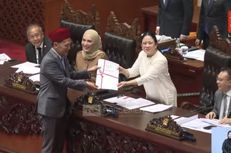


KPK Again Questions BNPB Secretary Rustian as Witness in Disaster Fund Corruption Case
-
News
-
1 minute ago
This article was translated by AI. Read the original article on Kompas.com. See Original

Odin in Norse mythology possesses knowledge and power but ultimately cannot evade the fate of Ragnarok.
Gilgamesh, the king in Mesopotamian lore, wields immense strength but must confront the reality that humans cannot live forever.
These tales are not always completely true by historical standards. Yet, societies continue to recount them because they ascribe meaning to the world they inhabit.
Politics also operates similarly. A leader can acquire an extraordinary image through success, victories, courage, or the ability to defeat adversaries.
Mass media, social media, supporters, and even detractors all contribute to shaping that narrative.
Both praise and criticism, often unwittingly, can amplify the persona being discussed.
Jokowi experienced this process. His supporters recognize his political successes and his capacity to maintain power.
Critics see an overreaching influence, unhealthy political practices, and a shrinking space for opposition.
In both narratives, Jokowi remains the central figure. He is no longer merely a former mayor turned president but a figure perceived as capable of altering the dynamics of national political play.
However, every mythology has its limits. Hercules has weaknesses. Achilles has a vulnerable heel. Gilgamesh does not achieve eternal life.
Figures who seem extraordinary ultimately confront things beyond their control.
In Indonesian politics, that limit becomes apparent as the narrative of Jokowi's strength intersects with the political journey of his son, Gibran Rakabuming Raka.
Gibran rose from mayor of Solo to vice president in a relatively short span.
His candidacy is also not free from the controversy over changing the age requirements for presidential and vice-presidential candidates in the Constitutional Court, then headed by his uncle, Anwar Usman.
For some, Gibran's ascent exemplifies how Jokowi's political influence paved paths for his family.
For others, it is an example of dynastic politics. Whatever the assessment, Gibran eventually assumed office as vice president.
However, the tale does not conclude like a royal saga that successfully passes the throne to its descendants.
On November 12, 2026, Gibran submitted his resignation as vice president, a decision accepted by President Prabowo Subianto.
He resigned before the end of his term. The announcement framed his departure as voluntary, not as a result of an impeachment decision that had concluded.
Here lies the anticlimax. A figure long viewed as having extraordinary political influence could not ensure his son's political longevity.
A father's influence does not automatically become a force that can be inherited.
In politics, support, coalitions, interests, and circumstances can shift much more rapidly than the narratives of someone's powers.
This might be the most intriguing lesson from Jokowi’s political mythology.
He was once perceived as a figure capable of overcoming numerous opponents, reshaping coalition maps, and witnessing powerful individuals punished.
Yet, political power remains bounded. It can build influence but not always dictate how the story concludes.
In mythology, a powerful figure is typically remembered for their greatness.
In politics, they are also remembered for their shortcomings. And, like the figures in ancient tales, Jokowi must ultimately confront the reality that political powers cannot always be inherited.