
Members of Parliament and High School Diplomas
-
News
-
30 minutes ago
This article was translated by AI. Read the original article on Kompas.com. See Original
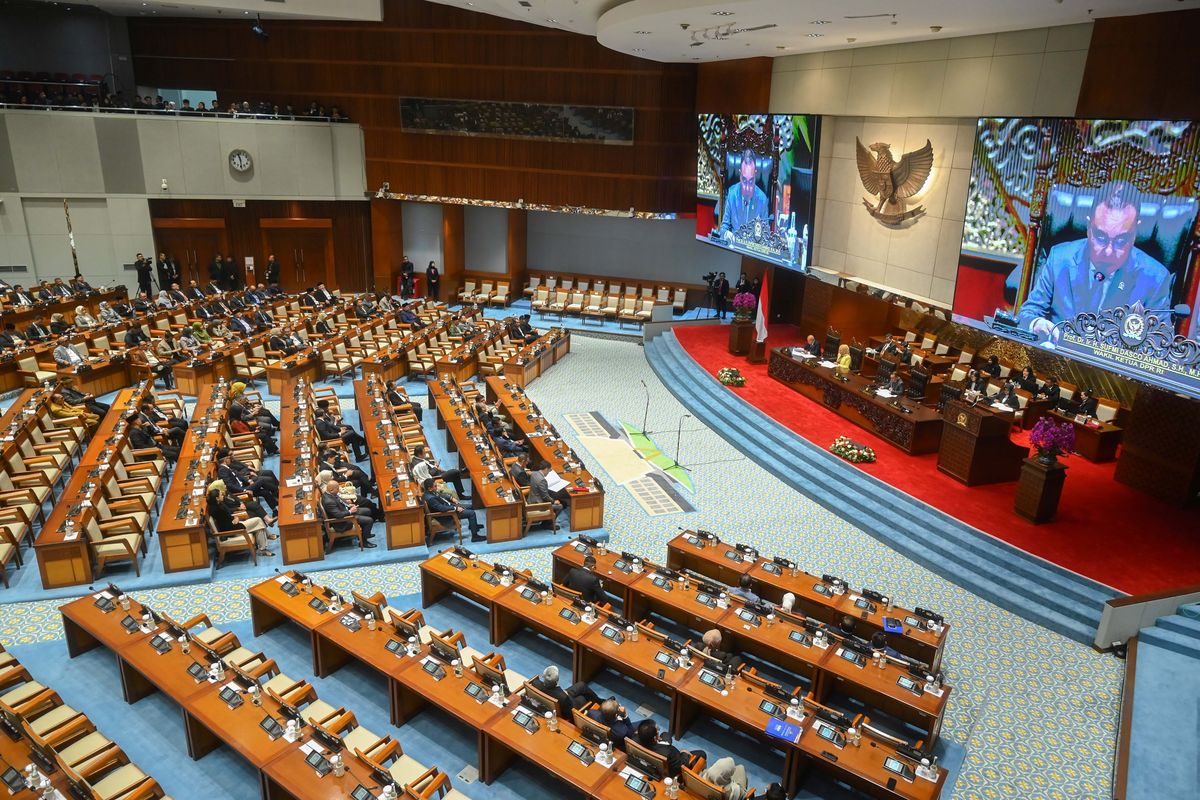
MORNING November 18, 2026, thousands of people are still knocking on Senayan's doors through a petition. They are calling for the diplomas of Members of Parliament to be opened and verified.
As of the night prior, 24,088 people had signed their names. Inside, the response indicates that educational data is available at the General Election Commission (KPU) (CNN Indonesia, November 18, 2026).
However, behind the request to disclose a document lies a longer question: what kind of knowledge is at work in the room where laws are born?
The educational data of Members of Parliament provided by the KPU, based on the composition as of December 2025, records 191 high school graduates, one with a D3 degree, 146 with Bachelor’s degrees, 168 with Master’s degrees, and 74 with Doctorates.
Out of the total 580 members, about 32.9 percent have at most a high school education (CNN Indonesia, November 18, 2026). Almost one-third.
This figure can be seen as a reflection of representation. The parliament is not merely a gathering of degree holders. A farmer has the right to be represented by someone who understands the land and seasons; a laborer has the right to send someone who comprehends the weary body after a night shift.
However, representation is not a mere statistic of the population. The parliament does not need to replicate the educational composition of society to validly voice its interests.
What the public entrusts to their representatives is the ability to advocate for a better life, even when the issues exceed personal experience. This is where the mandate becomes a burden.
The Election Law stipulates a minimum education of high school or equivalent for candidates for the House of Representatives. This is the threshold to enter candidacy (Law No. 7 of 2017, Article 240, paragraph 1 letter e).
This threshold does not inherently answer the competencies needed once someone takes their seat. Entry requirements are not a measure of sufficiency for the entire job.
Drafting laws demands the ability to weigh complex relationships. Changing a tax provision can impact state revenues and the livelihoods of small businesses.
Mining regulations bring together investment and environmental safety. Artificial intelligence regulations raise issues of employment, privacy, and legal liability at the same table.
A single article can be brief, but the implications can last a lifetime.
Higher education should equip someone with reading habits, testing arguments, understanding methods, and recognizing the limits of knowledge.
More limited formal education may leave gaps in preparation for such work. These gaps deserve to be openly discussed, without turning into insults.
High school graduates can continue learning and grow into capable legislators. A doctor may stop learning once the graduation cap is handed back.
The problem lies in how institutions ensure these competencies are present, regardless of who is elected.
India requires election candidates to disclose their highest education level, institution, and year of completion in Form 26. Candidates' profiles and affidavits are accessible through the Indian Election Commission portal.
This information provides voters with material for assessment, even though transparency alone does not guarantee the quality of political decisions (Election Commission of India, Form 26 and Affidavit Portal).
Indonesia needs to move from diploma verification to assessing how work is conducted.
Do lawmakers understand the issues they govern? Do they read the studies provided? Do expert opinions genuinely influence drafts, or are they merely a formality?
The last question touches a deeper wound: a nation may have many educated individuals, but little space for knowledge to shape direction.
In campuses and research institutions, knowledge is accumulated over time, costs, and diligence. It would be disheartening if all that effort ends up as piles of reports, while binding decisions affecting millions are made based on untamed interests.
This risk is not limited to high school graduates. It also lurks around bachelor and doctorate holders who submit their assessments to party interests, funders, or personal gains.
Politics needs knowledge to understand the consequences of its choices. Science requires democratic processes to prevent knowledge from turning into the power of a handful of experts.
The meeting of the two requires humility: representatives must be willing to learn, and experts must be willing to hear experiences not fully captured in models.
“Without facts, we cannot have truth. Without truth, we cannot have trust,” stated Maria Ressa in her Nobel lecture (translation, December 10, 2021).
Thus, the DPR needs to demonstrate a trail of knowledge behind its decisions: the evidence used, the objections considered, and the reasons a choice was made.
Political parties must also be accountable for the competencies of their nominees, beyond popularity and the ability to gain votes.
The public has the right to be represented. They also have the right to receive representatives who are capable of fulfilling their mandates.
In a home, a child may be studying with borrowed books. Their parents hope knowledge will take them further than their own lives.
That hope would be shattered if, years later, the child finds out that in the room where the future is shaped, knowledge is merely asked to wait outside.
Open those diplomas. Then open the doors to knowledge.
Do not let the public finance their children's education while their future is decided by authorities reluctant to learn.