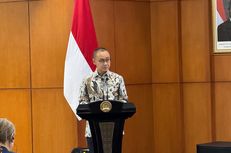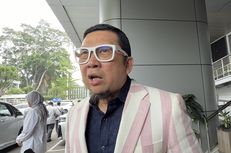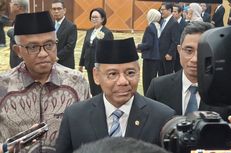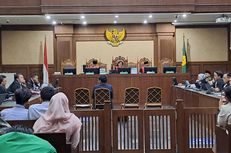
Expert at Yaqut Trial States Additional Hajj Quota Distribution Doesn't Have to Follow 92:8 Scheme
-
News
-
3 minutes ago
This article was translated by AI. Read the original article on Kompas.com. See Original

IN the coming days, President Prabowo will be busy calculating the political implications of selecting a vice presidential candidate to accompany him following the resignation of Gibran Rakabuming Raka on November 12.
At least two vice presidential candidates must be submitted by President Prabowo to the MPR RI in accordance with Article 8 Paragraph (2) of the 1945 Constitution, as well as the MD3 Law.
Although this is a constitutional right entirely within his purview, the two names presented to the MPR RI require thorough consideration by President Prabowo, ensuring that the government's objectives for the next three years can be achieved smoothly, particularly regarding key national policies and programs.
Political parties within the governing coalition tend to take a uniform approach, refraining from nominating candidates from their respective ranks.
There is a sort of political awareness among the parties regarding the sensitivity of proposing names, which could affect the cohesion of the coalition moving forward.
Parties that are too forward in suggesting candidates risk undermining the cohesiveness of the governing coalition.
On the other hand, the parties also recognize President Prabowo's decision-making habitus and political psychology, which tends to be top-down and beyond contention.
Nonetheless, parties within the coalition need to remain attentive to ongoing dynamics and be prepared to provide input should the opportunity arise.
There are three approaches to forecast potential candidates that President Prabowo might propose to the MPR RI.
The first approach is through a political interpolation mechanism by analyzing the vice presidential selection patterns from previous presidents.
The second approach involves examining the idiosyncratic factors inherent in the president.
The third approach focuses on analyzing the current political dynamics and needs.
By applying these three approaches, the potential candidates can be projected.
This projection is crucial as the position and role of the vice president are vital in assisting the administration.
Moreover, the ongoing dynamics will greatly influence the recomposition of power both in the parliament and the cabinet.
The political interpolation approach will scrutinize the methods used by the president in selecting his vice president.
During Soekarno's era, the vice president was chosen by acclamation due to the efforts of both Soekarno and Hatta in fighting for the republic's independence.
They were known as the Dwitunggal, complementing each other: Soekarno as the unity maker and Hatta as the technocrat strong in administrative matters—based on Herbeth Feith's concept.