
PDI-P Hosts Fatmawati Trophy 2026, National Fashion Design Competition
-
News
-
7 minutes ago
This article was translated by AI. Read the original article on Kompas.com. See Original
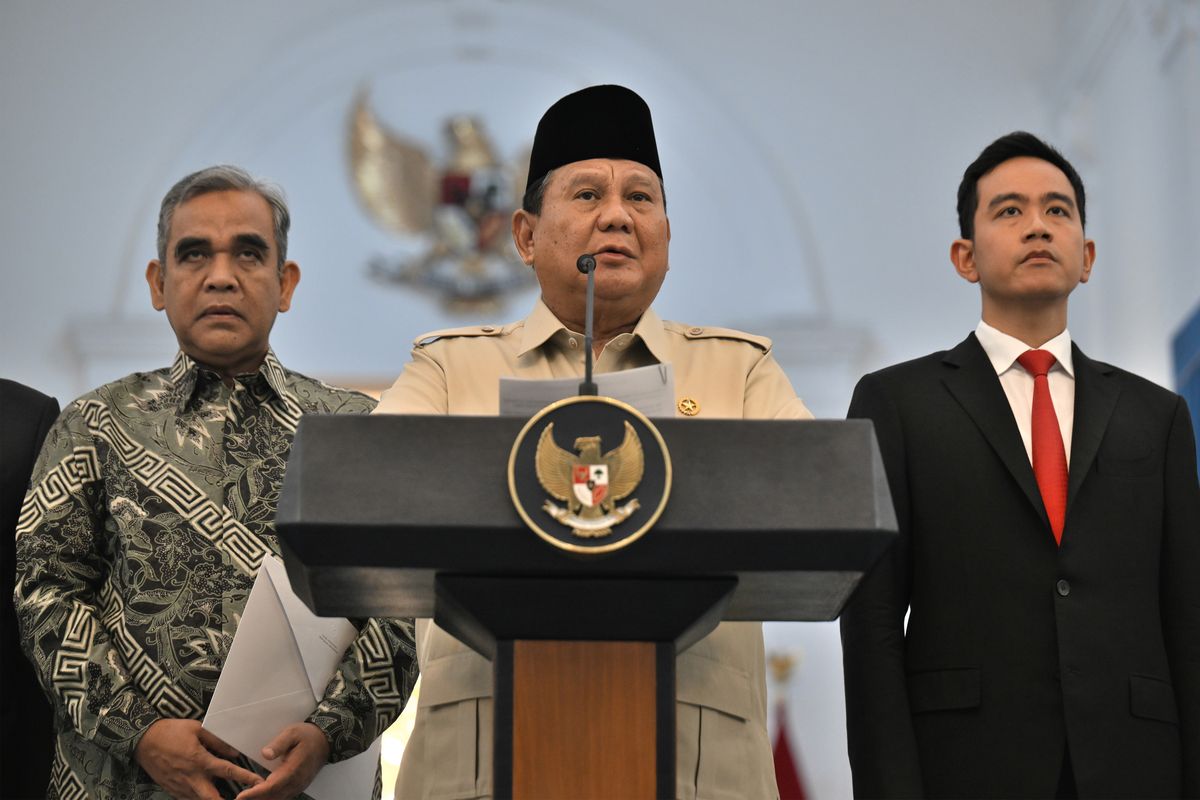
NAMES of potential successors to Gibran Rakabuming as Vice President are being weighed. Discussions are swirling in party meetings and coffee shop conversations.
Several figures are being touted to accompany President Prabowo Subianto. Some are being pushed forward while others quietly hope to be chosen.
Since Gibran Rakabuming Raka stepped down on November 12, the Vice Presidential seat has been vacant, and the constitutional clock is ticking. It must be filled within 60 days.
This seat is not just a second throne; it is a waiting room for history, a place where government direction is weighed and public trust is tested.
Among those frequently mentioned are Sufmi Dasco Ahmad and Puan Maharani, alongside Amran Sulaiman, Agus Harimurti Yudhoyono, Pramono Anung, Ganjar Pranowo, Sultan B. Najamudin, Mahfud MD, Zulkifli Hasan, and Anies Baswedan.
These figures color public discussions before President Prabowo Subianto officially presents two names for the MPR to choose from.
The MPR leadership aims for the new Vice President to be elected and inaugurated by December 2, 2026. The President has 14 days from the MPR's request letter to submit two names.
Article 8 paragraph (2) of the 1945 Constitution is no longer just a written constitutional note but a path that must be taken.
I want to invite us to weigh in on this with a clear mind. It is not about who deserves applause, but what criteria are essential for the Vice President that the country needs.
The role of the Vice President is crucial to assist the President in advancing a development agenda that has faced many challenges in the past two years.
In a presidential system, the Vice President is not the second center of power; they are a force multiplier.
The right Vice President broadens the President's reach, fills in the gaps, and stitches together the loose threads among the center, regions, parliament, and the public.
Choosing the wrong Vice President could become a burden, a source of double interpretations, and even a gravitational center that pulls the political pendulum in another direction.
Therefore, this vacancy must be viewed as a moment. A moment to build trust, grow public support, and assert a unified direction in policy.
A strong government is not enough with just good programs. It needs a leadership partner that the people trust unconditionally and without footnotes.
In 2024, the Prabowo-Gibran package was perceived by the public as a continuity package. Gibran was not merely an individual but a representation of Jokowi and a symbol of past legacies brought into the new government. This is a political fact, not an accusation.
The issue is that symbolic continuity does not always align with policy continuity.
The past two years have demonstrated the opposite. The President is clearly undergoing a massive correction.
Analyzing through the lens of political economics, President Prabowo is often steering a different path from his predecessor's legacy. In fact, it can be seen as the antithesis to past residues. There are at least five indicators.
First, the development paradigm. The previous era prioritized investment and physical infrastructure as the chief focus. Various flagship mega-projects were showcased as performance highlights.
President Prabowo's administration shifts emphasis to people, food, and sovereignty. Free Nutritious Meals, school renovations, people’s schools, Garuda Excellence Schools, food security, and strengthening the people's economy are not mere programs but a philosophical shift. From concrete to humanity. From "building the body to nurturing the soul."
Second, fiscal discipline and legacy projects. Presidential Instruction No. 1 of 2025 regarding state spending efficiency has curtailed room for mega-projects.
Budget allocations for the new capital (IKN) have plummeted sharply, from around IDR 44 trillion in 2024 to about IDR 15 trillion in 2025, as noted by economists.
IKN is not halted, but its positioning is no longer a priority. Strategic national projects are also being evaluated. They are no longer given blank checks.
Third, resource control. Presidential Regulation No. 5 of 2025 on Forest Area Regulation establishes a Task Force involving the Ministry of Defense, TNI, Police, and the Attorney General's Office.
Land in forest areas claimed without valid permits is being reclaimed by the state. The obligation to save export revenues from natural resources has also been tightened, from 30% for three months to 100% for a year.
The message is clear: natural wealth is not a commodity that can be freely controlled by anyone with substantial capital. This resonates with Article 33 of the 1945 Constitution.
Fourth, the governance of state assets. Assignments to state-owned enterprises are gradually being replaced by Danantara, a super holding aimed at managing state assets in a centralized and professional manner.
Where it will lead, we must oversee, but the architecture is clearly different.
Fifth, the state’s position on capital interests. In the political economics map, every policy correction will touch on existing interests.
Concessions are disrupted, rents are cut, permits are revoked, and business networks that thrived under investment-centric regimes are now being organized.
Those interests that are affected will not remain silent. They seek channels, whether through markets, opinions, or politics.
The alleged wiretapping of the Head of State, which is currently in the legal process, reminds us that the interests' movements do not always occur on the surface.
Underground movements can sometimes be larger than those visible. The President's efforts to dismantle transfer pricing and under-invoicing is a glaring indication that their existence has long been eroding the country’s wealth.
The changes in development agenda navigation do not entirely sever ongoing projects. Downstream processing and several old projects with clear benefits to the state continue.
However, the overall direction is clear. The state intends to return as a controller, not merely a facilitator. "Indonesia first!"
Here lies the problem. A government with a firm corrective direction cannot have a leadership partner that is symbolically perceived as a representative of the direction being corrected. Two suns in one sky will produce anomalies.
This is not about names. Names are the President’s prerogative. Choosing one from the two names presented by the President is a political domain of the MPR.
What we need to agree on first are the criteria. Based on policy direction and the need for political stability, I believe there are at least six things that must be fulfilled by the new Vice Presidential figure to replace Gibran.
First, credibility in constitutional and ethical terms. The most recent experience teaches us that questioned legitimacy will undermine stability.
The new Vice President must not only meet the qualifications but must do so without loopholes, eliminating any debates over requirements that drain national energy. This is a valuable lesson for our electoral system.
Second, being in sync with the President. They must align with the President’s policy direction, bringing no personal agenda. Their mindset should not be tainted with competing objectives and must not harbor overshadowing ambitions. The Vice President is a supporter, not a challenger.
Third, understanding the constitutional economy. Asta Cita is the blueprint for national development, and its foundation is Article 33.
The Vice President must be able to translate it into practical work. Through people-centered economics and mutual cooperation, cooperatives, SMEs, farmers, and the state's role in safeguarding production branches that dominate public needs.
Fourth, acting as a political and regional bridge. Stability requires cohesion. They need to be accepted across party lines in the coalition, capable of communicating with parliament, and understanding regional pulses.
We have long thought from the center, yet many national issues originate from the periphery.
Fifth, independence from vested interests. Amidst the crackdown on natural resources and asset management, the Vice President must not operate within the orbit of concessions and rents. Conflicts of interest are enemies of credibility.
Sixth, possessing public trust and the ability to communicate with the people. Trust cannot be mandated. It must be earned through a track record and sincerity in demeanor.
The Vice President should be able to articulate the Asta Cita ideas in coffee shops, markets, and villages.
Conversely, there are three things we do not need: figures propagating the bias of dual centers of power, figures burdened by unfulfilled legitimacy or legal issues, and figures reserved for interests treating positions merely as gateways for concessions.
As part of the MPR, the DPD RI has a duty to ensure this process is conducted accountable. It should not be merely ceremonial.
The MPR has the authority to verify candidate requirements, and this must be truly conducted openly and subject to public scrutiny. A clean process will produce a strong Vice President. A dark process will inherit new doubts.
This nation stands at an intersection rarely traversed. We can choose to debate names until we’re hoarse or weigh our needs until we are clear.
The state’s needs today do not require figures who are loud on stage but rather those who work in the field; those who unite rather than divide; those who strengthen rather than overshadow.
The President needs a Vice President who solidifies policy direction and reinforces public trust even more.