

70 Years Ago, Mohammad Hatta Resigned from the Vice Presidency
-
News
-
6 minutes ago
This article was translated by AI. Read the original article on Kompas.com. See Original
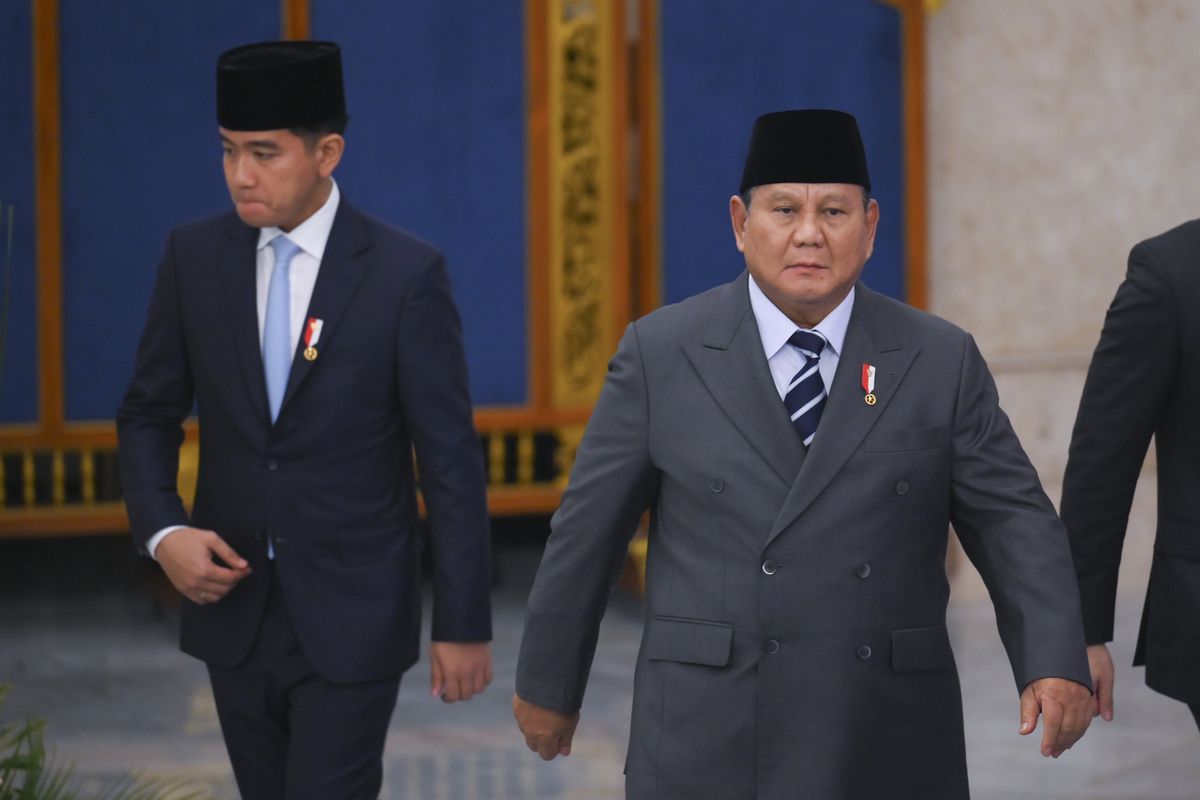
WAVE of public pressure for Vice President Gibran Rakabuming Raka to resign has transformed from mere noise on social media into a serious test of the ethical legitimacy of national leadership.
A wide range of discourses has emerged, from the verification of the validity of nomination administrative documents to fundamental debates concerning state ethics, reigniting sharp discussions in the public sphere.
Behind the complex and technical constitutional debates lies a stark political reality felt acutely by voters: Indonesia's presidential and vice-presidential election system is tightly bound in a joint ticket.
Sociologically and politically, this ticket's binding nature is at the heart of the mandate granted by the public.
According to Article 6A paragraph (1) of the 1945 Constitution, the public is not given the freedom to vote for the president and vice president separately.
Voters enter the polling place and mark a single ballot that combines both figures.
In the 2024 presidential contest, many voters determined their support based on the presence of the vice-presidential candidate—whether due to the representation of the younger generation, a symbol of continuity with previous government programs, or personal electoral appeal.
When this vice-presidential figure is subsequently engulfed in a storm of ethical doubts and legal challenges that undermine their legitimacy, public disappointment becomes unavoidable.
A feeling of entrapment arises among voters: how can a leadership package chosen as a cohesive unit continue to function normally when one part of it suffers from severe legitimacy issues?
Is there anyone willing to defend them fiercely or to even kick them out?
This fundamental irony exposes a significant clash between sociopolitical logic and constitutional legal design in Indonesia.
From a constitutional law perspective, the structure of executive accountability is designed with an individual approach, not collective responsibility.
Article 7A of the 1945 Constitution emphasizes that the impeachment mechanism requires proof of specific legal violations committed by an individual official, such as treason, corruption, bribery, serious crimes, or disgraceful conduct.
Our constitution deliberately does not recognize the principle of collective responsibility that could automatically void a leadership pair simply because one official is proven to have legal defects or ethical violations.
This constitutional design did not arise without deep historical context.
The framers of the 1945 Constitutional amendments prioritized the principles of stability and continuity of governance.
In a presidential system, the President holds the primary executive power, as stated in Article 4 paragraph (1), while the Vice President assists the President.
Therefore, if the Vice President resigns or is impeached by the People’s Consultative Assembly (MPR), the 1945 Constitution provides a safety valve for the President to propose two replacement vice-presidential candidates for selection by the MPR.
From this perspective, the legal collapse of the vice president's position should not entangle or annul the mandate of the President who holds the primary executive power.
A national leadership pair is only deemed void in its entirety when both the President and Vice President are unable to function, resign, or are impeached simultaneously, as regulated in Article 8 paragraph (3).
However, a rigid separation between the logic of constitutional law and sociopolitical realities does not necessarily resolve issues on the ground.
This is where the greatest leadership dilemma currently facing the nation lies.
If political and legal processes allow the vice president to remain in office amid intense public pressure and doubts about their ethical legitimacy, the government led by President Prabowo Subianto risks enduring a prolonged trust deficit.
Every national strategic policy issued by the government is potentially overshadowed by critical questions regarding its legitimacy.
Conversely, if the Vice President is impeached or resigns, the public that elected that pair must accept the reality that the "package" they chose on voting day has transformed midway without re-approval from the voters.
To untangle this knot, handling the issues transparently within formal legal corridors becomes an absolute prerequisite.
Problem-solving must no longer be left hanging in daily political uncertainties or obscured by national stability rhetoric.
Testing the validity of every document and legal accusation in the appropriate judicial bodies, such as Administrative Courts (PTUN) or review processes in the Supreme Court, is a dignified constitutional step.
Only clear, open, and highly-integrity-driven legal proof can provide final certainty about whether the public demands possess a solid legal basis or are merely a fleeting political competition dynamic post-election.
Ultimately, the current political dynamics teach a valuable lesson that healthy democracy requires a harmonious balance between adherence to constitutional text and sensitivity to public morality.
The constitution has indeed crafted a robust fortress to safeguard the stability of executive power, making it resilient against practical political shocks.
However, this legal fortress should not be an escape route to disregard the demands for ethical integrity and moral legitimacy of its leaders.
This nation does not merely need a formally legitimate government on a piece of legal paper, but also yearns for a national leadership that is reputable, free from doubts, and sincerely respected in the hearts of its people.