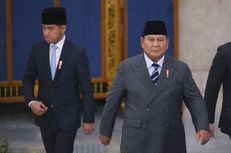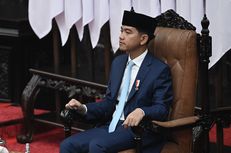


Gibran Exits the Parliament Building Following Meeting with MPR Leadership
-
News
-
2 minutes ago
This article was translated by AI. Read the original article on Kompas.com. See Original
JAKARTA, KOMPAS.com - The issue surrounding Gibran Rakabuming Raka allegedly resigning from his position as Vice President has dominated news in recent days.
However, the 1945 Constitution does not include any terms regarding resignation for either the President or Vice President.
For instance, Article 7A of the 1945 Constitution states that the President and/or Vice President can be dismissed if they are proven to have committed legal violations such as treason against the state, corruption, bribery, other serious crimes, or immoral acts, or if they are proven to no longer meet the qualifications to serve as President and/or Vice President.
"The proposal for the dismissal of the Vice President can be and/or submitted by the People's Representative Council to the People's Consultative Assembly, only after making a request to the Constitutional Court to examine, adjudicate, and decide on the opinion of the People's Representative Council that the President and/or Vice President has committed legal violations in the form of treason against the state, corruption, bribery, other serious crimes, or immoral acts; and/or the opinion that the President and/or Vice President no longer meets the qualifications to serve in that position," reads Article 7B, paragraph (1) of the 1945 Constitution.
Moreover, Article 8, paragraph (1) only states that a President who passes away, resigns, is dismissed, or is unable to fulfill their duties will be replaced by the Vice President.
In Article 8, paragraph (2), it only explains that the MPR must hold a session to elect a Vice President if there is a vacancy in the position.
"In the event of the President passing away, resigning, being dismissed, or being unable to fulfill their duties during their term, they will be replaced by the Vice President until the end of their term," states Article 8, paragraph (1) of the 1945 Constitution.
"In the event of a vacancy in the Vice President position, no later than sixty days, the People's Consultative Assembly must hold a session to elect a Vice President from two candidates proposed by the President," declares Article 8, paragraph (2) of the 1945 Constitution.
Sunny Ummul Firdaus, a Constitutional Law expert from Sebelas Maret University (UNS), explained that the 1945 Constitution indeed does not yet regulate voluntary resignation from the Vice President position.
However, he believes that the Vice President can still submit a resignation by providing a formal written statement to the relevant state institution, in this case, the MPR.
"According to constitutional law construction, an authentic written statement is required, delivered officially to the relevant state institution, along with certainty regarding the end of tenure," Sunny stated when contacted by Kompas.com.
He further elaborated that there must be an official document stating that the Vice President has resigned from their position.
This is because the Vice President position is constitutional and relates to the mandate of the people.
Therefore, he emphasizes the importance of the constitutional process in the dismissal of the Vice President, which cannot depend solely on a personal statement.
"The key point is to differentiate between a statement of intent to resign and a resignation that has been legally effective," Sunny concluded.