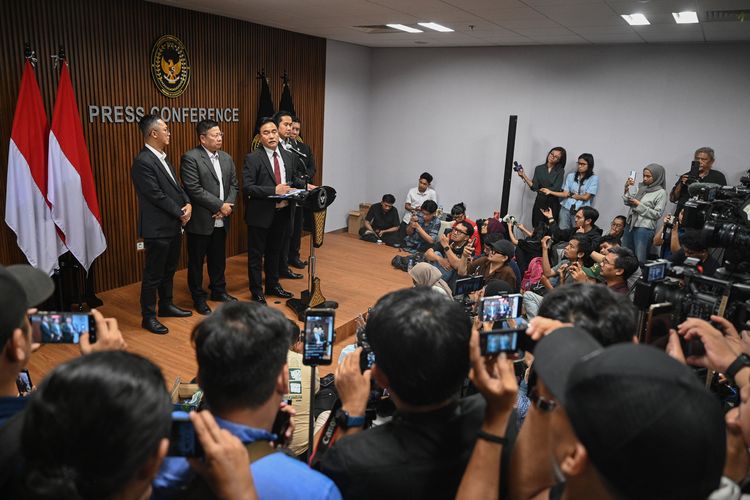


KPK Requests Klaten Legislators to Return Excess Fees to Klaten Inspectorate
-
News
-
1 minute ago
This article was translated by AI. Read the original article on Kompas.com. See Original
When a state purchases technology from the global surveillance industry, the relationship between security intersects with business interests, contracts, and technological dependencies.
Findings by ELSAM, Seknas FITRA, and FIND in May 2026 bolster this perspective. Their research identified six spyware suppliers and three intermediaries in Indonesia.
Furthermore, there were 28 shipments of surveillance products valued at approximately $11 million in 2023, connected to the Polus Group.
This figure refers to the transactions investigated, not the total government spending on surveillance technology.
The findings suggest that digital surveillance has evolved into an industrial ecosystem involving business interests, state procurement, and cross-border technologies that evade national legal oversight.
Not all wiretapping constitutes a violation. In certain circumstances, interception can be a legitimate tool for uncovering serious crimes.
However, the legitimacy of such actions relies on a legal basis, demonstrable need, proportionality, target and time limitations, and effective oversight mechanisms.
Without these principles, the term "national security" risks becoming an overly flexible justification.
Helen Nissenbaum, in her book "Privacy in Context" (2010), offers the understanding that privacy is not just about concealing information.
Privacy also concerns the appropriateness of information flows in specific contexts. Data obtained for a case investigation, for instance, cannot automatically be repurposed for political or other purposes.
Therefore, surveillance must be constrained not only regarding who may access data but also for what purposes, how long, and to whom information may be forwarded.
Indonesia indeed possesses Law Number 27 of 2022 concerning Personal Data Protection. This legislation regulates the rights of data subjects, obligations of data controllers and processors, administrative sanctions, and mandates the establishment of supervisory institutions.
However, as of November 5, 2026, the supervisory body has yet to be officially formed.
The Ministry of Communication and Information Technology has stated that the draft Presidential Regulation for its establishment is finalized and has been submitted to the President.
Meanwhile, Government Regulation Number 33 of 2026 as implementing rules of the Personal Data Protection Act will only take effect on January 16, 2027. This means, while we have a legal framework in principle, we are not institutionally prepared to implement it.
This issue is further compounded by the fact that Indonesia does not yet have a specific law titled "Wiretapping Law."
Wiretapping regulations remain scattered across telecommunications laws, the ITE Law, National Criminal Code Article 258, the New Criminal Procedure Code, and Intelligence Law.
Due to the absence of a comprehensive Wiretapping Law, the draft law has entered the National Legislation Body but remains unpassed to date. Consequently, the line between lawful and unlawful wiretapping remains at risk of being interpreted loosely.
Herein lies the relevance of comparison with neighboring countries. Singapore does not prohibit wiretapping but regulates it as Lawful Interception under strict conditions.
The legal framework is clearly outlined in the Telecommunications Act Sec.58, Criminal Procedure Code, Computer Misuse and Cybersecurity Act, and Internal Security Act (ISA).
Interception authority lies with the Ministry of Home Affairs and IMDA, but the mechanisms are not mass surveillance, rather they are targeted, time-bound, and require specific court authorization regarding the target, duration, and scope.
The strength lies in enforcement. Singapore implements mandatory SIM registration, integrates with the Personal Data Protection Act (PDPA), which excludes enforcement officials from commercial use, and adheres to ETSI technical standards for operators.
Its Smart Nation infrastructure—over 62,000 police cameras in 10,000 HDB blocks since 2016 and 90,000 cameras island-wide—is focused on public safety, not arbitrary access to communication content.
The outcome is that illegal wiretapping outside the legal framework can lead to severe penalties, as the system is designed to effectively combat financial and cyber crimes while remaining under legal control.