

The Absurdity of Logic: Treason for the Police Chief’s Chair?
-
News
-
3 minutes ago
This article was translated by AI. Read the original article on Kompas.com. See Original

JAKARTA, KOMPAS.com - The Indonesian National Police's Criminal Investigation Agency (Bareskrim Polri) has named three police generals as suspects in the alleged wiretapping of President Prabowo Subianto.
They are the Chief of Presidential Staff (KSP) General Listyo Sigit Prabowo, the Head of Law Division (Kadivkum) of the National Police Inspector General Ahrie Sonta, and the Senior Police Instructor at the Police Education and Training Institute (Lemdiklat) Inspector General Eko Hadi Santoso.
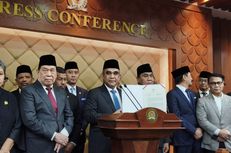
"The investigators have established three suspects with the initials LSP, ASN, and EH," said the Head of Bareskrim Polri, Commissioner General Asep Safrudin, during a press conference at the National Police Headquarters in Jakarta on Tuesday (3/11/2026).
Meanwhile, former Head of the Information Technology Division Inspector General Slamet Uliandi remains under investigation as a witness.
Asep revealed that the three suspects are alleged to have committed illegal wiretapping and electronic data deletion, as well as illegal access.
"These suspects are accused of wiretapping illegally without proper procedures against the President of the Republic of Indonesia, state officials, political figures, media representatives, civil society leaders, NGOs, and business figures," he stated.
The three suspects are charged under Article 258 of Law Number 1 of 2023 concerning the Criminal Code (KUHP).
"Which states that unlawfully listening to, recording, redirecting, altering, obstructing, and/or documenting non-public electronic information transmission is prohibited. The penalty for these actions is up to 10 years imprisonment," he said.
The suspects are also charged under Article 332 paragraphs (1) and/or (2) of the KUHP, with a potential sentence of six years.
"We also apply the ITE Law, particularly Article 32 paragraph (1), which stipulates that intentionally and without right or unlawfully altering, damaging, deleting, moving, or concealing someone else's or public electronic information carries a penalty of up to eight years," Asep added.