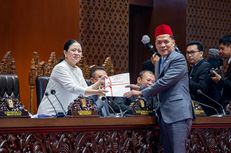
Puan Maharani: Asset Seizure Law Urgently Needs to be Passed after 18 Years
-
News
-
1 minute ago
This article was translated by AI. Read the original article on Kompas.com. See Original

JAKARTA, KOMPAS.com - The Constitutional Court (MK) has ruled that the constitutional review of Article 30 paragraphs (2) and (5) of Law Number 30 of 2009 on Electricity (Electricity Law) is inadmissible or NO (Niet Ontvankelijke Verklaard).
The case number 372/PUU-XXIV/2026 concerns the regulation of electricity poles situated on private land without clear compensation provisions.
"The ruling states: the applicant's request is inadmissible," read the decision delivered on Thursday (29/10/2026).
In its legal reasoning, the Court noted that the applicant's submission lacked a clear and adequate description regarding the conflict between the tested provisions and the 1945 Constitution.
"Without the aforementioned clear and adequate description, the Court finds it difficult to assess whether there is a conflict between the provisions of the law whose constitutionality is being challenged and the constitutional basis in the 1945 Constitution of the Republic of Indonesia," the ruling stated.
Therefore, MK indicated that despite having the authority to adjudicate this application, the substantive issues of the application would not be discussed due to the unclear reasons stated.
"However, because the applicant's request lacks clarity or is ambiguous (obscuur), the Court will not further consider the applicant's request," it stated.
This case was brought by a sailor named Dewa Nanda Adnan.
He filed a judicial review of Article 30 paragraphs (2) and (5) of Law Number 30 of 2009 on Electricity (Electricity Law) before the Constitutional Court (MK).
The applicant owns a plot of land in Magetan Regency, where two units of electricity poles for PLN's distribution network are located.
He questioned the lack of clear obligations for compensation regarding the land on which the electricity poles stand, as well as the absence of an obligation to record land dispute resolutions in the land registration system, leading to legal uncertainty.
“I want certainty so that my land ownership certificate (SHM) aligns with the physical state. If all the electricity poles are included as burdens on the SHM, there will be no confusion,” Dewa stated during the initial hearing of case number 372/PUU-XXIV/2026, as reported from the Constitutional Court's website on Wednesday (21/10/2026).
In one of his petitions, he requested the Court to amend Article 30 paragraph (2) of the Electricity Law to include the obligation for compensation, including for distribution networks.