
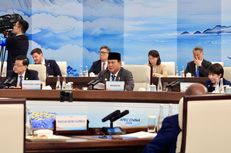
Prabowo Praises Shenzhen, from Fishing Village to Global Innovation Hub
-
News
-
Just now
This article was translated by AI. Read the original article on Kompas.com. See Original

JAKARTA, Kompas.com - Indonesia Corruption Watch (ICW) has highlighted three crucial points deemed problematic in the recently passed Asset Confiscation Bill.
"The main issues that we find concerning and that should have been included in the formulation of the asset confiscation law relate to illicit enrichment, which refers to unjustified increases in wealth and is currently a significant problem affecting our economic inequality," said Ibrahim, Head of the Law and Investigation Division at Indonesia Corruption Watch (ICW), during a meeting at the Senayan Parliamentary Complex in Jakarta on Thursday (19/11/2026).
He emphasized that addressing this issue is vital to tackling economic disparity.
According to him, the newly passed law by the House of Representatives today is incapable of targeting corrupt individuals whose wealth increases are unjustified.
"Moreover, the House itself ignored the requests made by the Corruption Eradication Commission (KPK) to establish illicit enrichment as a part of this legislation," he stated.
The second point raised by ICW concerns the potential inability to recover state losses from corruption cases that occurred before the law comes into effect.
This means that past corruption cases, such as those already published to the public, and the recorded financial losses to the state cannot be recovered under this law.
Meanwhile, the third point relates to the institutional management of confiscated assets, which has been shifted to presidential regulations (Perpres) and is directly under presidential control.
Ibrahim stressed that these three issues should have been openly discussed with the public before the regulation was passed.
Based on these three observations, ICW believes that the substance of the current law is significantly different from the original intent behind drafting asset confiscation regulations.
"Therefore, we argue that today’s asset confiscation law is a false asset confiscation law, not the genuine law that was initially discussed as outlined in the draft from 2023," Ibrahim concluded.