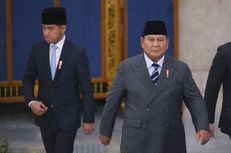
Without the Maung, Prabowo Attends the 49th ASEAN Summit Retreat in a Sedan
-
News
-
5 minutes ago
This article was translated by AI. Read the original article on Kompas.com. See Original
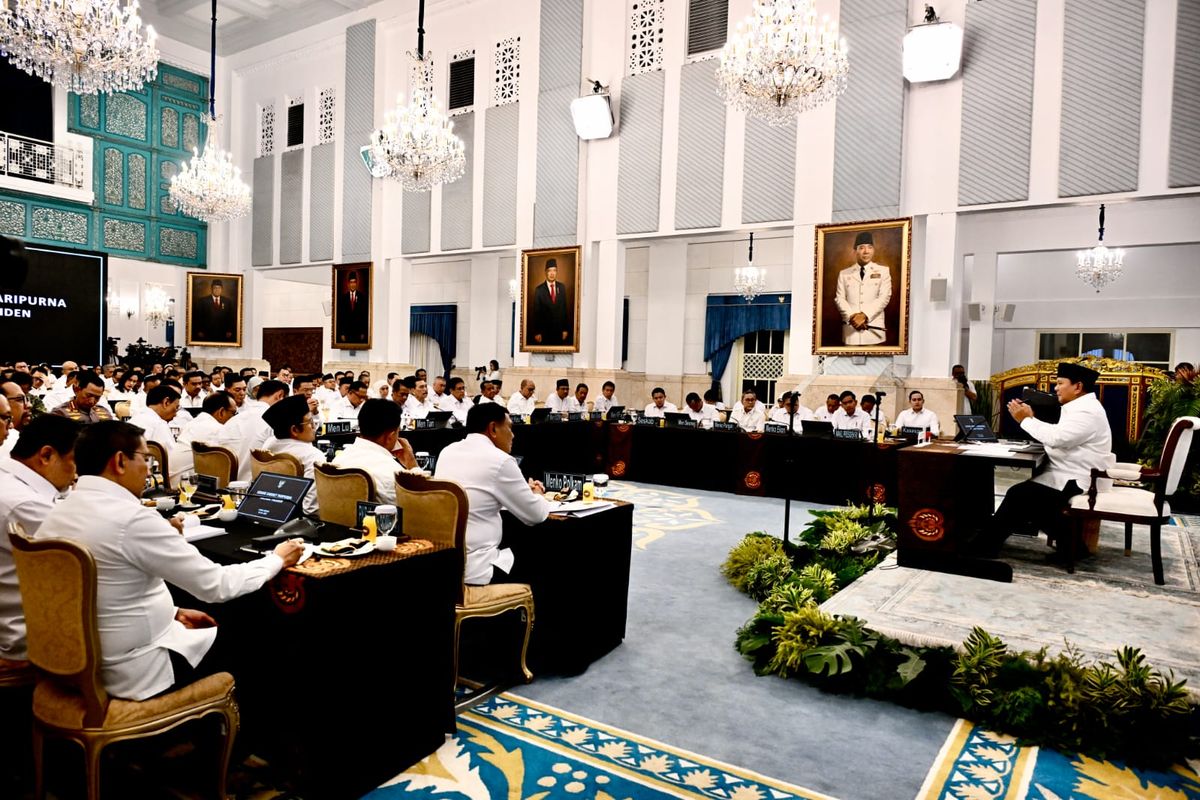
NETIZEN is very familiar with the phrase “I received a report.” This is undoubtedly a speech by President Prabowo Subianto. Now, this phrase is being used as a meme.
They often comment, tagging the president's account, whenever an official holds a press conference, saying, “Don’t believe it, Sir!”, “That’s a lie, Sir!” and similar comments.
The crux of the problem is that the reports presented to the president always carry a positive tone, while some realities are different.
For example, the economic growth for the first semester is claimed to be the highest in 13 years, reaching 5.45 percent (16/8). Then, the current economic conditions are stated to be stable by the Minister of Finance and the Coordinating Minister for Economic Affairs (19/10).
Positive-sounding reports also emerge in other sectors like MBG, KDMP, and even in dealing with forest fires.
Observers have repeatedly warned that it seems ministers provide reports based on the “Asal Bapak Senang” (ABS) principle to President Prabowo. This was confirmed in the story by Purbaya Yudhi Sadewa when he was the Chairman of the LPS Commissioner Council.
In a podcast in August 2025, he stated, “Officials when reporting to the President, it’s always positive. I was once called in, and I said things are not good. He didn't like me for that.”
That fragment of the podcast is now going viral again, showing how likely the president is often given ABS reports.
The question is, why does the president like to refer to these reports? And, does the president not verify them, for instance, through Bappisus or by checking the field directly?
I was curious, so I googled “presidential visits to traditional markets.” Interestingly, the news displayed pertains to visits by President Joko Widodo.
I adjusted the keywords by adding the name “Prabowo Subianto,” and the results were minimal. Some even displayed Prabowo during his tenure as Minister of Defense accompanying President Joko Widodo on visits.
Almost three decades ago, Morrison and Milliken (2000) wrote about the phenomenon of organizational silence within private companies. They argued that this culture becomes a barrier to change and development within the company. The question is, why does this happen?
Morrison and Milliken identified two root causes. First, leaders fear negative feedback. Second, they believe that leaders know best what is good.
As a result, criticism is seen as a threat, while agreement is viewed as a sign of success. Consequently, organizations value obedience more than openness.
A culture of silence forms when people learn that reporting issues is risky for them. Subordinates eventually choose to filter information, conceal failures, or only report good news to their superiors.
Over time, silence becomes not just an individual choice but a normative organization.
In government bureaucracy, similar mechanisms risk creating a gap between the information that reaches the president and the realities experienced by the public.
Therefore, the issue is not just whether the president receives reports, but whether the work culture allows bad news to be shared without fear.
Perhaps it’s difficult to achieve this in cabinet meetings. For example, the Coordinating Minister for Food openly stated, “We admit MBG has failed” during a seminar (4/9).
But would he dare to share the same directly in front of the president? Not necessarily. The risk is he could be removed from office.
Besides that culture of silence, perhaps the cabinet also suffers from perspective bias, where indicators (means) become targets (ends).
Goodhart’s Law states that when a measure becomes a target, it risks losing its ability to assess a program’s success substantively.
In government, when economic growth or budget absorption is used as a benchmark for success, the focus shifts from the quality of results to merely achieving numbers.
As a result, means (instruments) may be treated as ends (goals), while the substance of development, such as job creation, income, and community welfare, becomes overlooked.
For instance, the target for improving economic welfare seems parallel to establishing as many village cooperatives and outlets as possible.
In fact, the number of cooperatives formed and outlets built are merely means, not ends. Both are instruments for achieving a more substantive goal, namely improving community welfare.
Imagine if the government experiences such a phenomenon, reported figures may inflate while actual results deflate. “80,000 village cooperatives have been established, 28,000 outlets have been built, and so on.”
What needs to be emphasized is that the president should not be dazzled by reports full of numbers from his aides. Conversely, the president must leave room for doubt in accepting those reports.
In the past, I assumed perhaps Bappisus was formed for that purpose. The president was expected to obtain A1 information from the field to challenge reports from ministers with an A2 status. However, it seems my assumption was incorrect.
The problem becomes even more complicated when cabinet meetings create an echo among them. Imagine an echo that begins from ABS reports, then conveyed by the president without review and later reaffirmed and believed by the ministers. The outcome is a truth believed by the president and his cabinet.
Consequently, statements like, “Ladies and gentlemen, I am now proud to be your leader, I am proud to be your president, I am proud to have led this government because in two years, we have worked with tangible results” (21/10).
This statement does not align with the voices of public discontent, which continue to rise.
For example, I use ride-hailing services daily. When relaxed, I ask drivers about the impact of the maximum 8 percent cut policy set by the government. All drivers (two-wheeled and four-wheeled) respond similarly, “No impact!”.
This brief conversation at least shows that the Presidential Regulation No. 27 of 2026 has not been felt by drivers.
The regulation is merely an instrument, so it would be strange if the president claimed to have worked with tangible results merely upon issuing the regulation. Implementation needs to be ensured through monitoring and enforcement.
On a general aggregate level, an SMRC survey (17/10) confirms that 53.4 percent of respondents are dissatisfied with the president's performance. Following up from several previous surveys, public satisfaction levels have tended to decrease over time.
In November 2025, public satisfaction was still very high at 81.2 percent. Then it dropped by about 20 percent in March 2026, down to 66.4 percent.
By July, it fell again to 51.1 percent. By October 2026, only 44.5 percent reported being satisfied or quite satisfied.
In such conditions, there has been no visible effort for a turning point from the president. Conversely, the situation worsened with the appointment of 26 people to the Presidential Advisory Council.
In comparison, during the tenures of Susilo Bambang Yudhoyono and Joko Widodo, only nine people were appointed. This is what frustrates the public, making them view the government as tone-deaf.
The echo occurring among the ministers ultimately spreads downwards. Echelon officials internalize and externalize the same narrative, sometimes with the same arrogance as the president.
The effect is that they regard other narratives and perspectives as irrelevant or even not credible, akin to running with blinders on.
Instead of showering ministers with praise, the president must return to the realization that he is a recipient of the people's mandate.
The primary and foremost obligation is to listen to the public’s anxieties, serve them, provide solutions, and make them smile.
Currently, many micro-entrepreneurs, market traders, street vendors, and kiosks are complaining about declining revenues.
Some policies seem to be a trade-off and contribute to inflation. Raw material prices are increasing, and they adjust their selling prices accordingly. This causes the public to reduce their spending.
The effects are notably visible in the food and beverage MSMEs across various regions. Not to mention cuts in the TKD that have dampened the economy in the regions.
An INDEF survey (August 2026) confirmed that 22 percent of MSME actors reported a decrease in business activities related to the Nutritious Food Program (MBG).
Meanwhile, 14 percent reported a decline in business related to the presence of the Red and White Village Cooperative Program (KDMP).
Another survey from the Kadin Indonesia Institute (October 2026) revealed the proportion of micro-entrepreneurs interested in investing dropped sharply from 36.1 percent to 20 percent in the third quarter of 2026.
This reflects the caution among micro-entrepreneurs in developing their businesses.
From the demand side, a Bank Indonesia survey related to the Consumer Confidence Index (CCI) shows a decline from 118.5 in August to 118.1 in September.
Compared to the start of the year at 127, this means the CCI has decreased by 8.9 points as of September 2026. This indicates a decline in consumer confidence regarding the current economic conditions and their expectations for the future.
In addition to delaying praise for his aides, the president should emulate his predecessors by frequently visiting the field. Or at the very least, read the news and monitor social media.
So that in the future, the content of his speeches changes to, “I read the news...”.