JK Believes National Progress Does Not Depend on Natural Resource Wealth
-
News
-
6 hours ago
This article was translated by AI. Read the original article on Kompas.com. See Original

IN a cabinet plenary meeting marking the second anniversary of his administration, President Prabowo Subianto once again employed a metaphor that he has long cherished.
Wealth and natural resources, he stated, are like the blood of the nation. If that blood continues to leak, the body cannot survive.
Therefore, Indonesia is now in survival mode, survival mode. Those who are strong will survive, while those who are not will perish (Kompas.com, 23/10/2026).
The President cited the smuggling of tin, gold, coal, fuel, fertilizers, and narcotics as manifestations of this leakage, reminding that the archipelago has historically always been a target for powers seeking its wealth (Kompas.id, 22/10/2026).
This statement was quickly interpreted by the cabinet. Energy and Mineral Resources Minister Bahlil Lahadalia opened up the option to halt gas exports to neighboring countries in favor of prioritizing domestic needs (Kompas.id, 22/10/2026).
At this point, the speech deserves a closer reading. Is survival mode an accurate diagnosis, or is it merely rhetoric that shifts the source of issues outside the walls of one's own house?
For those who have followed Prabowo's political journey, this idea is not new. In Paradoks Indonesia, published in 2017, he depicted a wealthy nation where its people remain poor because national wealth continues to flow abroad, something he termed as net outflow of national wealth.
The book documented the results of natural resource extraction parked in foreign banks, the disparities that place around 66 percent of wealth in the hands of the top 10 percent, and severe environmental degradation.
These figures were debated at the time, even ridiculed. However, the diagnosis has now become the doctrine of the state.
Survival mode is a manifestation of Indonesia's paradox that has moved from the realm of the opposition to the cabinet table.
This anxiety has deep historical roots. Tan Malaka, long before the republic was established, viewed this country as a resource-rich land becoming a battlefield for foreign capital.
However, in "Madilog," he also issued a warning often forgotten. A people long colonized, he argued, are shackled by "mystical logic," a habit of explaining fate through supernatural forces and destinies outside oneself, rather than tracing the material causes that can be investigated.
This warning feels relevant today. The narrative of a blessed nation perpetually targeted by outsiders can indeed inspire, but if it stops there, it risks giving birth to a new myth.
The securitization theory developed by Ole Wæver and the Copenhagen School helps in interpreting such risks.
An issue is deemed a security problem not merely because its threat is real, but because it is declared an existential threat by authoritative actors.
The term survival is at the heart of such speech acts. Once the problem is framed as a matter of life and death for the nation, extraordinary measures become legitimized, and the scope for debate narrows.
Securitization can be productive when it disciplines a sluggish bureaucracy. It becomes dangerous when criticism is perceived as disloyalty and domestic issues are framed as the work of external parties.
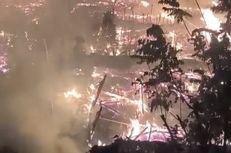
This danger is apparent in the haze issue. At the same forum, the President called forest burning environmental terrorism and vowed to revoke permits from violating companies, while also implying certain countries that he sees as eager to insult Indonesia.
The government indeed works hard, and the President claims that the area affected by forest fires in six provinces has decreased to 639.23 hectares (Kompas.com, 14/10/2026).
However, smoke has blanketed Singapore, disrupting flights between Kuala Lumpur and Singapore, and Malaysia is determined to bring this issue to discussions ahead of the ASEAN Summit in Manila (Kompas.com, 14/10/2026).
The irony is clear. The leakage crossing national borders is not only our wealth but also smoke from our own land.
In Manila, Indonesia does not face wealth thieves, but neighbors who are victims.
Threats to halt gas exports simultaneously complicate diplomacy that has long been guided by the principle that having a thousand friends is too few, and having one enemy is too many.
If leakage is the diagnosis, the next question is who opened the tap. Indonesia's paradox itself provides a clue.
The natural wealth extracted and then parked abroad is not stolen by foreigners, but channeled by concession holders within the country.
Hashim Djojohadikusumo, the President's brother, has even mentioned that the leakage of state revenue stems from oil palm plantations, a sector that has never been free from the shadow of forest fires.
The oligarchy theory by Jeffrey Winters explains why this issue is complex. Winters interprets oligarchy as a politics of wealth defense by a few individuals who control resources in extraordinary quantities.
Oligarchy does not depend on the type of regime. It can thrive under both authoritarianism and democracy, adapting to whoever is in power.
Therefore, measuring success in combating it is not about the turnover of conglomerates but about weakening the capacity of wealth to purchase immunity in the face of the law.
In these two years, Prabowo has demonstrated seriousness in changing policy orientation. Evaluating national strategic projects, regulating forest areas, and programs targeting the people have led some of his former critics to acknowledge a shift from elite interests toward those of the populace.
However, a narrative also circulates in public claiming that what is happening is merely a turnover from the "9 Dragons" to the "9 Hajis," from old tycoons to regional conglomerates connected to power, many of which rely on coal and palm oil.
This narrative may not be entirely accurate, and its sources are weak. Precisely for that reason, it needs to be answered with evidence, not just rebuttals.
The test is simple and in plain sight. The promise to revoke permits from land-burning companies will be measured by one thing: whether it applies equally to concessions owned by anyone, including those close to the power circle.
In Winters' view, oligarchy is not defeated by transferring concessions from one group to another but through laws that cannot be negotiated with wealth.
Tan Malaka taught that independence begins with the courage to think that traces real causes. Indonesia's paradox has already sufficiently illuminated those causes.
Survival mode is only meaningful when directed inward, to the taps of leaks opened by our own hands, not just at enemies outside the fence.
If the state truly is in survival, only one question remains. Are we saving the people whose lungs are filled with smoke, or the wealth of a few individuals whose concessions are also burning?