
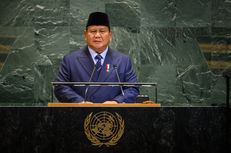
MBG and Indonesia's Diplomacy Behind the UN Resolution
-
News
-
1 hour ago
This article was translated by AI. Read the original article on Kompas.com. See Original

THIS WEEK, the Government Communication Agency (Bakom) announced its plans to overhaul the architecture of government communication management.
Technocratically, Bakom has been deemed ineffective in serving as a bridge between the Palace and the citizens.
This shift began when President Prabowo Subianto summoned Bakom Head Syahganda Nainggolan and Deputy Head Fadli Tri Hartono to his private residence in Hambalang, Bogor, on October 4, 2026, shortly after the seventh cabinet reshuffle.
The President requested that the new leadership of Bakom not only serve as the Palace's spokesperson but also master the art of communication that can penetrate dialogical spaces.
Bakom is expected to transform from a monotonous one-way communication model to an interactive-dialogical model. It should no longer just amplify government programs and achievements, but instead become more progressive and responsive, acting as the "eyes and ears" of the public in gathering aspirations.
Through this approach, public complaints and criticisms are hoped to be absorbed more broadly and can be immediately acted upon by the relevant authorities without being hindered by convoluted administrative processes.
Historically, Bakom, particularly when it was still known as the Presidential Communication Office, was often perceived merely as the government's "loudspeaker," strengthening narratives and expanding message outreach to the public.
Since its transformation into Bakom on September 17 of last year, its role has begun to shift towards synchronization, aligning narratives between the central and regional governments.
In this context, the appointment of Syahganda, who has been close to civil society elements, reflects the desired communication channel sought by Prabowo.
That channel is expected to support the strengthening of policy narratives while simultaneously opening pathways for external perspectives to enter the decision-making circle.
In other words, Bakom under Syahganda is tasked with translating public aspirations into meaningful input for state decision-making.
His track record as an activist gives hope that criticisms, no matter how sharp, must be heard, recorded, and formulated at the policy level.
This step is worthy of attention as it aligns with the tendency that only two-way communication can build an ecosystem for public aspirations.
This approach is crucial for ensuring that the public feels valued and that their aspirations genuinely reach policymakers, in addition to being in accordance with the dynamics of public information that are continually evolving.
Populix surveys indicate the same—showing that based on survey results, the public favors leaders who can solve problems (72 percent), exhibit leadership quality (82 percent), present clear visions and policies (76 percent), demonstrate intelligence (76 percent), and show integrity (69 percent).