
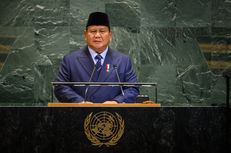
MBG and Indonesia's Diplomacy Behind the UN Resolution
-
News
-
2 hours ago
This article was translated by AI. Read the original article on Kompas.com. See Original

ON November 7, 2017, the Constitutional Court delivered a ruling meant to end decades of administrative discrimination.
Through Decision Number 97/PUU-XIV/2016, all nine constitutional judges unanimously granted the requests of four practitioners of indigenous beliefs: Nggay Mehang Tana, Pagar Demanra Sirait, Arnol Purba, and Carlim.
They challenged the regulations that mandated the blanking out of the religion column in Family Cards and electronic IDs under the Population Administration Law.
In a few weeks, this ruling will turn nine years old. It has been enough time to test whether this recognition on paper has translated into reality. The answer is: still halfway there.
While the belief column is now included in electronic IDs, the number of officially registered practitioners remains stagnant. Children of practitioners still struggle to learn about their beliefs in schools.
Moreover, the draft education law currently being discussed by the House of Representatives actually removes the word “belief”.
For the applicants, the blank column is not simply a technical issue. This column complicates their ability to obtain marriage and birth certificates, and even find employment. More fundamentally, it raises the question of the legal status of practitioners as citizens.
The Court's ruling established three foundations. First, the term “religion” in Article 61 paragraph (1) and Article 64 paragraph (1) of the Population Administration Law is declared contradictory to the constitution unless it encompasses “beliefs”.
Articles 61 paragraph (2) and 64 paragraph (5), which served as the basis for the blanking out of that column, lose their binding legal force.
The Court applied the original intent interpretation of Article 29 of the 1945 Constitution: that from the start, beliefs are inseparable from religion.
Second, the right to religion and belief is a constitutional and human right that is inherent and cannot be diminished under any circumstances.
The state is the duty bearer that must respect, protect, and fulfill the rights of all practitioners.
Third, the removal of the religion column has created legal uncertainty, violated the principle of equality before the law, and is discriminatory.
These three pillars lead to one goal: to restore practitioners as full citizens. The ratio legis of this decision is a rejection of all forms of discrimination.
Therefore, the measure of success is not merely an filled-out column, but the elimination of that discrimination within state services.