

KPK Examines Former Head of BPK Central Java in Connection with Pemalang Regent Extortion Case
-
News
-
1 minute ago
This article was translated by AI. Read the original article on Kompas.com. See Original

JAKARTA, KOMPAS.com - The National Food Agency (Bapanas) estimates that consumer losses due to the circulation of fortified rice that does not match the claims on packaging labels could reach IDR 89 trillion nationwide.
The Deputy for Food Availability and Stabilization at Bapanas, Brigadier General Hermawan, said that the estimate was calculated based on the price difference between fortified rice and the price it should be, as well as the volume of rice circulating and consumed by the public.
"This profit estimate is what it is. When calculated nationwide, using an average profit of IDR 23,000, this is calculated nationally against the population and the amount of goods circulating, which is around IDR 89 trillion," explained Hermawan during a press conference at the Indonesian National Police's Criminal Investigation Agency (Bareskrim), Wednesday (21/01/2026).
Hermawan revealed that the price of fortified rice found in the field ranges from IDR 23,000 to IDR 57,000 per kilogram.
According to calculations by Bapanas experts, using medium rice priced at IDR 13,500 per kilogram, and adding 1 percent of fortified kernel (artificial grains) is estimated to add only about IDR 1,000 to the price per kilogram.
"That is, medium rice priced at IDR 13,500 should have 1% of the kernel added to complete the 99% rice to become fortified rice at 100%. We have consulted experts at Bapanas, and that expert indicated it should only add IDR 1,000 for the 1% to enhance the vitamins," he said.
Thus, medium rice claimed to be premium should be sold at IDR 14,500 per kilogram, which reflects IDR 13,500 plus IDR 1,000 for the fortification cost.
However, inspections revealed that products claimed as premium rice were actually using medium rice.
Laboratory testing also found discrepancies between the nutritional content and claims on the packaging label.
Meanwhile, Deputy III of Bapanas, Andriko Noto Susanto, stated that some products did not contain vitamins as stated on the labels.
Other products contained nutrients like zinc and vitamin B, at levels much lower than claimed.
Andriko explained that monitoring is done by comparing the information stated on the label with the actual condition of the product.
"So we supervise the quality to see if it is truly premium. We also monitor the nutritional content. All of that is on the label. Everything is in the distribution license. And every business entity intending to distribute must have that," he clarified.
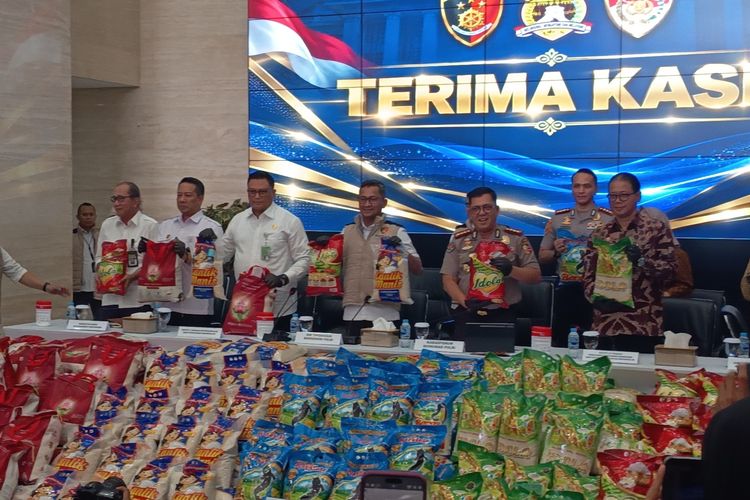 Press conference regarding fortified rice that does not match the label, at Bareskrim Mabes Polri, Wednesday (21/10/2026).
He added that the calculation of consumer losses did not only include the products shown in the presentation, but also involved 25 brands from 11 business entities.
"So the consumer losses mentioned previously are not only from those displayed, but also from 25 trademarks by 11 business entities. So that will be added later," he continued.