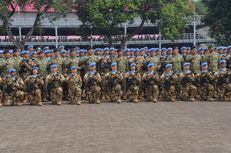
180 TNI Personnel Return from Peacekeeping Mission in Central Africa, Receive 2 National Awards
-
News
-
Just now
This article was translated by AI. Read the original article on Kompas.com. See Original

JAKARTA, KOMPAS.com - The Unqualified Opinion (WTP) from the Financial Audit Agency (BPK) has long been a coveted achievement for governments in their financial reports.
However, this distinction has once again been entangled with allegations of bribery and corruption. One such instance occurred in Muara Enim, South Sumatra, where the Corruption Eradication Commission (KPK) named the regent, Edison, a suspect in a bribery case related to findings from the BPK Representative in South Sumatra.
Recently, the anti-corruption agency also named Klaten Regent Hamenang Wajar Ismoyo and Central Java BPK Representative Head Ahmad Luthfi H. Rahmatullah as suspects in a similar corruption case on Friday (October 16, 2026).
Hamenang was found to have bribed Ahmad Luthfi H. Rahmatullah to eliminate excess payment findings of around Rp 5 billion. So, why do such cases keep recurring?
Researcher at the National Secretariat of the Indonesian Budget Transparency Forum (FITRA), Siska Barimbing, stated that this phenomenon continues because there are still loopholes exploited by local leaders and certain individuals in the BPK.
One of these issues arises from the provision of incentive funds from the central government to high-achieving local governments.
These amounts vary. The Ministry of Finance (Kemenkeu) recorded an average receipt of between Rp 5-6 billion in 2025, and Rp 7.5 billion per region per category in 2024.
"This is given to areas that successfully achieve (an opinion of) WTP. It’s quite substantial. This creates a loophole because there are incentives, when in fact, WTP should not require incentives as it is a requirement for accountability in local financial management, or public finances,” Siska told Kompas.com on Tuesday (October 20, 2026).
She then illustrated the potential collusion that could occur. For example, when a local head requests the BPK to eliminate various findings in the financial reports to secure the WTP opinion.
After the incentive funds are disbursed, the two parties split the money.
"For instance, the moral hazard could be (proposing to the BPK), 'I’ll give you Rp 1 billion; I’m still profiting this much,' so there’s still a loophole," Siska explained.
She revealed that the Regional Incentive Fund (DID) will no longer exist in 2026. However, the government is replacing it with the Fiscal Incentive Fund (DIF), which will be distributed to local governments according to the national budget. The concept is similar.
"It's almost similar. One of the purposes of this fiscal incentive fund is provided to regions that succeed in reducing poverty, maternal mortality rates, and their budget management. This still applies, though the amounts aren't as large as before, but the loopholes remain," she elaborated.
Siska stated that these various loopholes are increasingly exploited as local governments still desire to 'beautify' their financial reports to avoid allegations of corruption.
However, the WTP opinion cannot be used as a basis to claim that a region is free from corruption cases.